
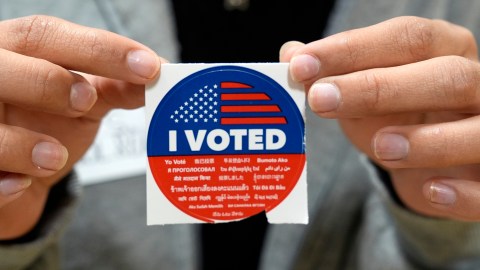
This Tuesday, June 2, there are six primary elections for the Democratic Party and the Republican Party to elect candidates for various state races and for the federal Congress.
“Primaries are essential, because it is the process that exists to shape some of the most urgent questions and answers regarding social and public policy issues,” said Ricardo Ramírez, founder of Forward Shift Strategies. “It is the way in which ideological parties or groups or sectors resolve questions, such as: what kind of party is it and who is going to represent us? It can be the difference between, for example, a type of policy that is more aggressive in combating the rise in the cost of housing versus another approach that is more, let’s say, medium, in solving that problem.”
The day includes races of high national impact, such as California and New Jersey, where much of the national political attention is concentrated, due to their disputed races for governor – in the case of California -, while other states hold legislative primaries.
Ramírez added that primary processes are essential in the American electoral “puzzle.”
California
One of the most watched primary races of the year is taking place in California, due to the race to succeed Governor Gavin Newsom and in the midst of an intense battle between Democrats.
The state applies a “high two” election system, where the contenders with the most votes will compete on the ballot, regardless of party.
For Ramírez, this form of election is “inadequate,” since it could “not represent the ideas and candidates that may exist in a population,” while it could favor political groups with more resources.
A recent poll from Emerson College Polling and Internal California Politics shows that former Secretary of Health, Xavier Becerra, has managed to open a significant gap regarding the businessman Tom Steyer and the republican Steve Hilton.
According to the survey, Becerra reaches 28% of preferences among likely voterswhile Steyer gets 22% and Hilton 21%. Republican Chad Bianco appears with 12%, while Democrats Katie Porter and Matt Mahan each register 5%.
However, these results differ from a survey by the Berkeley Institute of Government Studies, published on Friday, where Becerra also leading, although with fewer points (25%), places Hilton in second place with 21% and Steyer with 19%.
In total, more than 60 candidates appear on the ballot in California’s primary race. Elections are also held for lieutenant governor, secretary of state, public prosecutor and other state offices.
For the federal House of Representatives, there are races to pay attention to: in District 7, Mai Vang and Doris Matsui are in a race that reflects the tensions between political renewal and experience within the Democratic Party; in District 22, right-wing state assemblywoman Dr. Jasmeet Bains is running against Randy Villegas, and in District 41, where Congresswoman Linda Sánchez is challenged by former state assemblyman Héctor de la Torre.
New Jersey
In New Jersey, voters participate in primary elections to select candidates from both parties who will compete for a seat in the federal Senate, the 12 districts of the United States House of Representatives, and numerous local and county offices.
Democratic Senator Cory Booker is seeking his party’s nomination for a third full term, while several Republicans are vying for the right to face him in the general election.
There are also primaries in key congressional districts, including the competitive District 7, considered one of the most contested in the country and potentially decisive for the House of Representatives adjustment.
New Mexico
In New Mexico, voters are participating in a key primary election to determine the candidates who will compete in November for the governor, a seat in the federal Senate, the three districts of the United States House of Representatives, state executive offices, legislative positions and numerous local offices.
The most watched race is the Democratic gubernatorial primary, in which former Interior Secretary Deb Haaland and Bernalillo County Attorney Sam Bregman seek to succeed Gov. Michelle Lujan Grisham, who cannot seek a third consecutive term.
Republicans are also choosing their candidate for governor, with three contenders: Doug Turner, Duke Rodriguez and Greggory Hull.
The most prominent race is the race for the federal Senate, since for the first time in decades the state will elect a senator without an incumbent on the ballot, but there will only be Democratic voting between Ben Ray Lujan and Matt Dodson. Meanwhile, the Republicans failed to organize a race or propose a candidate.
Mountain
Voters will have to define the candidates who will compete in November for an open seat in the federal Senate, the two districts of the federal House of Representatives, state offices, the state Legislature and judicial positions.
For the federal Senate, Republicans will vote for Charles Child, Kurt Alme and Lee Calhoun; while Democrats will have to choose between Alani Bankhead, Christopher Kehoe, Michael Wolf, Michael Hummert and Reilly Neill.
Additionally, voters will select party nominees for Congressional Districts 1 and 2, as well as the 100 seats in the state House of Representatives and part of the state Senate. The primary is considered one of the most important of the electoral cycle in Montana because it will help define the political adjustment of a key state and several open federal offices.
South Dakota
In South Dakota, voters will have to define the candidates who will compete for the governorship, a seat in the federal Senate, state representation in the federal House of Representatives, several state executive offices and the local Legislature.
The most watched race is the Republican gubernatorial primary, where right-wing Gov. Larry Rhoden faces U.S. Rep. Dusty Johnson, state House Speaker Jon Hansen and businessman Toby Doeden.
Only Dan Ahlers is registered for the Democrats, the same as for the Senate race, with Julian Beaudion as the only one on the list.
Primaries are also being held for the federal Senate, where Republican Senator Mike Rounds is seeking the nomination for a third term, and for the state’s only congressional district.
Iowa
In Iowa, the primary elections are to define the candidates who will compete for the governor, an open seat in the federal Senate, the four districts of the federal House of Representatives and numerous state and legislative offices.
The most prominent race is the gubernatorial primary, opened after Republican Governor Kim Reynolds’ decision not to seek re-election.
There are several contenders in the Republican Party, but a new poll suggests the race could be decided at a convention with an unexpected leader. According to JMC Analytics and Polling, Zach Lahn led Rep. Randy Feenstra 24% to 22%, while former state administrator Adam Steen was in third place at 15%.
State Auditor Rob Sand is the only Democrat on the ballot for that position.
In addition, both parties will select their nominees for the federal Senate, where outgoing Republican Joni Ernst’s seat is at stake, as well as for all congressional districts and for the entire state House of Representatives and half of the state Senate.


