
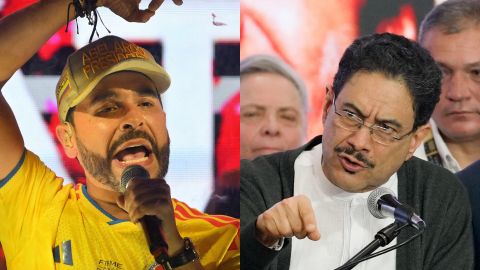
The right-wing candidate Abelardo de la Espriella and the left-wing Iván Cepeda will contest a presidential runoff in Colombia, in a scenario of maximum polarization and still uncertain outcome.
De la Espriella, a lawyer and outsider of the policy that promises a radical change in the government of Colombia, gave the surprise in the first round on Sunday by receiving 43.74% of the votes with the entire pre-count completed and coming first against what the polls predicted.
Senator Cepeda received 40.90% of the votes as a promise of continuity of the government of President Gustavo Petro and came in second place, despite the fact that it was anticipated that he would have the most votes.
The result of the June 21 runoff will largely depend on what voters do who opted for other candidates such as Senator Paloma Valencia, who had 6.9% of votes for the right led by former President Álvaro Uribe (who already supported De la Espriella), or the centrist Sergio Fajardo, who received 4.2% (he has not commented).
If the majority of Valencia’s votes now go to De la Espriella, the opponent – who draws comparisons with far-right leaders in the region – would be close to triumphing.
But in the three remaining weeks of the campaign for the second round there will be other decisive factors, analysts say.
One of them is the security that De la Espriella and Cepeda convey as possible presidents without ever having held government positions.
“One of the main emotions of this electoral process in Colombia is fear,” says Felipe Botero, director of the department of political science and global studies at the Universidad de los Andes in Bogotá.
“Who makes you less afraid, a Cepeda or a De la Espriella in power? That’s going to help a lot of people decide,” Botero tells BBC Mundo.
With a professional career as a criminal lawyer and businessman, De la Espriella at 47 years old obtained an astonishing flow of votes that grew in a few weeks.
His promises to apply a heavy-handed security policy and build megaprisons appear to have made him an attractive candidate in a country where insecurity worries many and drew comparisons with Salvadoran President Nayib Bukele.

Furthermore, his profile outside the political class and his constant references to religion, family and business freedom make him close to other presidents such as the American Donald Trump or the Argentine Javier Milei, whom he says he admires.
Some analysts believe that in recent days De la Espriella attracted a number of voters from the more traditional right represented by Valencia who opted for him to prevent Cepeda from winning in the first round.
But De la Espriella also represents “a far-right candidacy” that for many people poses a “risk of democratic erosion or undermining of institutions,” says Botero.
Patricia Muñoz Yi, a political science professor at the Javeriana University of Bogotá specializing in public opinion and political marketing, believes that it is too early to consider De la Espriella digital winner of the runoff.

“It has other challenges beyond maintaining this ascending line (of votes), such as the challenge of closing those gaps left by tensions and political competition with some right-wing candidates, especially Paloma Valencia,” Muñoz Yi tells BBC Mundo.
Although Uribe and Valencia announced their support for De la Espriella on the same Sunday, after knowing the pre-count of votes, the expert warns that this “does not necessarily guarantee that their followers” will automatically join the candidate.
And he points out that, to ensure victory, De la Espriella must also improve his voting in places in the country where Cepeda won, such as the capital Bogotá or the Caribbean departments, despite the fact that the right-winger grew up in this region since childhood.

Challenges for Cepeda
The son of a murdered communist leader, Cepeda is 63 years old, entered the Colombian Congress in 2010 and stood out for defending victims of the country’s long armed conflict and investigating paramilitarism.
He was a facilitator of the peace talks between the State and the FARC in 2016 and defends the idea of “total peace” proposed by Petro to end the conflicts with other armed groups, despite being questioned from the right for its lack of results.

Cepeda also promises to continue the government’s social reforms to reduce inequality, give political voice to marginalized sectors, redistribute land and reduce Amazon deforestation.
However, he is seen as someone more moderate and less charismatic than Petro.
And, although he was able to benefit electorally from the increase in the president’s approval ratings this year due to specific measures such as a 23% increase in the minimum wage, this seems insufficient for him to win the runoff.
After the results of the pre-count of votes were released, Petro and Cepeda questioned them and said that they will wait for the scrutiny commissions to “count until the last vote.”
Miguel García Sánchez, a political scientist who co-directs the Observatory of Democracy at the University of Los Andes, believes that Cepeda’s challenge is to “get closer to sectors that he has lost,” such as the political center, and perhaps mobilize voters who avoided participating on Sunday.

“The key would be to refine bridges, make some type of alliances and generate something more emotional for the electorate,” García Sánchez tells BBC Mundo.
Remember that in 2014 the then Colombian president, Juan Manuel Santos, built a broad coalition for the runoff and was re-elected despite having come second with less than 26% of the votes in the first round.
In 2022, Petro became the first left-wing president elected in Colombia after winning the first round with fewer votes than Cepeda but with the same percentage (40.3%) and beating Rodolfo Hernández, another outsider from the right.
But analysts point out that since then Petro, with his controversial and confrontational style, has lost part of the electoral support he obtained in the government.

Now his idea of calling a constituent assembly to change the Colombian Constitution and achieve reforms stopped in Congress worries a part of the electorate.
So, an open question is whether Cepeda will seek to distance himself from the president on issues such as the constituent assembly, to attract votes while continuing to mobilize Petro’s supporters in the runoff.
That would be a delicate balance for the official candidate.
“The left has it more difficult than four years ago,” says García Sánchez.

click hereto see more stories from BBC Recordsdata Mundo.
Subscribe hereto our new newsletter to receive a selection of our best content of the week every Friday.
You can also follow us on YouTube, instagram, TikTok, x, Facebookand in our whatsapp channel.
And remember that you can receive notifications in our app. Download the latest version and activate them.
- Cepeda and Petro are unaware of the results of the pre-count in Colombia and will wait for the scrutiny commissions to “count until the last vote”
- Who is Abelardo de la Espriella, the businessman who promises to govern Colombia with an “iron fist” inspired by Bukele and Milei
- Who is Iván Cepeda, the philosopher whose father was murdered in a state crime and now seeks to continue Petro’s path in Colombia


