
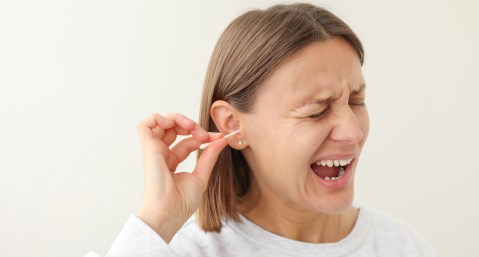
Every year, millions of people around the world go to otorhinolaryngology consultations with a problem that, in most cases, they have caused themselves: the pathological accumulation of earwax due to a poorly executed attempt at household cleaning.
According to the American Academy of Otorhinolaryngology, improper use of cotton swabs—so-called cotton swabs or swabs—is one of the most frequent causes of obstruction of the external auditory canal and perforation of the tympanic membrane in developed countries.
Despite this evidence, the habit of “cleaning” the ear in the shower or after bathing remains a widespread and culturally rooted practice.
A habit not recommended
Few hygiene routines are as universally accepted as inserting a cotton swab into the ear to remove earwax. However, specialists have been warning for decades to the contrary: this everyday and seemingly harmless gesture can cause severe and irreversible damage to one of the most delicate sensory organs of the human body.
Cerumen – the scientific name for earwax – is not dirt. It is a substance produced naturally by the ceruminous glands located in the external third of the ear canal. Its composition, a mixture of lipids, proteins, lysozymes and fatty acids, gives it antimicrobial, lubricating and hydrophobic properties. In other words: it repels water, kills bacteria and fungi, and keeps the skin of the ear canal supple and healthy.
But the ear cleans itself. The external auditory canal is equipped with a passive self-cleaning system called epithelial migration. The skin cells in the duct slowly move from the tympanic membrane to the outside, dragging old earwax, dust particles, and cellular debris with them. This process works continuously and silently, so that under normal conditions, the wax reaches the opening of the ear on its own and falls off naturally—often during sleep or when you move your jaw while chewing or speaking.
Interrupting this mechanism with swabs has a paradoxical effect: instead of extracting the earwax, it pushes it towards the inner part of the canal, compacting it against the tympanic membrane. The result is a plug of earwax, one of the most common causes of temporary hearing loss, tinnitus (ringing in the ear), sensation of pressure and dizziness.
What causes unnatural cleaning?
Earwax plug. The swab pushes the wax toward the eardrum, compacting it and blocking the ear canal.
Greater infectious risk. By removing earwax, its antimicrobial properties are eliminated, exposing the canal to bacteria and fungi.
Microabrasions. The rubbing of the swab generates small wounds in the skin of the canal, gateways to infections.
Drilling risk. A sudden or unexpected movement can perforate the tympanic membrane with permanent consequences.
When cleaning turns into injury
Beyond the plug, the risks of using swabs extend to more serious pathologies. The skin of the external auditory canal is extremely thin and gleaming; The simple repeated rubbing of cotton on its surface generates microabrasions that, although imperceptible, serve as a gateway for bacteria as Pseudomonas aeruginosa either Staphylococcus aureusresponsible for the otitis externa, a painful inflammation that in severe cases can spread to the bone.
The most serious risk, however, is the tympanic perforation. A sudden movement or accidental push—a running child, a jumping pet—can cause the rod to pierce the eardrum, causing sharp pain, bleeding, hearing loss, and, in some cases, damage to the ossicles of the middle ear. Although many perforations heal on their own, some require surgery and can leave permanent hearing damage.
Added to this is the call vicious circle of scratching: By cleaning the ear excessively, the skin loses the protective layer provided by earwax, becomes dry and itchy, which creates the sensation of needing to clean again. The more you clean, the more itchy you get, and the greater the dependency on the cotton swab.
What does science say?
The clinical guidelines of the main otorhinolaryngology societies in the world—including the Spanish Society of Otorhinolaryngology (SEORL) and the American Academy of Otolaryngology—are unanimous: swabs should not be inserted into the ear canal. Some manufacturers have added warnings to their packaging, and several countries have debated their regulation.
Scientific evidence supports that The vast majority of people do not need any type of active ear cleaning.. Earwax only becomes a clinical problem in a minority percentage of the population—older people whose epithelial migration slows down, hearing aid users, individuals with narrow ear canals or anatomical anomalies—and in these cases the treatment should always be performed or supervised by a healthcare professional.
Definitely: what should be done?
- Clean only the external part (the pinna) with a damp towel, without inserting anything into the canal.
- Use softeners (only if there is excess). If you tend to generate a lot of wax, you can consult with a specialist about the use of softening agents such as mineral oil drops or glycerin.
- If you suspect a plug or persistent discomfort, go to the doctor or infirmary; There are safe irrigations and ceruminolytic solutions.
- Also avoid ear candles, homemade high-pressure syringes or other popular methods without scientific support.
- Consult a specialist if itching, a sensation of blockage, pain or changes in hearing appear.
You may also be interested in:
· The power of dancing: benefits of moving to the rhythm of music at an older age
· Nutritional strategies to increase muscle mass
· Why do we tend to go to bed and get up earlier as we get older?


