
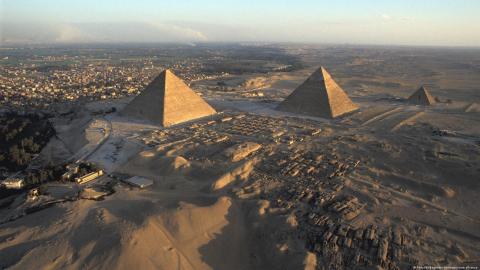
The Cheops pyramid has withstood earthquakes without major damage, demonstrating that ancient Egyptian builders developed very effective techniques that gave rise to a structural stability distinguished, despite the fact that they did not have modern theories of soil mechanics or seismology.
The Great Pyramid of Cheops (Egypt) It has been standing for about 4,600 years and has been unscathed by earthquakes such as that of 1847, with a magnitude of 6.8 points, or that of 1992, which was 5.8.
A team headed by National Research Institute for Astronomy and Geophysics (NRIAG) of Egypt studied the characteristics of this monument that give it resistance to telluric movements and published his results in Scientific Reports.
Knowledge accumulated over generations
The study shows that “The ancient Egyptian builders had exceptional practical and empirical knowledgeaccumulated over generations,” the first signatory of the article Mohamed ElGabry, from the NRIAG, told EFE.
Through trial and error method, They developed very effective architectural and construction techniqueswhich gave rise to distinguished structural stability, including good resistance to earthquakes, despite the fact that they did not have modern theories of soil mechanics or seismology, he recalled.

However, there is no direct evidence that they designed the pyramid specifically for resist earthquakesbut rather his objective was to build the “most stable and durable monument possible.”
The researcher considered it plausible that many of the features that contribute to the pyramid’s good performance during earthquakes were chosen primarily for reasons of static stability and durability.
“Its excellent seismic performance seems to be a very positive side effect of its extraordinary engineering intuition,” said ElGabry.
How the pyramid vibrates during an earthquake
The researchers recorded environmental vibrations generated, by human activity or climate changes, at 37 points around the pyramid, including its internal chambers, the building blocks and the adjacent ground.
The results indicate that every structure has a pure vibration speed, that is, most of the great pyramid vibrates with a very similar pure frequency (around 2.3 hertz).
This points out that “The entire monument behaves as a highly coherent and well-integrated structurerather than as a set of loosely connected parts.” A homogeneity that reduces internal tensions during tremors, he explained.
Another important feature that protects it from earthquakes is that the frequency of the pyramid is quite different from that of the surrounding ground, which helps avoid resonance, a dangerous amplification that is wasted when a structure ‘vibrates in unison’ with the ground.
Geometry, foundations and interior design: the keys to its seismic resistance

Among the characteristics that give it this resistance, the scientist highlighted its extremely wide tainted and the low center of gravitycoupled with a highly symmetrical geometry, a gradual reduction of mass towards the top and its construction on a bed of solid limestone rock.
Likewise, the sophisticated internal designin order in the relief chambers, located above the King’s Chamber, plays a basic role.
The measurements revealed that the amplification of vibrations decreases inside these chambers, despite being at a higher altitude, suggesting that they play an important role in dissipating seismic energy and protecting the King’s Chamber.
The terrain on which the pyramid was built, a plateau of solid and resistant limestone, influences in a “very significant way” to mitigate the risks of an earthquake.
A solid foundation It is one of the most important factors for seismic resistance, since it minimizes soil amplification and differential settlements.
In this case, the data confirmed that the foundation has a low seismic vulnerability indexdeclared the researcher.
4,600 years after its construction, The Cheops pyramid remains in “very good structural condition” and the study confirms – he stressed – that “its original design continues to offer effective protection against seismic forces.”
ElGabry concluded that as long as there is no serious internal damage or significant changes to the foundation, the pyramid should continue to withstand potential future earthquakes well.
FEW (EFE, Scientific Reports)


