
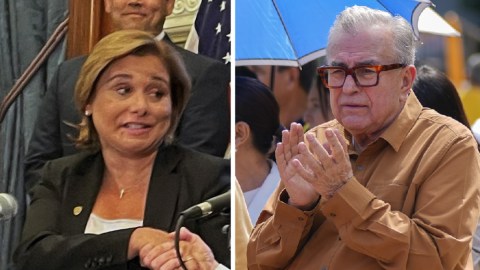
The investigations by the Identical Prosecutor’s Office of the Republic (FGR) against the licensed governor of Sinaloa, Rubén Rocha Moya, and against the governor of Chihuahua, María Eugenia “Maru” Campos, once again place Mexico in front of one of its deepest contradictions: the inability to build a true rule of law without being trapped between domestic impunity, political polarization and the strategic pressures of the United States.
The underlying problem is not only the characters involved or the media scandals that dominate headlines and social networks. The central issue is that Mexico continues to fail to develop sufficiently strong and legitimate institutions to investigate political corruption and high-level criminal networks without depending, directly or indirectly, on US pressure. Every time Washington dictates the pace of the Mexican security agenda, national sovereignty is exposed as an aspiration limited by deep power asymmetries.
The cases of Rocha Moya and Maru Campos are different, but they reveal the same structural crisis. In the first, the Mexican government faces serious accusations related to alleged links between political actors and criminal networks. In the second, the controversy revolves around the cooperation of state authorities with US agencies in security operations within the national territory. Both cases have been quickly absorbed by the logic of the political spectacle: Morena accuses the government of Chihuahua of “betrayal of the country” and subordination to foreigners; The opposition, for its part, celebrates the investigations against actors close to the ruling party and claims cooperation with the United States as an automatic synonym of institutional effectiveness, defense of federalism and even protection of Mexican democracy.
However, neither side seems willing to seriously discuss the central problem: the profound institutional decomposition that has allowed for decades the simultaneous expansion of corruption, impunity, illicit economies and political capture in large regions of the country.
The Mexican opposition acts as if corruption and criminal links were the exclusive property of Morena, forgetting that a good part of the real crisis was incubated precisely during the PRI and PAN governments. But Morena cannot continue to present itself as a morally distinct force while protecting, minimizing or relativizing accusations involving relevant members of its own political elite. The old pact of impunity that characterized the Mexican political system does not seem to have disappeared; he simply changed administrators.
In the midst of this dispute, the United States finds ideal conditions to advance an increasingly aggressive hemispheric security agenda. Under the second administration of Donald Trump, the fight against drug trafficking and fentanyl has ceased to be solely an issue of bilateral cooperation and has become a central component of a broader regional geopolitical management strategy. The designation of criminal organizations as terrorist threats, the hardening of the discourse on unilateral interventions and the growing pressure on Mexican state and federal governments are part of a logic that transcends the fight against drug trafficking.
Washington perfectly understands the internal Mexican fractures and uses them strategically. While the ruling party and the opposition accuse each other, the United States strengthens mechanisms of diplomatic pressure, intelligence, security and border management that expand its margin of influence over Mexico. The Mexican crisis of violence and corruption thus ends up becoming a functional instrument for US strategic interests.
This does not mean denying the seriousness of the prison problem or minimizing the need for international cooperation. Mexico faces violent organizations, transnational trafficking networks and deeply rooted corruption structures. But it is one thing to cooperate and quite another to normalize a structural dependency in which justice enforcement priorities seem to be activated only when they coincide with Washington’s interests.
The Rocha Moya case must be investigated with absolute rigor and transparency. If there is solid evidence of criminal links, the Mexican State has the obligation to prosecute any official, regardless of their political position. But the same principle should apply to all levels of government, including opposition actors and state authorities who may have crossed legal or constitutional boundaries in their relationships with foreign agencies.
Selective justice does not strengthen the rule of law; weakens it even more. Nor does it help to turn any debate about sovereignty into empty nationalist propaganda, or to assume that all cooperation with the United States automatically constitutes treason. Mexico faces a much more complex challenge: building institutions strong enough to investigate both internal corruption and the distortions produced by external dependence, without succumbing to automatic subordinations or pamphleteering discourses.
The real challenge for Mexico is not choosing between Washington and domestic polarization. The challenge is to build a State capable of simultaneously confronting the corruption of its political elites, the expansion of criminal networks and the growing geopolitical pressures of its powerful northern neighbor.
Because as long as the country remains trapped between internal impunity and strategic dependence, sovereignty will continue to be more of a political discourse than an effective reality.
The texts published in this section are the sole responsibility of the authors, so La Opinión does not assume responsibility for them.


