
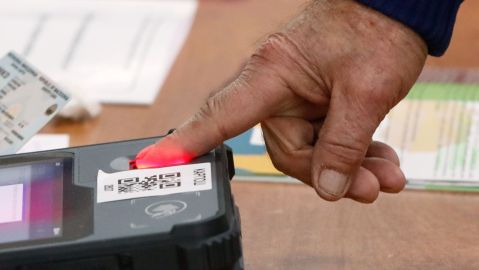
He Internal Revenue Service (IRS) and the United States Department of the Treasury analyze changes that would allow the conservation of the biometric data of millions of taxpayers, a measure that has already begun to raise concerns about privacy and government surveillance.
The information was revealed by Politico, which had access to internal documents and presentations used by Treasury officials in recent meetings on digital security and combating tax fraud.
According to the report, the US government is evaluating modifying the agreement with the technology company ID.me, in charge of verifying the identity of users who access federal platforms, including the tax system.
The IRS wants to extend the biometric retention time
Currently, biometric information linked to closed accounts must be deleted within 24 hours. However, the new proposal would allow the company keep that data up to 36 months later that an account has been deleted.
The initiative arises in the middle of the growth of digital fraud driven by artificial intelligence and deepfake technology, a problem that increasingly worries federal agencies.
According to data cited in the report, AI-based scams increased more than 1,210% during 2025, according to figures from ID.me itself.
A company spokesperson said that biometric data is not shared freely with the federal government.
“The federal government cannot share ID.me biometric data between agencies because ID.me does not share that data with the government in the first place,” the company stated.
The firm added that onlywould release biometric information through a court order or a mandatory factual requirement.
Privacy and surveillance concerns grow
Despite these guarantees, privacy experts consider that extending storage time represents a risk potential for citizens.
An IRS employee cited anonymously by Politico called the proposed as “terrifying”by warning about the possibility of extremely vivid information remaining active for years without clear knowledge of users.
In addition, the IRS is analyzing incorporating mechanisms of “one-to-many comparison”a technology that would allow biometric data to be crossed to detect fraud linked to false identities created through artificial intelligence.
However, specialists warn that these types of systems can be invasive and imprecise.
The senator Tag Warner urged caution when implementing the new measures.
“The privacy of the taxpayer is of mandatory importance, and the IRS must take extreme precautions to safeguard biometric data,” declared the Democratic legislator.
Fear over the handling of personal data
The discussion also occurs in a context of growing mistrust about the internal information management most within the federal government and private companies.
Nina Olson, executive director of the group Center for Taxpayer Rights, warned that citizens could feel less willing to share financial information if they perceive that their data will remain stored for years.
“Taxpayers will startchange the way you file returns if they feel that there is no transparency,” he stated.
So far, the IRS has not confirmed whether the modifications will be officially implemented, although it acknowledged that there are internal discussions about new data retention policies.
Keep reading:
- The Trump government underestimates the tax contribution of undocumented immigrants
- Court allows ICE to access immigrant tax data through the IRS


