
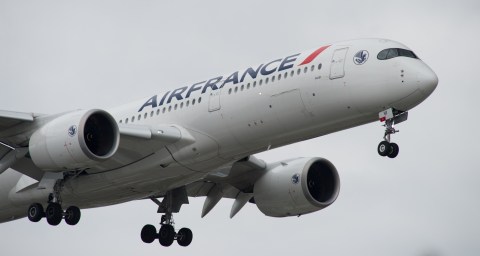
An Air France flight bound for Detroit was diverted to Canada due to the presence of a passenger who boarded the plane “by mistake” during an Ebola outbreak in central Africa, according to authorities.
The United States Customs and Border Protection (CBP) took decisive action by prohibiting the flight from landing in Detroit, citing entry restrictions for public health reasons, he reported. NBCNews.
Flight 378 took off from Paris and was redirected to Montreal’s Trudeau International Airport at the request of US authorities. Air France confirmed that there were no medical emergencies on board.
“There was no medical emergency on board and, like all airlines, Air France is obliged to comply with the entry requirements of the countries it serves,” an Air France spokesperson said in a statement.
This shows concern in the US about the risks of being exposed to a massive epidemic or new pandemic, as occurred with COVID-19.
New entry restrictions to the US
As of May 18, the Centers for Disease Control and Prevention (CDC) announced restrictions for non-U.S. passengers who have been to Congo, South Sudan or Uganda in the past three weeks. These regulations will be in force for 30 days.
According to the new established procedures, all flights with passengers from the aforementioned countries must land at Washington-Dulles International Airport, where enhanced public health measures will be implemented.
The Ebola outbreak has resulted in more than 139 suspected deaths and more than 600 suspected cases, according to the World Health Organization (WHO). It is estimated that testing for a new vaccine will take months to begin.
The question remains whether this type of medical paranoia is due only to precautionary measures or to being influenced by the danger of possible mass contagion.
Although the risk of spread in the United States is low, national health authorities and the WHO have admitted, fear is free.
Americans have also been warned not to travel to certain areas of Africa as health officials step up detection and containment efforts.
Airlines measures to ensure the health of passengers
Airlines are applying a combination of masks, reinforced disinfection, health modification and more distance on board to reduce the risk of contagion during epidemic outbreaks. They also tend to limit non-essential services and, in some cases, adjust flight occupancy to reduce exposure among passengers.
Most common measurements
- Use of face masks or masks for passengers and crew on flights or sections where regulations require it, or as the airline’s own policy.
- Disinfectant gel and hygiene kits upon boarding, in addition to frequent cleaning of contact surfaces.
- Intensive aircraft disinfectionespecially after flights from high-risk areas or when a person suspected or confirmed to have an infection has traveled.
- Distancing on boardfor example not selling middle seats on certain routes or periods.
- Health checks prior to boardingsuch as questionnaires, symptom screening, or temperature checks at some airports and airlines.
- Reduction of onboard services such as food and drinks, to limit contact and movement in the cabin.
Although the Ebola outbreak in Central Africa does not put the celebration of the Soccer World Cup (FIFA 2026) at risk, the authorities have pointed out, the modifying measures are not out of place.
It is worth clarifying that, although the virus is highly lethal, it is not transmitted through the air and requires direct contact with body fluids, which allows for effective epidemiological modification.
Host countries such as Mexico and the United States already apply travel alerts and special monitoring protocols for delegations from affected areas.
The International Football Federation (FIFA), in coordination with the WHO, evaluates daily medical checks and possible preventive isolation for those involved.
Meanwhile, among the sporting decisions, it has been taken as a maximum precautionary measure that the Democratic Republic of the Congo (DRC) team cancels its preparation concentration and friendlies abroad.
It is feared then that the issuance of the temporary entry ban to United States to any non-American person who has been in the Democratic Republic of the Congo (DRC), Uganda or South Sudan if it lasts longer than the estimated time and could partially disrupt the celebration of the great sporting event, due to the danger of the Ebola outbreak.
You may also be interested in:
· It’s not hantavirus or Ebola!: Massive and deadly measles outbreak originating in Bangladesh worries US experts.
· More about the Bundibugyo virus, the Ebola species that is wreaking havoc: a strain that has no vaccines or treatment
· Revelations about the Andes strain: first genetic analysis of the cruise hantavirus rules out that it is due to mutations


