
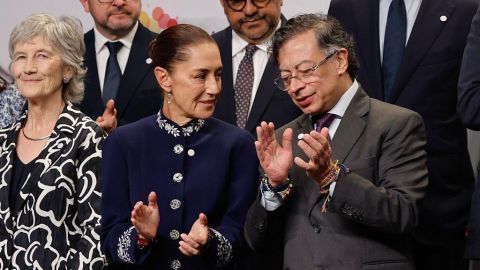
The government of donald trump A few days ago, he presented a new concept for the fight against drug trafficking in which Mexico and Colombia appear as two of the countries targeted by the United States.
This is the National Strategy for Drug Retention 2026, a document that Washington publishes every year and which states its objectives to reduce drug trafficking to its country.
Unlike past governments, including the first of Trump himself (2017-2021), the new Strategy gives a more aggressive outlook, using various executive orders signed since January 2025 and that give power to the armed and intelligence branches to act even beyond their territory.
Two Trump policies are key: one is the designation of drug cartels as “terrorist organizations”a list that includes six Mexican cartels and one Colombian one; and the other is the declaration as a “weapon of mass destruction” of fentanyl, a drug that has caused tens of thousands of deaths in the United States and that is produced and distributed by Latin American cartels.
With both policies, the Trump government has created a correct framework to act in countries of origin and transit of drugs, analysts say.
In the Latin American region, US actions have already been seen under this approach, the most notable case being that of Venezuela, where numerous vessels were lethally attacked in the Caribbean for alleged drug trafficking for weeks.
Without forgetting the arrest and “extraction” of the president Nicolas Maduro in a military surgical operation in Caracas on January 3.

Although the latter is an extreme tool, it shows how the US government seeks to carry out its anti-drug policy in other countries, especially Mexico and Colombia, as nations with high production and/or transit of drugs (and with governments on the opposite political spectrum to Trump’s).
But In Mexico some cases have already begun to be uncoveredsuch as the recent death of two agents of the Central Intelligence Agency (CIA) in the state of Chihuahua, in an anti-drug operation without endorsement from the federal government.
“The designation of different cartels as ‘terrorists’ is what gives it a deeper justification,” security analyst and researcher Víctor Sánchez explains to BBC Mundo.
“This is how covert operations are justified from the American perspective like what we saw recently in Chihuahua, or interventions by special groups to attack characters like what we saw in Venezuela with Nicolás Maduro,” he adds.
The Strategy also raises warnings about accountability to foreign governments, particularly Mexico, Colombia, Canada, China and India.

The key points
The 2026 Strategy raises usual objectives, such as the defense of borders, the fight against money laundering, the fight against the illegal trade of drug precursors, among others; But one of the most striking is related to how the United States can act against groups designated as “terrorists.”
The designation, the document explains, “is not merely symbolic; it constitutes a strategic trigger that rethinks the approach of the United States government, going from considering it a traditional law enforcement problem to a threat to national security“.
To support that, he cites both Title 10 Armed Forces and 50 Warfare and National Defense of the US Codes to point out that the country’s forces can conduct “counterterrorism operations” against criminal networks beyond their territorial jurisdiction.
“This change provides new and expanded capabilities to attack the entirety of these networks, including their financial and logistical support systems, using the full capabilities of the United States government, including diplomatic, informational, military and economic tools,” he adds.
In addition to this key change, it also focuses on the requirement for countries of drug production and transitamong which it points to Mexico and Colombia.
Among some of the most notable aspects, the Strategy indicates that:
- Colombia must reduce coca crops in a measurable way, as well as dismantle gangs related to cocaine trafficking.
- Mexico must deliver results in drug seizures, especially synthetic drugs such as fentanyl, destroy production sites and eliminate the ability of cartels “to threaten the territory and security of the United States through its extraterritorial command and administration structures.”

The Strategy also includes other points that are directly related to both countries as points of production and transit of narcotics:
- That national gangs that operate as distributors for transnational criminal organizations and foreign terrorist organizations “will be targeted and dismantled.”
- That the US will “take advantage of all available tools in our arsenal” to eliminate cartels that threaten the national security of the United States.
- That in terms of “accountability”, it will include “governments that support foreign terrorist organizations and their drug trafficking activities.”
- It also means “holding source and transit nations accountable for their lack of enforcement action against chemical companies that sell fentanyl and other synthetic drug precursors” to cartels.
- Detainees who are prosecuted in the US will be charged “not only with drug smuggling and violent crimes, but also with terrorism and facilitation of terrorism,” which would increase the penalties.
- Washington will offer aid to countries, “as long as tangible results are obtained.”
These last points acquire greater resonance in Mexico due to the recent US judicial accusation against two active senior officials – the governor of Sinaloa, Ruben Rocha Moyaand the senator Enrique Inzunza Cázarezboth from the ruling Morena party – which has been something unprecedented in the relations between both countries.
The document also explicitly points out Canada, China and India as countries where an important part of the problem of trafficking of chemicals and drugs that reach the United States is generated.

But Sánchez considers that Mexico is the main objective of this new Strategy: “At the end of the day, it is the flow that carries most of the drug trafficking to the US.”
“The largest production of fentanyl comes from Mexico; the largest production of methamphetamines and other synthetic drugs comes from Mexico; cocaine that comes from Colombia, Peru and Bolivia also passes through Mexico,” he points out.
The fact that Trump uses the designation of “terrorists” against the cartels, coupled with the declaration of fentanyl as a “weapon of mass destruction,” is the predominant support that the Departments of Defense, Justice and the US anti-drug and intelligence agencies have to act under the Strategy.
“The designation of ‘terrorists’ of different cartels is what gives it a deeper justification. Because what they are attacking are terrorist groups, not just criminal groups. So it makes it a matter of internal security,” says Sánchez.
“It doesn’t mean that it makes it correct in Mexico, but it does give it an aura of legality from the American perspective”
What results should there be?
For months, Trump and other officials have insisted that Mexican authorities must deliver results in the fight against drug trafficking and have offered support from their armed forces and intelligence.
The president of Mexico, Claudia SheinbaumHowever, he has said that he agrees to cooperate, but rejects the intervention of any Washington force due to a matter of national sovereignty.
“Cooperation, coordination, without subordination” has been his constant message to Washington.
What specific results Washington wants to see from other countries is not detailed in the Strategy.
The document talks about some indicators and a tool: Precursor Incident Communications System (PICS).
In it, US agencies and target countries – including Mexico and Colombia – must report progress and set a goal for two years and another for 2030 regarding events of seizure or destruction of drug manufacturing sites.
However, there are no more details about what the share of those involved is.
Sánchez considers that “there are no clear parameters,” or at least they are not public.
“What is striking is the hardening of the position regarding the results of the Mexican government. Without a doubt, the Mexican government could do more. But there is also no doubt that it has done more than its predecessors. And yet there is constant pressure,” says the analyst.

The Sheinbaum government presented in its last update on May 11 that, since taking office 20 months ago, it has achieved:
- 391.7 tons of drugs (2,226.6 kg of narcotics and 5.48 million fentanyl pills) seized.
- 28,031 firearms seized.
- 52,628 people linked to organized crime arrested.
- 2,337 laboratories and drug concentration areas dismantled.
Added to this is that 92 organized crime leaders were extradited from Mexico to the United States.a movement not seen before, as well as the despondency of some bosses, such as the leader of the Jalisco New Generation CartelNemesio “El Mencho” Oseguera Cervantes.
In Colombia, the government reported at the beginning of the year that, since the president’s term began Gustavo Petro in 2022:
- They have seized more than 2,840 tons of cocaine, “the highest figure recorded in the history of the country.”
- They have arrested 14,000 people linked to drug trafficking.
- They have extradited 615 people to the United States.
In response to the presentation of the new US Strategy, the president of Mexico insisted on May 12 that her government seeks to work with Washington “to reduce all these crimes in a strategy that is giving results,” while rejecting that the recent accusations against figures from her party are breaking cooperation.
“There can always be tensions. The important thing is that we find a way, respecting our sovereignty and with the dignity of the people of Mexico, to move forward.”
The case of the activities of CIA agents in Chihuahua, of which Sheinbaum claims his government was not notified by the US, has been seen by analysts from both countries as a new level in the US offensive on drug trafficking that comes preceded by multiple Trump’s threats to take action on his own.
And recent court indictments against members of his party have strained bilateral cooperation.
Sánchez considers that actions such as the “extraction” of Maduro by the US are the last resort, which in the Mexican case would generate a major diplomatic crisis. But Washington could act in other ways.
“I believe that covert operations are going to grow, with the participation of US agents. Not that they carry out armed actions, but that they guide authorities,” he points out.

click here to glimpse more stories from BBC News World.
Subscribe here to our new publication to receive every Friday a selection of our best content of the week.
You can also follow us on YouTube, instagram, TikTok, x, Facebook and in our new whatsapp channel.
And remember that you can receive notifications in our app. Download the latest version and activate them.
- Why US drug trafficking accusations against the governor of Sinaloa are a blow to Claudia Sheinbaum (and force her into a new balancing act)


