
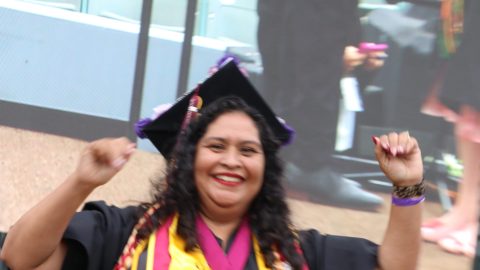
“Today is the day I can say: It wasn’t easy, but I did it,” could be seen on the cap of Yolanda Sáenz Chávez, who overcame countless obstacles to qualify as a teacher at the Cal Voice Dominguez Hills College of Education.
Yolanda, mother of four daughters, was the happiest of all the graduates who gathered at the Dignity Sports Park Tennis Stadium, where a total of 4,200 students will obtain the graduate pin and place it on their gowns.
“Yes we could! Yes we could!” her daughters chanted before the graduation ceremony, and at the end they placed several orchid necklaces around her neck, while her husband, Guillermo Chávez, gave her a kiss and a bouquet of flowers with an A+ grade.

“A Hispanic has grown up with the tradition that women may not go to school because they have to be housewives, take care of their family, their husband,” said Yolanda, born in Michoacán, Mexico. “That was my mother’s thought.”
It was after their third daughter was born that Yolanda and her husband agreed that she would stay home. They paid too much money for daycare.
“My decision was to give 100% of my time to my daughters, but the desire to be a teacher always remained inside me,” said the graduate.
“Mommy, what you have done is a great thing,” said her daughter Xitlali, 21, who, for her part, will graduate in Political Science in June.

Yolanda Sáenz Chávez’s achievements could not have been achieved without the support of her husband.
“We are going to celebrate 30 years of marriage and he is a good man,” she said.
“He did what he wanted because he wanted to achieve it,” said Guillermo Chávez. “I think the most difficult thing was seeing her distressed when she had to do a lot of tasks.”
California State University Dominguez Hills will have five more graduation ceremonies, with more than 40,000 guests expected to attend.
“Our graduates are dedicated to serving, caring and healing our communities, at a time when we truly need love,” said Dr. Mary Ann Villarreal, interim president of CSUDH. She received the appointment to the Board of Regents on January 1.

“I’m incredibly proud of who they’re going to become and what they’re going to do. They’re going to change our communities.”
Indeed, the Class of 2026 reflects CSUDH’s mission to provide a high-quality, accessible education that prepares graduates to meet the needs of the regional workforce in the health, education, business, public service and technology sectors.
In addition to recognizing the perseverance and achievements of graduates of the Faculty of Arts and Humanities, and those of the Faculty of Education, Villarreal invited professionals to always have the desire to strengthen the communities they represent, supporting others on their path to knowledge.
“All of that is woven into the title with which you will leave here today [ayer]. Therefore, it is not just a piece of paper; It is a symbol of everything they have achieved,” he stressed, and reminded them that, by receiving their degree, “they also assume a share of responsibility: that of putting their skills, their experience and their credentials to work; that of sharing your knowledge; and to have the audacity to change the world for the better.”

Objective achieved
Irene Lucía Harapat, another Latina graduate, told La Opinión the adventure of her life, since she left school at the age of 16 to take care of her sick father, and her return to school, at the age of 37, to show her daughters that they can have greater achievements in life. She earned her teaching certificate from a community college.
Due to life circumstances, her biological mother abandoned her, her brother and her sick father, who died in September 2018.
“My dad [Darrel Harapat] “He was paralyzed because he had had a stroke, he was left without support and that broke his heart and his health worsened,” he said. “I stopped studying, because my dad couldn’t take care of himself.”

But it happened that her boyfriend – her now husband, Edberg Camacho – and his family offered them help. Edberg spoke with his mother, Maria, and his stepfather. They welcomed Irene Lucía, her brother and her father into their home.
However, her biggest motivation to return to study was Raquel, her youngest daughter, who had speech problems since she was two years old.
“I dedicated myself to looking for help everywhere for my daughter; I took her to her speech therapist twice a week,” she recalled. The girl was also born with respiratory problems and vomited when she drank milk.
“We went to the emergency room all the time to see specialists and they didn’t find anything,” he said.
After several years, they found the reason why the girl’s tongue got stuck and she couldn’t pronounce words.
“What she had was something so small. Her tongue was stuck to the roof of her mouth! It didn’t occur to me or anyone else to move her tongue! The girl began to improve her vocal expression when she was in fourth grade.
And, although Irene Lucía, born in the city of Compton, intended to inspire her daughters to think about a university career.
“I felt hypocritical to tell them what they should do, but I didn’t do it,” she said.

It was in this way that she talked with her husband about her plans, and although she worked and studied, she completed her goal of graduating in two years to help autistic children or children who suffer from dyslexia.
“Of all the beautiful things that happened to me, I am proud of the support that my husband and my mother-in-law have given me.” [María] during all these years so that I can finish my studies,” said Irene Lucia. “Without their support I could never have achieved it.”
Another María, his biological mother, also attended his graduation, with whom he has reconciled and mutually forgiven.

A diverse student community
Dominguez Hills State University has a total of 14,262 students: 12,473 undergraduate and 1,789 graduate students, of which 80.5% belong to underrepresented groups: African American/Black, Latino/Hispanic, and Native American.
Among these students, 68.2% are Hispanic/Latino; 12.2% black/African American; 7.7% Asian, 4.8% Anglo and 2.4% two or more races.


