
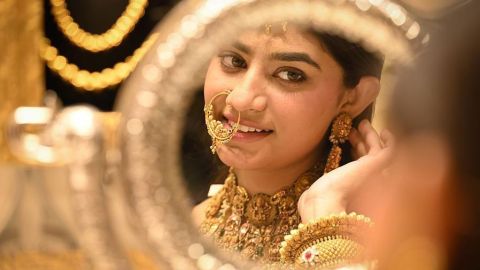
In India, citizens have been urged to stop buying gold for a year.
“For the sake of the country, we will have to decide that for a year, even if there are events at home, we will not buy gold jewellery,” Prime Minister Narendra Modi declared on May 10.
“Patriotism is not just about being willing to sacrifice one’s life at the border. In these times, it is about living responsibly and fulfilling our duties to the nation in our daily lives,” he added.
Three days later, India also raised import tariffs on gold from 6% to 15%.
It is a difficult measure to accept for the second largest gold market in the world, both in jewelry and in investment. In the last fiscal year, which ended on March 31, the country imported US$72 billion of this precious metal.
In India, gold also plays an important cultural role, as it is often given as a gift at weddings and passed down as inheritance.
Modi claimed that gold buying was consuming large amounts of foreign currency at a time when India is already facing a rise in oil prices. The South Asian country imports more than 85% of its oil needs.
Oil prices soared by up to 70% at their peak following the start of the US-Israeli war against Iran and the effective closure of the Strait of Hormuz, a key trade route through which around 20% of the world’s supply of petroleum and pure liquefied gasoline transits.
Rising energy prices are putting pressure on governments around the world to implement savings measures.
Although many countries have mainly focused on energy savings, India seems to be the only one asking its citizens to reduce spending on gold.
Gold has become a broader economic concern in India, as both gold and oil imports are largely paid for in US dollars.
Higher demand for dollars may weaken the Indian rupee, which has already fallen about 5% against the dollar this year. This depreciation could generate inflationary pressure.
“For the jewelery sector, this is worse than the Covid-19 times,” says Sanjeev Agarwal, a jeweler in New Delhi.
Another jeweler in the capital, Abhishek Agarwal, says companies fear they will not be able to survive if people stop buying gold.

Non-essential imports
More than 90% of India’s gold is imported, Professor Sundaravalli Narayanaswami, director of the Indian Gold Policy Center at the Indian Institute of Management in Ahmedabad, told the BBC.
“Every year between 600 and 700 tons of gold are imported, and exports are very low, so this gold has accumulated in homes,” he said.
Indian women are often said to own around 11% of the world’s gold, although this figure is difficult to verify and estimates vary.
In India—and around the world—many consider gold a safe investment in times of uncertainty, meaning demand can remain high even during economic downturns.
Gold prices have risen sharply in recent years, surpassing $5,000 an ounce for the first time in January.
Gold accounts for around 9% of India’s import bill. But unlike oil, it is not generally considered essential, as it is purchased primarily for jewelry or investment, and not for industrial production.
In the past, India has attempted to discourage excessive gold imports in times of economic hardship, increasing import tariffs and promoting alternative investment options that do not involve owning physical gold.

What impact will it have?
In addition to refraining from buying gold, Modi also urged the population to use public transportation, carpool, telework and limit non-essential foreign travel to reduce fuel consumption.
He appealed to families to reduce the use of cooking oil and asked farmers to reduce fertilizer consumption.
Other governments around the world have implemented similar measures to address rising fuel prices.
For example, in Sri Lanka a fuel quota system for vehicles was established and government institutions were asked to reduce energy consumption; and in Thailand the population was urged to use air conditioning less.
Egypt previously ordered the early closure of shops and restaurants, while Mozambique advised its citizens to telework.
But Modi’s call for people to stop buying gold is “quite unusual,” says Hamad Hussain of research firm Capital Economics.
“But in the case of India, that is explained by the fact that it imports large quantities of gold, which represents a significant part of its import bill. So, in a way, it makes sense,” he says.

one full year
Economists are divided over whether a possible reduction in Indian demand would have a significant impact on the global price of gold.
Since India, the world’s most populous country, is a big consumer, lower demand would “put pressure on global gold prices… by shifting the balance toward oversupply,” Hussain says.
However, Sebastien Tillett, from the consulting firm Oxford Economics, believes that the impact would be “marginal” because prices are currently more influenced by investor demand and geopolitical uncertainty.
He also doubts that Modi’s appeal to Indians will have a far-reaching impact on gold spending in the country.
“Public appeals may have some effect, but they are more likely to postpone or modify purchases rather than eliminate them,” he explains, adding that gold remains “deeply rooted in Indian culture and household savings.”
“The short-term impact could also be tempered by seasonality: demand for gold is typically lower outside of the main wedding and festival shopping seasons, so it seems that some of the slowdown could have occurred anyway,” he adds.
Previous increases in gold import tariffs in 2013 were linked to increased smuggling and illegal trade, according to government and industry officials.
Some analysts described Modi’s call as the “most drastic” set of measures announced to date in response to rising energy prices, while opposition leader Rahul Gandhi said the government was “shifting the responsibility to the people.”
Some members of the Indian jewelery sector requested a direct meeting with the government to find a solution.
“If it was just two months, maybe we could manage, but a whole year is too much,” says another jeweler, Shweta Gupta. “How are we supposed to pay our employees?”

click hereto review more stories from BBC News Mundo.
Subscribe hereto our new e-newsletter to receive a selection of our best content of the week every Friday.
You can also follow us on YouTube, instagram, TikTok, x, Facebookand in our new whatsapp channel.
And remember that you can receive notifications in our app. Download the latest version and activate them.
- The Indian billionaire who offers to save Pablo Escobar’s 80 hippos condemned to euthanasia in Colombia
- The fascinating story of the Koh-i-Noor, the British Right House diamond that the mayor of New York said should be returned to India


