
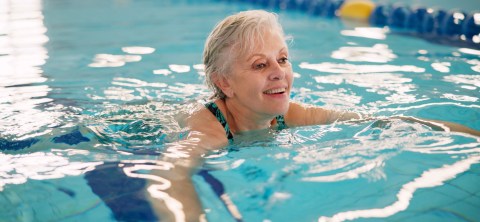
Researchers from the Federal University of Rio Grande do Sul, in Brazil, conclude that aerobic exercise, such as walking and swimming, reduces blood pressure in people with hypertension throughout the day. The combination with strength training + HIIT also demonstrated significant effects.
A study, published in British Journal of Sports Pillsshows that this type of exercise reduces blood pressure throughout the entire day, even while sleeping.
The research was carried out by members of the Graduate Program in Cardiology and the Graduate Program in Epidemiology of the aforementioned Brazilian university..
Evaluation methods
It is important to note that measuring blood pressure only when you go to the doctor’s office is not the most appropriate, as it is a specific reading that does not reflect what happens during sleep, work or daily activities.
Therefore, use is made of the tension MAP, which records the pressure in minute intervals for 24 hours through a portable device; one method more accurately predicts the risk of heart attack or stroke.
For the study, systematic searches were carried out in the databases MEDLINE, Embase, Cochrane Central and the Regional Portal of the Virtual Health Library from November 2024 to August 2025, in addition to including randomized controlled trials to evaluate the effects of physical training.
Recommendations for the management of hypertension
The researchers suggest integrating aerobic exercise and combined training into clinical guidelines as primary strategies against hypertension.
They conclude that aerobic training (continuous and interval) and combined training significantly reduce ambulatory blood pressure, although the evidence for dynamic and isometric resistance training remains uncertain.
Finally, they emphasize the need for larger studies to validate the effects of other types of exercise, such as yoga and pilates.
Risks associated with exercising
However, there are risks, but for most people with hypertension, exercise is also beneficial if it is well chosen and supervised. The main danger appears with very high intensities, isometric exercises, lifting maximum loads or Valsalva maneuver, because they can raise blood pressure too much.
What risks may appear?
- Sudden increase in blood pressure during exertion, especially with very heavy weights or static exertion.
- Dizziness or drop in pressure when changing position quickly, especially if there is hypertension or antihypertensive treatment.
- Increased risk in intense competitive sports, arm-only exercises, inverted positions, and contact activities in people with moderate or severe hypertension.
- If diastolic pressure rises instead of falling with exercise, it may be a sign of poor control or that the effort is not adequate.
Which exercise is usually safest?
Moderate intensity aerobic exercise is usually the most recommended because it helps lower blood pressure. Strength can also be included, but avoiding maximums, prolonged isometry and breath holding.
When to be more careful
There should be more caution if hypertension is moderate or severe, if there are organic complications or if the pressure is not well controlled. In these cases, a medical evaluation is usually advisable before starting or increasing training.
Rule of thumb
If you have hypertension, the goal is not to avoid exercise, but to do it regularly. moderate, progressive and controlledpreferably with professional guidance.
You may also be interested in:
· An effective approach to reducing cravings involves at least one exercise session
· Hidden epidemic: alcohol wreaks havoc on US public health
· How to address childhood obesity so as not to stigmatize or generate trauma


