
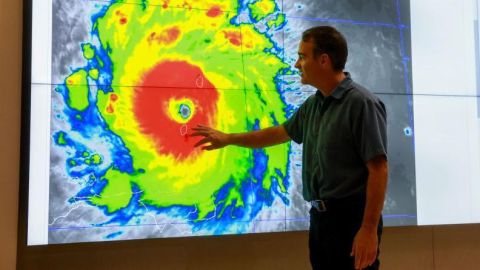
The signs that the El Niño meteorological phenomenon may occur this year have increased in recent weeks and, according to some specialist models, there are even conditions that point towards a “Super El Niño.”
A typical El Niño phenomenon typically raises global temperatures and causes more tropical storms in some regions, as well as drier conditions in others.
Therefore, when talking about a particularly strong phenomenon, colloquially called “Super El Niño” or even “El Niño Godzilla”, it is understandable that concerns arise.
However, climate scientists tell the BBC that caution is needed regarding these predictions.
Currently, there is uncertainty about the possible severity of the event and, therefore, it is unknown to what extent it may affect the planet’s weather patterns.
What indicators are there and what do they mean?
El Niño and its counterpart, La Niña, are two opposite states of a natural climate phenomenon called the El Niño Southern Oscillation (ENSO).
It receives its name from the fishermen of Peru and Ecuador who thus referred to the phenomenon of unusually warm waters that occurred just before the birth of the Christ Child at Christmas.
La Niña is called that simply because it is the opposite phenomenon.
They do not necessarily alternate and are usually identified by the sea surface temperature in the central and eastern Pacific. During El Niño, these waters are warmer; and, in the case of La Niña, they are colder.
These phenomena usually occur every two to seven years and generally last nine to 12 months. However, they can persist for longer.
The last La Niña phenomenon occurred between 2024 and 2025.
Currently, conditions in the Pacific are “neutral,” meaning we have neither El Niño nor La Niña.


“Super El Niño”
While most climate prediction models point to the development of El Niño later this year, there remains much uncertainty about the intensity it could reach and therefore the extent to which global climate and weather patterns could be affected.
There are signs that this next El Niño could become a “strong” phenomenon, which some sources refer to as “Super El Niño” or “El Niño Godzilla.”
The US Climate Prediction Center puts this as sea surface temperatures in the central tropical Pacific +1.5°C above the historical average, and suggests there is about a 33% chance of that occurring between October and December of this year.
“Super El Niño” phenomena are relatively rare.
Although a few months of a strong El Niño occurred in late 2023, the most recent sustained period occurred between 2015 and 2016.

This episode contributed to 2016 being the hottest year on record (now surpassed by 2023, 2024 and 2025), in addition to many other records being broken.
Sea levels continued to rise globally and Arctic sea ice extent remained well below average.
Tim Stockdale of the European Center for Medium-Range Weather Forecasts (Ecmwf) says the term “Super El Niño” is relatively new to him.
“I think people created this to indicate a very important El Niño event, like the ones we saw in 1997-98 or 2015-16, when anomalies exceeded 2°C, for example, in the central Pacific region,” he told the BBC.
According to Stockdale, current models indicate that a moderate El Niño is likely, while some suggest that a strong event is possible.

What impact does it have in Latin America and other regions?
No two El Niño events are the same, but certain weather patterns are more or less likely when this phenomenon develops.
The most obvious impacts are usually observed in the places closest to the unusually warm waters of the Pacific, such as those surrounding several Latin American countries, specifically those in the northern hemisphere such as Mexico and Central America.
When El Niño is more intense, it tends to produce conditions much more conducive to the formation of hurricanes in the eastern and central Pacific in the Latin American region.
On the other hand, in the Atlantic there is usually a calmer storm season (an exception was 2023).
In South America, countries such as Peru and Ecuador can experience much wetter weather, causing heavy rain and devastating flooding.
And in northern South America, adjacent to the Caribbean and the Atlantic, drought conditions tend to be created.
In other regions, Western Pacific countries such as Australia, Indonesia and the Philippines tend to be drier than traditional due to El Niño.
Drought and forest fires can be serious problems in these regions.
But El Niño may also have much broader implications, and may be associated with a weaker monsoon season in India and heavy winter rains in the southwestern US.
Historically there have been very devastating moments related to El Niño.
Between 1876 and 1877, there was a strong El Niño effect that led to natural disasters and severe famine in various parts of the world.
It is estimated that more than 50 million people died, mainly in India, China and Brazil, due to the food disruption that was generated.

Atmospheric scientist Kimberley Reid of the University of Melbourne in Australia believes that talking about El Niño in grand terms is “nonsense.”
He explains that the intensity of the phenomenon is not necessarily reflected in the magnitude of the resulting impacts everywhere. Places like the American continent, he explains, could be more affected near the warmer waters of the Pacific.
But for places like Australia, Asia and Africa, “temperatures 0.5°C, 1°C or 2°C higher than traditional in that Pacific region are less important than whether an El Niño is present or not.”
According to Reid, it is important to take into account several factors that can influence the climate of a specific region. “When we focus solely on El Niño, we don’t have a complete view of the story,” he explains.
“I like to compare it to body mass index (BMI). If you look at a bodybuilder’s BMI, you’d probably say they’re obese, even if they have a very low percentage of body fat.”

There are no guarantees
Predictions about the intensity of El Niño do not always come true.
In 2017, for example, they pointed to the appearance of an El Niño phenomenon, which would therefore cause warming of the waters of the Pacific.
However, over time, conditions reversed and what was finally observed was the appearance of the La Niña phenomenon.
Reid says “failed predictions” like this are very rare, but stresses that “even when all the models indicate a high probability… that doesn’t necessarily mean it’s going to happen.”
“History teaches us to be cautious with predictions for March and April, even if they appear to have a high degree of confidence,” he notes.
The difficulty in predicting El Niño between March and May even has a name: the “spring predictability barrier” in the northern hemisphere, or the “autumn predictability barrier” in the southern hemisphere.
Stockdale wrote that early forecasts “tend to attract attention” but do not guarantee specific results.
“It is important to understand where confidence is justified and where uncertainty exists, in order to responsibly interpret current El Niño headlines,” he explains.
Reid advises people to “remember that phrases like ‘Super El Niño’ or ‘El Niño Godzilla’ generate a lot more attention than ‘El Niño is an uncertain thing this time of year.’”
And he concludes: “We are seeing extreme weather events more frequently due to climate change. It is important to be aware of what could happen and prepare for it by doing everything possible to reduce our emissions and reduce the probability of these extreme events occurring.”
* With reporting from Catherine Heathwood and Sarah Keith-Lucas of BBC News.

click hereto see more stories from BBC News Mundo.
Subscribe hereto our new newsletter to receive a selection of our best content of the week every Friday.
You can also follow us on YouTube, instagram, TikTok, x, Facebookand in our new whatsapp channel.
And remember that you can receive notifications in our app. Download the latest version and activate them.
- How El Niño and La Niña differ, the cyclical phenomena that can alter the climate around the world


