

By EFE
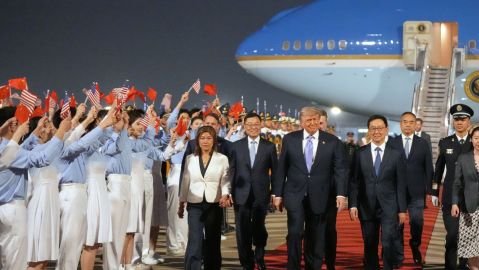
The president donald trump He landed this Wednesday in Beijing at 7:50 p.m. local time (11:50 GMT) to carry out a state visit to China until next Friday, his second to the Asian country since the one carried out in 2017 during his first term.
Trump, who is traveling accompanied by the Secretary of State, Marco Rubio, and a delegation of senior American executives such as Elon Musk (Tesla), Jensen Huang (Nvidia) or Tim Cook dinner (Apple), He will meet this Thursday with his Chinese counterpart, Xi Jinping, in a visit marked by the trade truce between both powers, technological tensions, Taiwan and the war in Iran.
The American president was received at the foot of the tarmac by the Chinese vice president, Han Zheng, along with the Chinese ambassador to the United States, Xie Feng, and the Chinese vice foreign minister, Ma Zhaoxu, in a welcome ceremony in which about 300 young Chinese participated, as well as a military band and an honor guard.
Trump stepped off Air Force One at 8:08 p.m. local time (12:08 GMT) and raised his fist in front of the cameras while the military band played before addressing the official motorcade.
Following the president came his son Eric Trump and his daughter-in-law Lara Trump, followed by Musk, Rubio and Huang, members of the US delegation accompanying the president on the visit.
The route from the airport to the center of Beijing was decorated with flags of China and the United States, while several skyscrapers displayed illuminated messages of welcome to the Chinese capital as the presidential motorcade passed by, which arrived at Trump’s resort around 8:38 p.m. local time (12:38 GMT).
More than two million viewers followed this Wednesday live on CCTV – the predominant Chinese state television channel – the landing of Air Force One in Beijing.
Trump’s arrival also dominated Chinese social networkswhere topics related to his visit occupied five of the top ten trends on Weibo, the Chinese equivalent of platform X, this Wednesday.
The hashtag ‘Trump arrives in Beijing’ also accumulated more than 8.3 million views and some 26,000 comments on the platform a few minutes after landing.
Among the most prominent comments on Weibo were predominant messages of welcome and calls for a “stable” and “mutually beneficial” relationship between both powersin line with the Chinese Government’s usual rhetoric on relations with the United States.
In just two days, Trump will face a concentrated agenda that will include bilateral meetings with Xi, a state dinner and formal activities in emblematic spaces of Chinese power such as the Great Hall of the People and Zhongnanhai, headquarters of the leadership of the Chinese Communist Party (CCP).
The visit comes nine years after Trump’s previous trip to Chinain November 2017, when he participated with Xi in events in the Forbidden City in Beijing.
Both sides are now seeking to consolidate the trade truce reached after months of tariff war, although disputes persist over technology, rare earths and access to the Chinese market.
Before arriving in Beijing, delegations led by US Treasury Secretary Scott Bessent and the Chinese Vice Premier, He Lifeng, They held “constructive” economic consultations in Seoul this Wednesday to advance the resolution of their tariff tensions, stated the Chinese news agency Xinhua.
Before leaving for Beijing, Trump announced that he will address the situation in Taiwan with Xi self-governed to which Washington sells weapons and Beijing does not rule out invading – and war in Iran, while Washington pressures China to contribute to promoting a de-escalation in the Middle East.
Hours before the American president’s landing, The Chinese Government urged the US this Wednesday to “handle with caution” the Taiwan question and to “stop” the shipment of weapons to the island. For his part, the Republican leader said he will ask China to “open” the country to American companies. EFE
Keep reading:
- US imposes new sanctions on networks in China and the Middle East for military support to Iran
- Trump seeks agreement with Iran before traveling to China and preventing the Hormuz crisis from overshadowing the summit
- What are China’s “teapot refineries” and how are they cushioning the oil crisis due to the war in Iran?


