
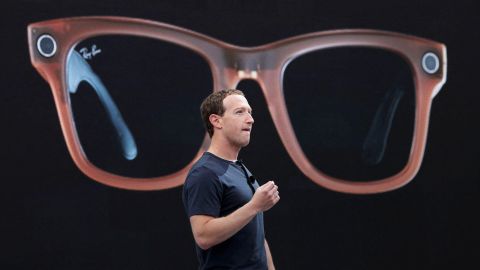
Problems related to a new generation of “smart glasses” seem to be piling up.
Despite this, some of the world’s largest technology companies are preparing to sell millions of pairs in the coming years.
Men wearing Meta’s Ray-Ban glasses – the bet of the company behind Facebook in the “smart” or AI glasses market – are accosting women leaving the beach, entering a store, or simply standing on the street in order to record their reactions to casual questions or pick-up lines, without their knowledge or consent.
Women only discover the existence of the videos in which they appear after they have become popular and often generated abusive comments on the internet.
In addition, they have few legal remedies, because taking photographs or videos in public spaces is considered, therefore, a legal activity.
One woman told the BBC that when she asked the person who had posted a secret recording of her to remove it, he told her that doing so was “a paid service.”

Meta lenses are currently the most popular on the market; It is estimated that they account for more than 80% of sales of smart or AI glasses, because the company is the first major player in the technology sector to launch a product of this type in recent years.
Manufactured in collaboration with EssilorLuxottica and equipped with the classic Ray-Ban look, these lenses incorporate an almost invisible camera in the frame, small speakers in the temples and lenses capable of showing certain information to the user.
Users can start a video recording or take a photo with a simple casual tap on the mount.
The nature of the camera integrated into Meta’s lenses is so discreet that even its users have been surprised by what they were recording – and when they were doing it – as well as the final destination of those recordings.
After workers in Kenya—who were tasked with watching videos recorded with Meta’s glasses to generate training data for the company’s artificial intelligence—reported that they were required to watch explicit content, such as sexual acts and bathroom scenes, several owners of the glasses filed two lawsuits.
In one of them, the plaintiffs alleged that they had no idea that such videos had been recorded. In the other, they said they were unaware that the company was sharing their videos with third parties for review.
Meta has previously stated that in its terms of service, users are informed that their content may be subject to human review under certain circumstances.
However, sales continue to rise. To date, seven million pairs have already been sold—a figure that continues to grow—according to the company’s own data.

“They are one of the fastest-growing consumer electronics products in history,” Meta CEO Trace Zuckerberg boasted earlier this year.
Tracy Clayton, spokesperson for Meta, told the BBC that users must use any technology responsibly.
“We have dedicated teams to limit and combat misuse, however, as with any technology, the ultimate responsibility lies with each individual.”
Now, other big tech companies plan to join what could become the tech industry’s long-awaited new product category.
According to various information, Apple would be developing its own version of smart glasses, the launch of which could occur next year. For its part, Snap has announced that this year it will launch a new version of its smart glasses, dubbed Specs.
Google is also preparing to try again in the field of smart glasses, more than a decade after the notorious failure of its Google Glass, a device that the company withdrew from the market just two years after its launch, after receiving harsh criticism and raising serious privacy concerns due to its high price.
All of these devices are expected to offer some combination of artificial intelligence (AI) and augmented reality (AR) technologies—just as Meta’s glasses do—which typically requires the addition of a camera.
Productive uses

Of course, the ways people will use the next generation of smart glasses won’t be all negative.
Trace Smith wears his Meta Ray-Ban glasses every day.
“I’ve used them all over the world, in all kinds of places. The basic functions are fantastic,” Smith said.
As a partner at the advisory firm ISG—specializing in enterprise machinery—Smith can be classified as an early adopter and technology expert.
However, the reasons you like these lenses have nothing to do with major advances in their technological capabilities.
He likes to wear them while doing dishes at home, as they make it easier for him to listen to music or a podcast without isolating him from surrounding noises, which is something most headphones do.
Answering phone calls through the lenses is extremely easy. When you travel, you appreciate not having to constantly pull out your phone to take a photo or record a quick video.
Still, Smith noted that there are some potential privacy issues that are evident.
The small light that comes on when the lenses are recording looks dim in daylight and often goes unnoticed, he said.
Most people seem to have no idea that they are wearing anything other than conventional glasses.
If other companies’ AI products or smart glasses were to sell as well as Meta’s version, researchers predict that up to 100 million people will purchase a pair in the coming years.
If such a prediction were to come true, the ability of institutions to enforce rules and laws—which typically prohibit filming in places like courts, museums, movie theaters, hospitals, and bathrooms—would be seriously compromised when millions of lenses suddenly became cameras, too.
David Kessler, a lawyer who heads the US privacy practice at the firm Norton Rose Fulbright, commented that many of his corporate clients are already being forced to deal with this situation.
“We could be heading into some pretty dark territory,” Kessler warned. “I am not at all a detractor of technology, but, from a social perspective… will I have to be aware [de si me están grabando] every time you go out?”
Additionally, Meta reportedly plans to incorporate facial recognition technology into an updated version of its glasses; This would mean that users would not only have the ability to surreptitiously record anyone, but also instantly identify them.
“Designed for privacy”

Meta markets its glasses under the motto: “Designed for privacy, controlled by you.”
He suggests that glasses wearers not record people who say they do not want to be recorded, and that they turn them off completely “in sensitive spaces.”
Often those suggestions seem to be ignored.
An increasingly new use for these lenses is to record pranks on unsuspecting people.
Users — often young men — get people to sign fake petitions or get store employees to smell candles they have sprayed with bad odors.
Sometimes they steal food just as it is being delivered by a force-thru service and film their escape on the run.
People often recoil instinctively when they discover that a person is wearing smart glasses.
The influencer Aniessa Navarro commented that she felt unwell when she realized, during a private hair removal session, that the technician who treated her was wearing Meta glasses.
The technician assured that the glasses did not have a battery nor were they recording, and explained that she needed to wear them because of the prescription lenses they incorporated.
Two weeks ago, Andrew Bosworth, CTO of Meta, was asked via Instagram about “the stigma surrounding people wearing smart glasses daily.”
He responded by stating that the large number of Meta Ray-Ban lenses sold “suggests that they are widely accepted.”
However, David Harris—a former AI researcher at Meta who now teaches at the University of Berkeley and advises on artificial intelligence policy in both the US and the European Union—thinks it is likely that this generation of AI smart glasses will face the same problems that doomed Google Glass to failure more than a decade ago.
“Technology like this is, at its core, an invasion of privacy and will undoubtedly face increasing opposition,” he said.
More signs of such opposition are already beginning to emerge.
In December, a man posted a video complaining that a woman — whom he had been filming on the New York subway — had broken his Meta glasses.
If you expected to receive signs of solidarity, you were wrong; Internet users hailed her as a hero.

click hereto watch more stories from BBC Knowledge World.
Subscribe hereto our new publication to receive every Friday a selection of our best content of the week.
You can also follow us on YouTube, instagram, TikTok, x, Facebookand in our whatsapp channel.
And remember that you can receive notifications in our app. Download the latest version and activate them.
- Meta announces that it will lay off 8,000 workers while multiplying its investment in AI
- Palantir: why is the AI company’s growing global power causing concern?


