
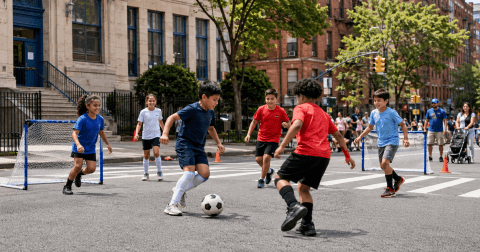
New York began to experience the 2026 World Cup before the first whistle. Not in a stadium, not on a giant screen, but on the streets in front of public schools.
The city launched Soccer Streetsan initiative that will transform car-free school blocks at temporary soccer fields, art spaces and community celebrations for students from all five boroughs. The program will tour 50 public schools until the last day of school, June 26, as part of local preparation for the 2026 FIFA World Cup.
The proposal seeks to bring the globalist climate directly to the neighborhoods, in a city that expects a strong presence of fans during the tournament. Although the New York-New Jersey area games will be played at MetLife Stadium in East Rutherford, New Jersey, the city wants the cultural and community impact to also be felt in its schools, streets and public spaces.
How Soccer Streets will work
According to the official official announcement, Soccer Streets will be a traveling series of school days. At every stop, the street in front of a school will be closed to traffic and converted into a safe play space for children and adolescents.
Activities will include soccer, art stations and block party-style celebrations. The initiative began on May 1 and will continue school by school until June 26.
the city does not propose closing all 50 streets at the same time nor permanently. It is about mobile activations in different establishments, with temporary closures during activities. Streetsblog also reported that some of these blocks will be added to the existing car-free school streets program.

You can see: Working at the 2026 World Cup in the US without permission can be expensive: fines, deportation and immigration ban
Why do they do it before the World Cup?
The 2026 World Cup will be the first with a shared venue between USAMexico and Canada, and the New York-New Jersey area will be one of the main regions of the tournament.
The city has already announced free World Cup events in the five boroughs with the host committee NYNJ, as part of a strategy to extend the experience beyond the stadium and bring it closer to communities that may not be able to pay for tickets or travel to the games.
In this framework, Soccer Streets functions as a political and community signal: The World Cup will not only be for tourists, sponsors or massive fan zones, but also for students and families of neighborhoods where football is part of daily life.
You can see: Why Texas is a good place to watch a 2026 World Cup match
Football, school and safer streets
The initiative also connects to a broader discussion in New York: how to use school streets as safe spaces for children.
Over the past several years, the city has expanded open streets, school streets, and car-free activities programs to reduce traffic risks, gain public space, and promote outdoor recreation. Soccer Streets takes advantage of this urban infrastructure and puts it at the service of a world event.
The approach has a strong point: it does not require building stadiums or large works. United States a block, cones, temporary arches, non-public support and community programming. For a city with little available space, converting a street into a court for a few hours may be more realistic than waiting for new sports facilities in each neighborhood.
You can see: Casa México Los Ángeles will screen live matches from the 2026 World Cup
Which schools will participate
The city reported that The program will reach 50 public schools in the five boroughs, but the calendar may vary depending on the logistics of each school community. Events are free and that streets will be closed to allow students to play soccer, make art and participate in community activities.
For families, the most practical thing will be to consult directly with their children’s school or with the official channels of the New York Department of Education and Department of Transportationsince the activations do not function as a permanent open park, but rather as scheduled days.

A World Cup that is also played in the neighborhoods
Football has an advantage that few public policies achieve: it attracts people without much explanation. In New York, where Latin American, African, European, Asian and Caribbean communities coexist, pelota usually functions as a common language.
That is why Soccer Streets can have a value that goes beyond the World Cup preview. If the program works, it could leave a question: how many School streets could more frequently become safe spaces for play, coexistence and physical activity for children who grow up in neighborhoods with little access to courts.
The World Cup will pass. But the need for children to have somewhere to play will continue to be an everyday discussion.
Continue reading:
Katy Perry, Maná and more celebrities will headline the opening ceremonies of the 2026 FIFA World Cup
Neither the US nor Canada: this is the fan base that will dominate the 2026 World Cup
Cristiano Ronaldo’s physical secret at 41: why he doesn’t drink milk and what foods he avoids


