
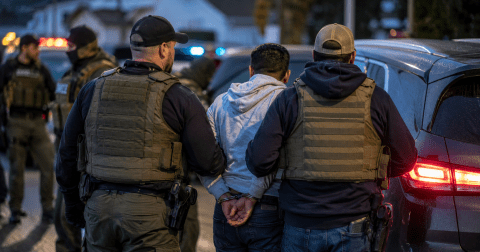
ICE raids stopped occupying the center of the national conversation every day, but In many immigrant communities, fear did not subside. It changed its form: fewer cameras, fewer press conferences, more silence at home, at work and on daily routes.
In states of the central and southern United States, Community organizations report families who avoid driving, workers who are absent for fear of controls, parents who prepare emergency plans for their children and businesses that train their employees for possible encounters with immigration agents.
The data that explains this tension is concrete. According to information obtained by the Deportation Files Project, cited by KCUR/NPR Midwest Newsroom, immigration arrests increased sharply since the beginning of Donald Trump’s second term. States like Iowa, Missouri, Kansas, Oklahoma and Texas recorded increases of more than 30% as ICE operations intensified.
The Deportation Files Project obtains data directly from US government immigration agencies through requests under the Freedom of Information Act, known as FOIA. That is, it is “government data provided by ICE in response to a FOIA request.”
Fear moves outside the big cities
For years, immigration raids were primarily associated with large urban areas and border states. But the new photograph is broader. Fear spread through medium-sized cities, rural areas, agricultural corridors, restaurants, factories, churches, schools and small businesses in the Midwest and the Great Plains.
KCUR reported that, although the federal raids fell off the media radar, immigrant communities in that region remain on alert. The increase is not concentrated in a single point: Iowa, Missouri, Kansas, Oklahoma and Texas appear as states where arrests grew more than 30%, according to data analyzed by the Deportation Files Project.
In Missouri, the impact was already seen before. KCUR reported in April that more than 3,200 people from nearly 80 countries had been arrested by ICE in the state since January 2025.according to new figures obtained through a public records lawsuit and released by the Deportation Files Project.
The reading for immigrant communities is clear: the risk is no longer perceived only on the border or in highly visible sanctuary cities. It also appears in states where Local collaboration with federal authorities can cause a traffic stop, a minor arrest or a visit to court to end in immigration proceedings.

Texas, one of the most sensitive hotspots
Texas occupies a central place due to its migratory weight, its border with Mexico and the magnitude of its Latino population. But also because it combines large cities, rural areas, industries with a high presence of immigrant workers and a tougher state policy of cooperation with federal enforcement.
For many families, the concern is not abstract. A raid or arrest can mean family separation, immediate loss of income, difficulty paying rent, children left without a caregiver, and legal proceedings that are difficult to afford.
Although the increase in arrests does not mean that all immigrants are under the same level of risk, it does change the social climate. Fear of ICE can change daily decisions: whether or not to take your children to school, whether or not to go to the doctor, whether or not to report a crime, whether or not to drive to work.
You can see: What it is like to live in fear of ICE
Not all operations are traditional “raids”
One of the important points is to distinguish between mass raids and immigration arrests. Many arrests do not occur like the operations that people imagine—agents entering a work site or surrounding a neighborhood—but rather through contacts with local authorities, prior arrests, controls, courts, or targeted actions.
The Deportation Files Project collects and processes data on ICE arrests, detainers, detentions, encounters, and removals, with information available through early March 2026 in its latest data update.
You can see: Raids in Las Vegas: what is really happening and who ICE is looking for
There are also signs that the national pattern has changed rapidly. Spectrum Native News reported that ICE arrests peaked near 40,000 in December and then fell nearly 12%. following internal changes and criticism of federal tactics, according to data provided to the Deportation Files Project and analyzed by The Associated Press.
That doesn’t eliminate the impact. Even with subsequent declines, enforcement levels remain high enough to sustain fear in immigrant communities.

You can see: Can they arrest you without a court order?
What immigrants should know if ICE comes to their home or work
The service part is key: knowing rights does not alone stop a raid, but it can prevent serious mistakes.
The ACLU reminds that people have constitutional rights in the United States regardless of their immigration status. Among them, the right to remain silent and not discuss immigration status or citizenship with agents without consulting a lawyer.
If ICE agents arrive at a home, civil rights organizations recommend not opening the door automatically. The ACLU indicates that a person can ask to have the order shown under the door or through a window. To enter without consent, officers need a valid warrant signed by a judge; An ICE administrative order is not equivalent to a court order to enter a home.
He Nationwide Immigrant Justice Center It also warns that people have the right to remain silent and that anything they say can later be used in immigration court. The organization recommends not opening the door to immigration agents without an order signed by a judge and teaching children not to open the door.
In a workplace, the basic recommendation is to stay calm, do not run, do not argue and do not resist. ACLU DC notes that ICE needs a court order or permission from the employer to enter private areas of the business, such as a kitchen or warehouse not open to the public.
You can see: ICE renounces express training for its new agents.
What to do if someone is detained by ICE
If a person is detained, the recommendation of legal organizations is to ask to speak with a lawyer, do not sign documents that you do not understand and request an interpreter if you need one. It is also advisable for the family to have the foreigner’s number, known as A-number, on hand, if the person already has an immigration file.
The ACLU insists on another practical point: do not lie, do not present false documents and do not falsely claim to be a US citizen. These decisions can worsen the immigration case and bring more serious legal consequences.
This type of information is not a substitute for true advice. But it does help to prepare a family plan: who picks up the children, where important documents are, which lawyer to call and which trusted person can act if someone does not return from work or a court date.
You can see:
Children afraid to go to school: pediatricians warn about the impact of the raids in the US
Are there nationalities more controlled by US immigration authorities?
Las Vegas raids: what’s really happening and who ICE is looking for
Texas tightens construction controls: what happens if you work without a license from May 1


