
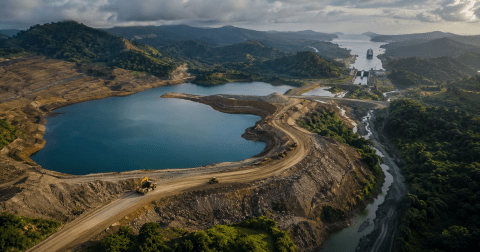
He Panama Canal faces an unseen threat that could disrupt world commerce in a matter of weeks: lack of water
After the historic crisis of 2023, when a drought forced the passage of ships to be restricted and caused delays that impacted international logistics chains, Panama is moving forward with one of the most important infrastructure decisions in recent years: building a new synthetic lake to reinforce the Canal’s water supply.
The project, known as Indian River reservoirseeks to guarantee the water resource necessary to operate a route through which approximately 5% to 6% of global maritime trade passes, according to estimates widely cited by maritime sector organizations and Panamanian authorities.
The Panama Canal Authority maintains that the challenge is no longer hypothetical. Climate change, the variability of rainfall and the increase in demand for drinking water force structural decisions to be made.
You can see: It’s not just an expansion: the South American airport that wants to compete with the big hubs in the world
Why the Panama Canal needs so much water
Although millions of people associate it with ships crossing between oceans, few know a key fact: The Panama Canal works thanks to fresh water.
Each transit through its locks uses enormous volumes of water coming mainly from Gatun Lake, the large synthetic reservoir that feeds the system. When it rains less than expected, the balance is broken. That happened strongly in 2023.
The combination of the El Niño phenomenon and well-below-average rainfall led the Canal to impose historic restrictions. The Canal Authority temporarily reduced the number of ships authorized to cross each day, creating bottlenecks and forcing shipping companies to rethink routes.
Reuters reported at the time that some vessels faced waits of several days and that logistics costs rose significantly due to congestion and detours.
For a country whose economy largely revolves around this infrastructure, The signal was clear: Relying only on rain was no longer enough.

You can see: Will Panama build a tunnel under the Canal? What is known so far
What will the new synthetic lake be like?
The official answer is Indian River projectapproved as part of a long-term water strategy. The initiative contemplates the construction of a new reservoir in the Indio River basin, located west of the Canal, with the objective of transferring water to Gatun Lake and thus reinforcing both the canal operation and the supply for human consumption.
The megaproject includes a 4,600-hectare lake and a 9 km transfer tunnel. According to the Panama Canal Authority, the estimated investment is around $1.6 billion. The schedule projects initial stages from 2027, with works that would extend over several years.
The Canal’s administrator, Ricaurte Vásquez Morales, has publicly defended the project as a strategic necessity and not as an optional expansion. “We cannot remain immobile in the face of climate reality,” has been the line of argument repeated by the Panamanian authorities in different official presentations.
Why is there talk of a work “inspired by China”
Many analysts associated the project with large Chinese hydraulic developments. The reference points to the logic behind these works: redirect and store water on a large scale to sustain economic activity, cities and critical infrastructure.
For decades, China developed gigantic water transfer systems to supply regions with water stress. Although the Panamanian case is much smaller in scale, it shares the opinion of aggressively intervene in the natural water system to protect strategic assets.
Technically, more than a copy, it is a similar solution to a comparable problem: how to guarantee water when the climate is no longer predictable.
The human cost of the project
The most sparkling aspect is not in the engineering: it is in the communities. The construction of the reservoir would involve the resettlement of families living in the Indio River basin.
Different reports indicate that thousands of people could be affected directly or indirectly, depending on the ideal design and the definitive territorial scope.
The Canal Authority affirms that there will be compensation, relocation and dialogue processes, but different social organizations and community leaders expressed their concern. They warn of possible displacement, loss of productive land and impact on rural ways of life.
That debate is just beginning.
Why this matters outside of Panama
When the Panama Canal has problems, the impact does not remain in Panama. Ships that transport products to the United States, Latin America, Asia and Europe depend on this route to save time and costs.
When traffic slows down, shipping companies must choose between waiting or taking much longer journeys, such as rounding South America around Cape Horn. This makes operations more expensive and may end up being reflected in the prices of consumer goods.
In other words: a synthetic lake in Panama may seem like a local story, but it has global consequences.
Continue reading:
They build the deepest Metro in Latin America: stations 65 meters underground
A historic airport closes in California: what will happen to the area and who it affects


