
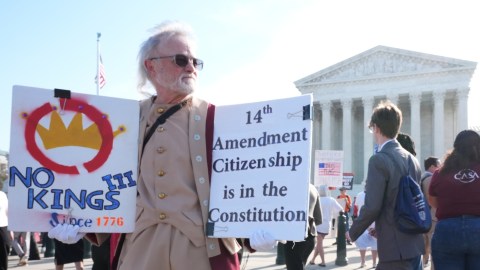
On the first day of his second term, the president Trump issued an executive order attempting to end the right to birthright citizenship in the United States.. The order is clearly unconstitutional, as it violates the Fourteenth Amendment guarantee that all persons born in the United States are citizens.
It also threatens to cause serious harm, particularly to Latino communities and all long-established American people, as demonstrated by the numerous writings of amicus curiae presented in the recent Supreme Court case challenging the executive order. If this order were ever to go into effect, it would deny children critical constitutional protections and important services, while setting the stage for more deportations.
Yes ok The order remains blocked while the Court reflects on the casethese writings and other recent studies remind us that we must remain alert about the real threats that these attacks by the administration against citizens represent.
Latino communities are the most vulnerable to this Trump executive order. Under its technical terms, the order would deny citizenship to any future children born in the U.S. to undocumented immigrants and to any children of parents who are in the country with temporary legal authorization, such as a study or work visa. That makes the order much more harmful to Latino families.
A study that appears in the writings revealed that, in the short term, Latino communities would end up accounting for almost 80 percent of all “unauthorized births”that is, births to undocumented parents. By 2050, Latinos would make up more than 90 percent of “unauthorized persons” born in the United States. This is expected to be a very large group: another study predicts that, in the next 20 years, “at least 750,000 children will be born… to undocumented or temporary immigrant mothers and fathers of any race or ethnicity.
The order would deny these future children constitutional rights that have been in place for centuries. The Fourteenth Amendment guarantees citizenship to all children born in the United States, with only a few exceptions, and has done so since 1868. Many long-standing federal laws and Supreme Court case law have also recognized this right. The executive order would put an end to all of this if it ever goes into effect.
The loss of those rights would create what the organization LatinoJustice PRLDEF and 22 other groups have described as a “racialized immigration system,” where Latino people would be mostly relegated to a lower social class, due to their lack of citizenship. Without citizenship, these children would not be able to enjoy fundamental legal rights and protections, such as protections against deportation, guarantees that become especially important as the Trump administration accelerates and intensifies its aggressive attempts to deport noncitizens.
They would also not be able to receive the benefits of numerous federal and state programs and services, according to a brief presented by a group of local governments and leaders. For example, they would not be able to participate in federal health insurance programs such as Medicaid and the Children’s Health Insurance Program (CHIP).
Then, The health of Latino girls and boys would be in great danger. Without health insurance, noncitizen children would be less likely to receive preventive health care, such as health checks and vaccines that protect them from preventable diseases.
Additionally, according to local governments and leaders, these children would also lose access to federal nutrition assistance benefits, such as the Supplemental Nutrition Assistance Program (SNAP), which is the “nation’s largest anti-hunger program.”
Another brief filed by the Aoki Middle Foundation for Severe Rice and Nation Stories explains that they could also lose the ability to obtain legal employment, participate in state financial or tuition assistance programs for their education, and have access to everyday aspects of civic and economic life, such as obtaining a driver’s license or buying a home.
As adults, these children would also not be able to vote or serve as jurors. As the organization LatinoJustice PRLDEF explains, it is “a threat against the very institution of government” to impose the laws of a country on a group of people and, at the same time, “deny them the ability to participate in [el] democratic process” in which they live immersed.
Furthermore, in the worst case scenario, a group of health professionals and non-profit associations warn, some children could become stateless. As stateless people, no nation would recognize them as its citizens. These children could end up being deported to foreign countries where they have never lived.
However, the Trump administration’s attempts to deny citizenship to these newborns do not only threaten Latino communities in the United States. Combined with this administration’s aggressive efforts to deport noncitizens, these practices also threaten the entire American people of which Latino communities are a part.
Latinos are essential to the current labor market, as LatinoJustice PRLDEF and other organizations demonstrate. They make up forty eight.7 percent of the labor market of foreigners in the country. and the men Undocumented Latinos are 26 percent more likely to participate in the labor force than men born in the United States. They often fill essential jobs that many of us in the United States depend on, such as child care and manual labor in the agricultural and construction sectors. Trump’s citizenship and immigration policies threaten to leave these jobs empty.
Latino immigrant communities also share the tax burden in the country. As the organizations explain, “in 2022, immigrants—the majority of whom are Latino—paid more than $579 billion” in taxes, and undocumented immigrants paid more than $31 billion in taxes for Social Security and Medicare. These tax revenues would be reduced—or perhaps disappear entirely—under the Trump administration’s policies.
President Trump’s executive order threatens to do all of this damage and more if it is ever allowed to go into effect.
For now, the courts have blocked it. The Supreme Court is expected to issue its final decision on the fate of this order before July 4.
Thomas Wolf He is Director of Democratic Initiatives, and Maryjane Johnson
Program Associate, Democracy at Brennan Middle for Justice.


