

By The Opinion
Donald Trump’s Administration accelerates negotiations with Iran to reach a temporary agreement to reduce tension in the Middle East before the expected visit of the US president to China, scheduled for May 14 and 15.
According to reports from CNN and Reuters, Washington and Tehran are working on a preliminary memorandum aimed at ending the war and opening a broader negotiation window on the Iranian nuclear program and the reopening of the Strait of Hormuz, one of the main energy corridors on the planet.
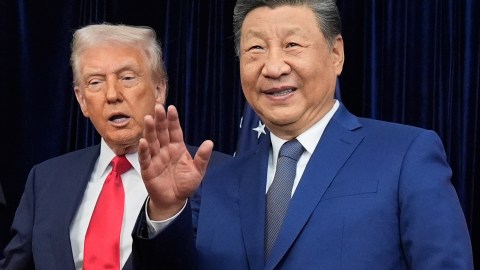
The White House seeks to prevent the regional crisis from dominating the agenda of the meeting between Trump and Chinese President Xi Jinping, where sensitive issues such as trade, technology, tariffs and restrictions on semiconductors will also be discussed.
According to Reuters, The draft under discussion contemplates three phases: “the formal end of hostilities, the resolution of the blockade in the Strait of Hormuz and a 30-day negotiation for a broader agreement.”
The rapprochement between Washington and Tehran coincides with the visit to Beijing of Iranian Foreign Minister Abbas Araqchí, who held meetings with the head of Chinese diplomacy, Wang Yi.
During the meeting, Wang assured that the Middle East is going through a “decisive turning point,” while Araqchí affirmed that the reopening of the Strait of Hormuz could be resolved “as soon as possible,” in a gesture of coordination with Beijing.
China depends heavily on stability in Hormuz. Nearly forty-five percent of the Asian giant’s energy imports transit through this strategic maritime route, which turns the war into a direct economic problem for Beijing.
Professor at the National University of Singapore, Ja Ian Chong, considered that Chinese diplomatic movements seek to “strengthen Beijing’s hand” before Trump’s visit.
According to the analyst, If Washington needs China’s support to stabilize the conflict with Iran, Xi could take advantage of the situation to demand concessions on technological and trade issues.
Trump seeks to avoid an image of weakness
Trump has publicly insisted that he maintains a “very good relationship” with Xi Jinping and assured this week that China has been “very respectful” regarding the Iranian conflict.
The Republican president also acknowledged that there is a “very good possibility” of reaching an agreement before his arrival in Beijing.
However, analysts warn that an open and unresolved conflict could weaken the United States’ negotiating position during the bilateral summit.
“If Trump arrives in Beijing still distracted by an unresolved conflict in the Middle East, he will have less room to declare the victory he wants,” Chong explained.
The war already forced the postponement of Trump’s previous visit to China last March, while Washington concentrated military and diplomatic efforts in the region.
Keep reading:
• Trump says war with Iran is over and avoids Congressional deadline on military authorization
• Iranian leader says Persian Gulf will have a future without the United States
• “We will win no matter what,” warns Donald Trump about war against Iran


