
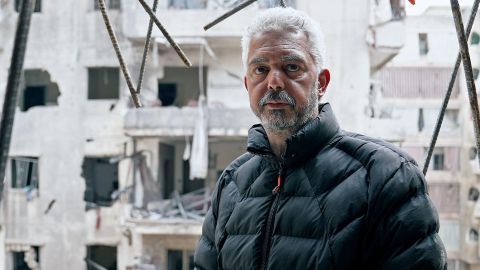
The neighborhood of Hay el Sellom, in the southern suburbs of Beirut, Lebanon, is almost unrecognizable.
What was once a cheerful, densely populated community is now a panorama of collapsed concrete, twisted metal and exposed wires. Houses have been reduced to layers of rubble. Stairs that lead nowhere. The sounds of everyday life have been replaced by silence.
Despite repeated Israeli attacks since the start of the war in Iran against other parts of Beirut’s southern suburbs, where Hezbollah holds sway, residents say this neighborhood remained calm until the afternoon of April 8.
The suburbs in southern Beirut have been subjected to repeated evacuation orders and airstrikes from Israel since the start of the war, but residents told the BBC that few left Hay el Sellom, having nowhere else to go. They also said this neighborhood had remained relatively calm.
That Wednesday, Mohammed’s son Abbas was sleeping at home when the building came under an Israeli airstrike. “The three floors above mine fell on top of a room,” says Mohammed. “Everyone broke down…on him.”
It was part of a wave of deadly attacks that began at 2:15 p.m. local time and hit some 100 targets across Lebanon in just 10 minutes, according to Israel.
The destruction caused in this short space of time surpassed that of any other day in this war. Targets included Hezbollah command centers and military sites, but casualties included many Lebanese civilians.
The day’s death toll reached 361, according to Lebanese authorities, with more than 1,000 injured.
“This is the second house I have lost”
In the weeks after the attack, the BBC visited some of the affected areas to work out what happened that day. We meet Mohammed in the ruins of his apartment.
“This is the second house I have lost,” he says. “In the last war (in 2024) I lost a house. And in this war I lost another.”
“I wish it was just my house that I lost, and that my son had survived. These bricks can be rebuilt. But nothing will bring my son back to me.”
He insists that all those who died were residents of the building. “If I thought there was even a 1% chance that someone from Hezbollah would live here, I wouldn’t have stayed,” he says. “I would never have risked my son’s life.”
“Maybe, since I’m forty-five years old, I wouldn’t have worried about the risk to myself, but I wouldn’t have put a young man with his whole life ahead of him to live in a building if I knew that someone (from Hezbollah) was there.”
After his son’s death, Mohammed expressed his sympathies for Hezbollah in an interview with local media, asking it to defend Lebanon. That is a sentiment echoed by many people we spoke to in areas that have been consistently attacked by Israel.

Hezbollah – an Iranian-backed militant group and political party based in Lebanon – launched rockets towards Israel on March 2, in response to US and Israeli attacks on Iran. What followed was that Israel occupied large areas of southern Lebanon and launched attacks in an attempt to destroy Hezbollah’s leadership.
A temporary ceasefire between the US and Iran was announced early on April 8, a pause in a broader regional war that had already transformed the Middle East.
Although Israel claimed that Lebanon would not be included in that agreement, the population in the area was cautiously hopeful, until the onslaught began.
“Everything was silent”
By analyzing verified videos, social media posts and satellite images, and comparing them with eyewitness testimonies, we have identified at least five attacks that hit Hay el Sellom in rapid succession.
Some Israeli media reported that Ali Mohammed Ghulam Dahini, whom they identified as a top Hezbollah commander, was hit in the neighborhood. We also found a tribute poster that pictures him as a combatant of this militia group.
We asked the Israel Defense Forces (IDF) if Dehini was targeted, but they did not answer the question and did not provide specific information about who or what was targeted in Hay el Sellom.

What is clear is the magnitude of the civilian casualties. Lebanon’s Health Ministry told the BBC that more than 80 people died in this neighborhood. Our analysis shows that at least 15 of those killed were children.
The narrow streets that cut through the motley buildings in Hay el Sellom slowed rescue attempts. Residents describe how many people were trapped in the rubble, crying out for help, sending messages and hoping they could be helped.
One of the first to arrive at a nearby hospital was Ghassan Jawad. He was asleep when the building collapsed on top of him and his family.
“Suddenly I found myself underground,” he says. “I thought he died.” Remember the sound of people screaming. “I started praying because I knew I had come this far.”
Then, he continues, something unexpected happened. “My cat started digging. She made a small hole so she could breathe.”
After about 10 minutes, he heard voices above, as neighbors began digging through the rubble. “They brought hammers and metal bars,” he says. “They took me out.” But others did not survive.
“I could hear people dying,” he says quietly. “I heard my mother praying next to me… then her voice stopped.” His mother, two sisters and his children all died. “Everything was silent,” he says. “Completely silent.”
Simultaneous attack
Just over six kilometers away, in central Beirut, another neighborhood was also attacked, Corniche al Mazraa, one of the busiest areas of the city.
At 2:15 p.m., life continued its course: clients were participating in a gym class, a restaurant was preparing food and a hairdresser was in the middle of a cut, as shown in images from several security cameras.
Then, without warning, the explosions came, killing 16 people, according to the Lebanese Ministry of Health.
It was the first time this neighborhood had become a target in this war.
Noha, a fitness trainer, was teaching a class on the seventh floor when two bombs fell on the warehouse of a clothing company, producing a powerful explosion that damaged surrounding buildings.

The woman had frequently observed from a distance how the southern neighborhoods of the Lebanese capital were attacked, but she never thought that these attacks would reach the heart of the city. “For us, this happened without warning,” he says.
“I looked out and found the world was black. I found people covered in blood. I found people on the floor.”
Noha questions why they attacked the area. “The target was civilian. Definitely, a civilian target,” he says. “We were the ones attacked.”
The BBC investigated whether there was evidence of a Hezbollah target in the area, but could not find it. He also asked the IDF, but they did not respond.

dead sisters
The BBC has identified at least four other attacks that occurred within a 1.6km radius of the gym.
Across the country, similar scenes were taking place in the same brief 10-minute space. From Hermel in the north, through the Bekka Valley to villages in the deepest south, attacks were reported almost simultaneously.
The southern city of Sidon was one of those attacked without warning, with bombs flattening the Hezbollah-affiliated Al Zahraa religious complex.
Rahma, 27, and Rayan, 22, young women from a family forced to flee their home near the border with Israel, were visiting a mosque when the attack occurred.

“They said they were going to pray,” says his mother, Kawkab. “Half an hour later, the complex received an impact.” Both girls died.
“We came here for safety,” adds Kawkab.
Al Zahraa cleric Sheikh Sadiq Naboulsi was also killed in the attack. He had close ideological and family ties with Hezbollah, although he did not hold an official position. Another man killed there, Mohammed Ma’ani, was a senior Hezbollah official in the group’s liaison and coordination unit. The IDF refused to confirm whether either of the two men were intended targets.
It has also not been possible to identify seven of the other nine dead individuals reported at the scene. All available evidence suggests they were civilians.

The IDF reports that it attacked 250 Hezbollah operatives that day but has not provided a complete list of their names. Lebanon’s Health Ministry disputes that, noting that the vast majority of those killed were civilians.
When asked what measures they take to protect civilians, the IDF indicated that it made “great efforts to mitigate harm to uninvolved individuals.”
The IDF also stated that most of the targets were located “within the heart of the civilian population, as part of Hezbollah’s cynical exploitation of using Lebanese civilians as human shields to protect its operations.”
Hezbollah denies this, highlighting that Israel attacks civilian targets as a pressure tactic. The group, banned as a terrorist organization by the United Kingdom, the United States and some Arab countries, added that it never wanted war and was acting in self-defense.
On April 8, Israel claims it struck 100 targets in the span of 10 minutes, producing one of Lebanon’s deadliest days in decades. More than 360 people were killed and more than 1,000 injured that day, the Lebanese government claims.
Israel called the operation “Eternal Darkness.” For the Lebanese people who experienced it, it is known as Black Wednesday.
With additional reporting by Jasmin Dyer and Jake Tacchi.

click hereto factor in more stories from BBC News Mundo.
Subscribe hereto our new e-newsletter to receive a selection of our best content of the week every Friday.
You can also follow us on YouTube, instagram, TikTok, x, Facebookand in our whatsapp channel.
And remember that you can receive notifications in our app. Download the latest version and activate them.
- “When I hear the bombings, my mother tells me not to be afraid, but I feel like she is shaking with fear”: the harsh testimonies of children trapped in the conflict in the Middle East
- Satellite images showing how Israel has devastated entire towns in southern Lebanon
- Israel says prepared for “extremely powerful” operation on Lebanon border as tensions rise with Hezbollah


