
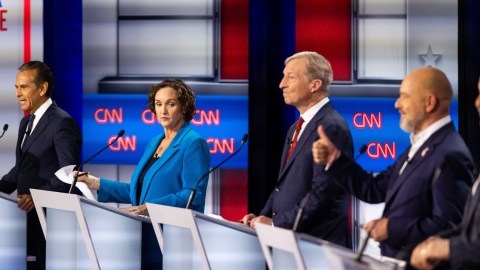
The meeting, organized by CNN, brought together Republicans Chad Bianco and Steve Hilton, as well as Democrats Xavier Becerra, Matt Mahan, Katie Porter, Tom Steyer and Antonio Villaraigosa, andn a debate marked by deep differences on key issues such as taxes on the rich, immigration and the relationship with the federal government, less than a month before the June 2 primary elections.
One of the central axes was the high cost of living in the state, particularly the price of gasoline, which exceeded $6 dollars per gallon on the same day of the debate. The positions showed a strong polarization: several Democrats, including Becerra, attributed the rise to President Donald Trump and to international factors such as the war in Iran, while Republicans blamed state policies.
Hilton defended that it could reduce the price to $3 per gallon, prompting Mahan’s response: “You’re lying to people.”
The tone of the debate was confrontational, where the name of the national leader dominated the night. “Donald Trump is the president in all the other states where the cost of living is much lower than in California,” replied Hilton, who has the president’s support. Amid the interruptions, Porter intervened: “Guys, guys, enough arguing.”
However, Becerra stated: “I am going to repeat Donald Trump’s name as many times as necessary because he is the real threat we have in California.”while Porter bluntly expressed: “Donald Trump sucks.”
Millionaire tax
One of the central themes was the call Billionaire Tax Actan extraordinary tax aimed at the state’s largest fortunes. Congresswoman Porter supported the measure by stating that the richest should contribute more, although she warned that “it will not fundamentally change California’s economy” as it is a one-time tax. For his part, Steyer agreed to support it, but considered that “it does not go far enough.”
While Mahan criticized his fellow Democrats for focusing on expanding government rather than making it more efficient.
The cost of living in California is a critical issue and the central axis of the political and social debate ahead of the 2026 elections, characterized by an affordability crisis that has driven a high level of emigration to other states.
According to analysts, accumulated inflation has exceeded 90% since 2000, drastically reducing the purchasing power of residents.
CNN CA GOVERNMENTAL DEBATE:
We are now not going to proceed to vote the identical blueprint but inquire of diversified outcomes. Ballots are out and the assorted is California’s. We are now not going to undergo four more years of failed insurance policies. pic.twitter.com/LdzyzjpLxL— Steve Hilton (@SteveHiltonx) Can also 6, 2026
Migration, epicenter of the meeting
During the debate, The immigration issue generated one of the most tense exchanges. The moderator asked Republican Steve Hilton if he would push for the deportation of undocumented farm workers in California, in reference to the tightening of immigration policy under the government of Donald Trump.
Hilton responded by highlighting his inner experience: “I’m the only immigrant in this scenario. I’m a proper immigrant.” He added that, in his opinion, Americans support immigration when it is “properly controlled” and He stressed that decisions in this matter correspond to the federal government, with which, he assured, he would collaborate to enforce the law.
In contrast, Katie Porter defended that the governor’s role is to guarantee the protection of all state residents, regardless of their immigration status.
The debate also addressed “sanctuary state” policies. Antonio Villaraigosa stated that these laws do not “protect violent criminals.” Likewise, California’s attempt to prohibit federal agents from wearing face masks during operations was discussed, a measure that was blocked by a federal judge.
Chad Bianco questioned the state’s authority to impose that restriction, although he acknowledged that in “certain circumstances” it allows that practice within its jurisdiction.
For his part, Xavier Becerra adopted a tougher stance when asked about possible legal actions against ICE leaders: “I think we should supervise Donald Trump’s masked mercenary force they call ICE.”
Thus, with markedly opposing positions and without consensus, the debate made it clear that the race for governor of California is entering its decisive phase, with a polarized electorate and multiple fronts of discussion that will define the political course of the state, in a contest, considered the most open in decades after the upcoming departure of Governor Gavin Newsom.
Keep reading:
· Nine candidates for governor of California, face to face in debate
· Antonio Villaraigosa’s options in the electoral campaign
· Two Republicans and one Democrat lead poll for California governor


