
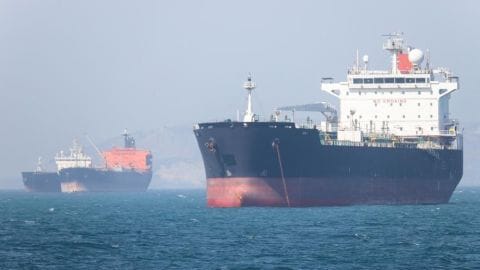
President Donald Trump announced that the United States will help “guide” ships that have been stranded in the Strait of Hormuz due to the war with Iran.
The sea passage has remained virtually blocked since the US and Israel launched airstrikes against Iran, which responded by closing the largest strait through which 20% of the world’s oil and liquid gasoline used to pass.
It is a narrow route in the Persian Gulf region, one of the most important shipping routes in the world. It borders Iran to the north and Oman and the United Arab Emirates (UAE) to the south, connecting the Gulf region to the Arabian Sea.
Its waters are deep enough for the world’s largest crude oil tankers and it is used by the Middle East’s major oil and gas producers, as well as their customers.
Trump called his ship protection initiative Project Freedom, but experts believe that, as proposed, it could lead to a resumption of hostilities with Iran.
What did Trump say?
The president stated that countries “from all over the world” asked the United States to help free their ships, which are “trapped in the Strait of Hormuz” and are “mere neutral and innocent bystanders!”
Therefore, in response, he said the US will “guide its vessels safely out of these restricted waterways.”
“The movement of the ships has the sole objective of freeing people, companies and countries that have done absolutely nothing wrong; they are victims of circumstances,” Trump said in a post on his Truth Social platform.
He added that this is “a humanitarian gesture on behalf of the United States, the countries of the Middle East, but, in particular, the country of Iran,” since many of these ships are running out “of food and everything necessary so that large crews can remain on board in a healthy and hygienic manner.”

What is Iran’s response?
Trump’s announcement appears moderate compared to previous statements against Iran.
He even implies that Iran is part of the operation: the president even went so far as to say that Project Freedom is also undertaken on behalf of Iran.
But in Tehran they don’t see the operation that way.
A statement from the head of Iran’s central command said it would attack “any foreign armed force” attempting to approach or enter the strait, “especially the aggressive US military.”
Senior minister Ali Abdollahi said Iran has “repeatedly” stated that the Strait of Hormuz “is under the watchful eye” of the Iranian armed forces, and that safe passage through it must be coordinated with them “under all circumstances.”

Is the plan already in motion?
An estimated 20,000 sailors and 2,000 ships have been trapped in the Persian Gulf since the start of the war with Iran, according to the International Maritime Organization, a U.N. agency that regulates shipping.
There is growing concern about dwindling supplies and the effects on the physical and mental health of sailors.
But Trump did not say how they could move forward. He only threatened to use force “if, in any way, this humanitarian process is interfered with.”
Hours later, US Central Command (Centcom) announced that “missile destroyers, more than 100 land- and sea-based aircraft, multi-domain unmanned platforms, and 15,000 military personnel” would be used to support the operation.
The statement does not specify how the set of resources and personnel would provide support to the ships.
If US protection is intended to be an offer of information and advice to ships and their crews, that may be of little help given Iran’s ominous threats to attack them.
If, on the other hand, the US attempted to provide the affected ships with a military escort, this could once again place them in direct military confrontation with Iran.
Hours after the US operation supposedly began, the Iranian military declared: “Thanks to a firm and prompt warning from the Islamic Republic Navy, US and Zionist enemy destroyers have been prevented from entering the Strait of Hormuz.”
Shortly afterward, Centcom denied Iranian claims that one of its warships was hit by two missiles.

The United Arab Emirates – a US ally in the Gulf, which has been frequently attacked by Iran during the war – said that an oil tanker affiliated with Adnoc, its state oil company, was targeted by two drones while transiting the Strait of Hormuz.
No one was injured, the country’s Ministry of Foreign Affairs reported in a statement.
It is unclear whether the tanker’s movements were permitted by the US as part of Project Freedom.
This Monday, Centcom stated that US Navy missile destroyers were operating in the Persian Gulf “after passing through the Strait of Hormuz in support of Project Freedom.”
He added that U.S. forces are “actively collaborating in efforts to restore commercial shipping transit,” but did not provide further details.
“As a first step, two US-flagged merchant ships have successfully crossed the Strait of Hormuz and continue their journey safely,” Centcom also stated.
Once again, no details were released regarding the identity of the merchant vessels.
Iran has drastically restricted traffic through the strait since the war began, allowing only a handful of ships to pass through, mainly from countries allied with Tehran.
- Why the Strait of Hormuz is Iran’s most powerful weapon in the war against the US
What is happening in the strait?
A ceasefire aimed at allowing the parties to reach an agreement to end hostilities is currently in force, but there has been little progress.
Iran has strongly opposed the United States imposing a naval blockade on Iranian ports.
The BBC spoke on Sunday with the captain of the tanker Ramoon Kapoor, one of those trapped, who claimed to have seen “several attacks, several missiles, explosions” and stated that the situation was “quite tense.”
He also noted that his crew suffers from considerable stress and anxiety.
The UK Maritime Trade Operations Center has warned ships attempting to transit the Strait of Hormuz that they face “critical” security threats due to “ongoing regional military operations” as well as “the proximity and dangers of any mines or threats reported along planned transit routes.”
Trump’s announcements during the conflict have often influenced markets, particularly the price of oil.
However, his announcement of Project Freedom did not provoke any immediate reaction.
There was a rapid rally following Iran’s claim to have hit a US warship and subsequent US denial, but overall the price of a barrel of Brent crude has remained well above US$100, more than 50% above its pre-war level.

click hereto learn about more stories from BBC Files World.
Subscribe hereto our new publication to receive every Friday a selection of our best content of the week.
You can also follow us on YouTube, instagram, TikTok, x, Facebookand in our new whatsapp channel.
And remember that you can receive notifications in our app. Download the latest version and activate them.
- “Iran will never give up control of the Strait of Hormuz”: the BBC interviews the former commander of the Revolutionary Guard in Tehran
- From the Strait of Hormuz to the Strait of Malacca: the 5 narrow navigable waterways on which world trade depends


