
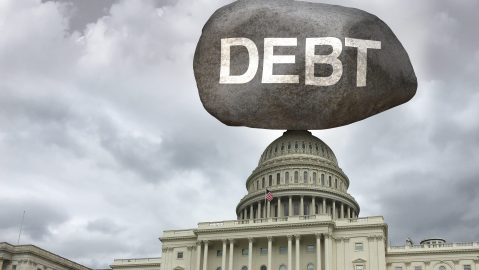
When you hear that a country owes money, it sounds far away, it seems unreal. However, it is more common than we think. But when that debt is already larger than everything it produces in a year, no one would think about it, especially if we are talking about the United States. Well, that’s just what’s happening now. And although it sounds technical, This has very real implications for those who live and work in this country..
At the moment, The national debt in the hands of the public reached $31.27 trillion dollars, while the Gross Domestic Product (GDP) stood at $31.22 trillion in the period from April 2025 to March 2026.. It is the first time something like this has happened since World War II, according to the Committee for a Responsible Federal Budget (CRFB).
“Outside of a brief period at the start of the COVID-19 pandemic, when GDP temporarily fell, Debt only exceeded GDP for two years at the end of World War II“said the non-partisan analysis center.
To understand it better, Imagine you earn $50,000 a year, but you owe $55,000. It doesn’t mean you’re immediately bankrupt, but yes you have less room for action. The same thing happens with the US government.
Why is the debt growing so much?
As happens in our homes, the situation could not be defined by a single cause, but rather by a series of decisions. According to the Peter G. Peterson Foundation, Factors such as tax cuts, increased public spending and the increase in the cost of programs such as Medicare and Social Security influencedriven by the aging of the population.
Furthermore, there is a constant problem: the country spends more than it collects. Since the 2008 crisis, when the debt was around $5 trillion, the government has resorted to borrowing to cover that deficit.
The weight of interests is felt more and more
One of the most delicate points is the cost of interest. At the moment, The United States spends more on paying its debt than in key areas. This means that a significant portion of the budget is spent covering past commitments, rather than being invested in new needs.
“Among other implications, with our current debt levels, overspending and national debt threaten our national defense and military readiness,” warned Jonathan Williams, president and chief economist of the American Legislative Exchange Council (ALEC), a nonpartisan organization. “As an example, Net interest payments on the national debt now exceed $1 trillion annually“.
The growth of debt can bring consequences such as higher interest rates, inflationary pressure and fewer resources for public programs. There is also the risk of loss of confidence on the part of investors.
“Local federal debt is clearly unsustainable, no matter how many times the debt ceiling is raised,” Williams said. “If Congress does not begin to implement fiscally responsible policies in a nonpartisan manner, Americans will pay the price in higher taxeslower economic growth and unpleasant inflation.”
Are there reasons to be calm?
Despite the warnings, the US economy remains strong and continues to attract investment. Demand for its debt remains high, indicating that markets are still confident in its stability. Furthermore, in several recent years, The economy has grown faster than the cost of interestwhich helps contain the impact.
However, the Congressional Budget Office (CBO) projections are not very encouraging, as it estimates that debt could reach $fifty three trillion dollars by 2036equivalent to about 120% of GDP.
You may also be interested in:
- Price of the dollar in Mexico today, May 5, 2026
- Costco will close all its stores one day in May: what is happening?
- First refunds of Trump tariffs already have a delivery date
- Oil reaches all-time highs and gasoline soars to its highest level since July 2022
- Spirit Airways closes and announces immediate cancellation of operations: what will happen to your flight?


