
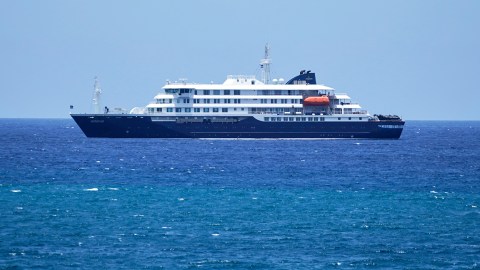
A cruise ship in the Atlantic, operated by the Dutch company Oceanwide Expeditions, became the scene of an international health emergency after the death of at least three passengers in a suspected hantavirus outbreaka potentially fatal disease spread by rodents, although there is a strain that can be transmitted from human to human.
The ship, the MV Hondius, departed from Ushuaia, in the extreme south of Argentina, heading to Cape Verdewith about 150 passengers and dozens of crew members on board. During the journey, several passengers began to present symptoms compatible with a serious infectionwhich led to a series of medical evacuations and the intervention of international health authorities, including the World Health Organization (WHO).
According to official reports and international media, The fatalities include a 70-year-old Dutch man, his 69-year-old wife and a German passenger.. Other travelers also developed symptoms, and at least one was taken in critical condition to a hospital in South Africa.
A crew member of the MV Hondius published a video narrating the situation on the vessel.
“I am currently on board the MV Hondius, and what is happening right now is very precise for all of us,” the passenger said. “We are not just a story, we are not just headlines; we are people with families, with lives, with loved ones waiting for us at home.”
The outbreak generated global concern, especially because it is a rare virus in maritime environments. However, experts have stressed that the risk of mass contagion is low. The World Health Organization (WHO) confirmed at least one case of hantavirus and keeps other possible infections under investigation.
“There is a lot of uncertainty, and that is the most difficult thing. The only thing we want right now is to feel safe, have clarity and go home,” the passenger continued. “So if you see the news about this, remember that there are real people behind all of this and it’s not something that’s happening somewhere far away. It’s happening to us right now.”
What is hantavirus?
Hantavirus is a group of viruses transmitted primarily by infected rodents. People can contract it by inhaling contaminated particles present in the urine, feces or saliva of these animals.
There are two main forms of the disease. In America, The virus can cause the so-called hantavirus pulmonary syndrome (HPS).a serious condition that affects the lungs and can be fatal in approximately 30% to 40% of cases. In Europe and Asia, however, hemorrhagic fever with renal syndrome (HFRS) is more common, which tends to be less lethal.
The initial symptoms usually resemble those of the flu: fever, headache, nausea and general malaise. In more severe cases, patients can develop severe respiratory distress, which can lead to death if immediate medical attention is not received.
Unlike other respiratory viruses, hantavirus does not spread easily from person to person. Only some strains, such as the so-called “Andes”, present in South America, have shown limited capacity for contagion between humans under specific conditions.
An outbreak under investigation
Health authorities are investigating the origin of the outbreak on the cruise ship. One of the hypotheses is that the contagion occurred before boardingpossibly during activities in regions of southern America where the virus is endemic.
The ship remained off the coast of Cape Verde for several days without authorization to dock, while the health situation was evaluated and isolation measures were implemented.
For its part, Oceanwide Expeditions has indicated that it is collaborating with medical authorities and managing the evacuation of patients, in addition to reinforcing health protocols on board.
Although hantavirus remains a rare disease, this incident has highlighted the health risks of traveling to remote regions and the importance of epidemiological surveillance in closed environments such as cruise ships.
Note: This article was written with support from AI.


