
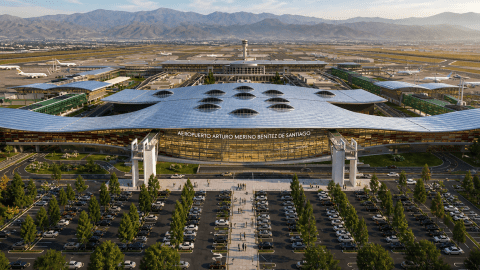
A South American airport is preparing for a transformation that could alter the map of connections in the region. With an investment close to $4,000 million, the project aims at something more ambitious than enlarging terminals: it seeks to become a international hub capable of competing with the large connection centers of the continent.
It is about the Arturo Merino Benitez International Airportwhich is preparing for a transformation that can redefine the aerial map in South America. The idea does not only aim to grow: it seeks to consolidate Santiago as a nerve center with an expansion of terminals, improvements to runways and a reconfiguration of the airport to increase its operational capacity.
Compete with the giants of the region
The objective is clear: receive more international flights, reduce connection times and attract airlines that today prioritize other hubs.
That is why the most relevant change is not physical. It’s strategic. These types of investments usually seek to transform the airport from being a point of origin or destination and into a connection node, where thousands of passengers make a stopover to continue their journey to other countries. That leap is what distinguishes a large airport from a true hub.
Today, the main South America hubs They concentrate a large part of international traffic. Among them, the São Paulo-Guarulhos International Airport, in Brazil, the Jorge Chávez International Airport in Lima, Peru, and the El Dorado International Airport, in Colombia. They serve as key hubs for connections between North America, Europe and the rest of the continent.
To enter that league, expanding infrastructure is not enough. Something more complex is needed: agreements with airlines, strategic routes, operational efficiency and a geographical location that facilitates connections.
Therefore, although the project is presented as an expansion, it is actually a bid to reposition itself on the international aerial map.

You can see: They are building a floating airport: it will be the largest in the world and will receive 80 million passengers
What changes for passengers
For those who travel, the impact can be concrete:
- More international routes, especially long distance.
- Greater range of flights and, potentially, more competition between airlines.
- More efficient connections within the region.
- More modern infrastructure and faster transit times.
However, these benefits are not immediate. They depend on how the airport’s operation evolves and whether it manages to attract new airlines.
A bet that redefines the aerial map
One of the promises of the project is to make it “the largest in South America,” but that statement needs context. An airport can be the largest by surface area, by number of passengers or by operational capacity, but it is not the same as being an important hub, which kicks the game and redefines the business for many players.
The interesting thing, beyond records, is that this type of investment not only impacts infrastructure. It also redefines routes, prices and travel decisions. If the project progresses as planned, it could generate a new hub of connections in South America, with effects throughout the region.
But the real challenge is not in building, but in operating: getting airlines, passengers and routes to choose that airport over already consolidated hubs. That’s where everything is played.
Continue reading:
They build the largest underwater tunnel in the world: 18 kilometers and connects two countries
Can they deny you the flight even if your passport is valid? The most common mistakes when traveling to the USA
The job in the US that can pay more than $100,000 and can be learned in a few months


