
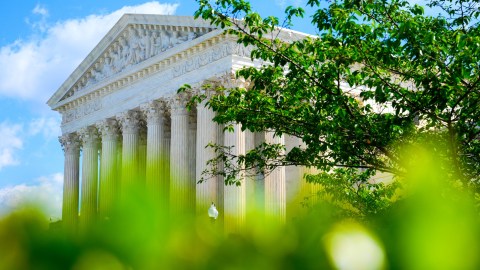
The Supreme Court justices heard arguments for and against ending the Temporary Protected Status (TSP) for immigrants from Haiti and Syria, although their decision could determine the future of immigrants from the 17 countries attached to the same program.
The judges’ questions did not make their inclination towards an eventual decision very clear, since while Judge Brett Kavanaugh – appointed by Donald Trump – suggested that the country is in a better situation since Bashar al-Assad was overthrown in 2024.
Meanwhile, Judge Sonia Sotomayor – appointed by Barack Obama – questioned the well-liked attorney general, John Sauer, how President Trump’s statement that immigrants are “poisoning the blood of the United States” does not demonstrate discriminatory intent.
One of the central arguments of the Trump administration’s immigration policies is that there is an “invasion” of immigrants in the United States and the term “poisoning” was even used by the right-wing president during his campaign.
Judge Ketanji Brown Jackson also referred to President Trump’s discriminatory expressions, when she noted that immigrants from Haiti came from a “dirty, disgusting and disgusting” country.
The judges’ decision, which could be in June or July, would directly affect more than 350,000 immigrants from Haiti and Syria, but would set a precedent over other TPS, impacting 1.3 million people, most of whom have been in the US for more than a decade, where they have family.
Conservative Justice Samuel Alito – appointed by George W. Bush – even justified that there was a report that justified the end of TPS, when the plaintiffs argue that the Trump administration did not consult with various organizations to develop a justification.
The central question in this case is whether the applicable law prevents the courts from considering whether the process to justify the suspension was adequate.
Judge Amy Coney Barrett – who has two children adopted from Haiti – questioned the prosecution followed by the Trump administration.
There are 1.3 million immigrants waiting
The magistrates questioned the Trump government and the defense of immigrants about the cases Mullin v. doe and Trump v. Miotwhich were consolidated for a joint decision.
The International Refugee Assistance Project (IRAP) represents the TPS beneficiaries of the Syrian class action lawsuit and its president, Sharif Aly, acknowledged that there is a dilemma in the Supreme Court’s decision that could impact many people.
“While we are unaware of the Supreme Court’s final decision, we know that what is at stake is of utmost importance,” Aly said. “The Court now faces the choice of upholding the system of checks and balances that is the essence of the Constitution or allowing the President to ignore laws enacted by Congress.”
FWD.us President Todd Schulte highlighted the work of advocates in both cases, while criticizing the Trump administration’s attempts to end TPS.
“Today, in court, I was able to appreciate the incredible work of those who defend TPS beneficiaries. It was clear that President Trump ignored his own government’s analysis of the countries’ situation, invented a consultation process that was never carried out and disguised a political directive as a comely review,” he said. “Every court that has reviewed this record to date has ruled that he violated the law with his arbitrary and capricious actions.”


