
Five former U.S. officials, including a former top military lawyer, criticized the Pentagon for failing to acknowledge possible U.S. involvement in the deadly attack on an Iranian school earlier this year.
Some of these officials stated that it was highly unusual not to disclose even basic details of the attack after so much time.
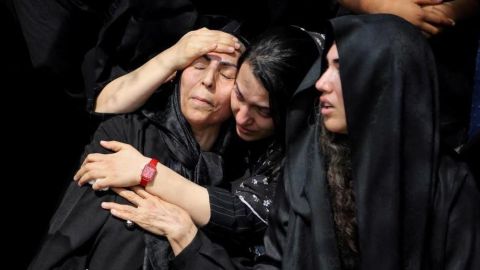
A missile hit an elementary school in Minab during the first fighting of the war between the United States and Israel on February 28, killing 168 people, including about 110 children, according to Iranian officials.
In the two months since then, the Pentagon has simply stated that the incident is under investigation.
In early March, US media reported that US military investigators believed US forces were likely responsible for the unintentional hit on the school, but had not yet reached a definitive conclusion.
In response to a series of questions from the BBC about the attack and accusations of lack of transparency, a Pentagon official stated that “this incident is currently under investigation” and added that more details would be provided as they became available.
The BBC reviewed three historic cases in which civilians were killed during US military operations and, in each case, the Pentagon had released much more information in less than a month.
The current US stance “departs markedly from the usual response,” said Lt. Col. Rachel E. VanLandingham, former chief legal officer of the US Air Force and former chief legal adviser to US Central Command during the Iraq and Afghanistan wars.
“Previous governments, at least, demonstrated fidelity and commitment to international humanitarian law,” said VanLandingham, who argued that what was “missing” in the administration’s statements was a commitment to accountability and, “above all, to ensuring that this does not happen again.”

President Donald Trump declared on March 7 that, in his opinion, Iran was to blame for the attack on Minab, without providing evidence. Days later, when asked about a video showing a US Tomahawk missile hitting the military building next to the school, he responded: “I haven’t seen it” and claimed, without evidence, that Iran possessed Tomahawk missiles.
On March 11, when asked about reports that an initial military investigation had concluded that the US had attacked the school, Trump said: “I have no knowledge of it.”
Defense Secretary Pete Hegseth was questioned by the BBC on March 4 about the attack and stated: “The only thing I can say is that we are investigating it. Of course, we never attack civilian targets.”
Independent confirmation
The US Department of Defense has refused to answer numerous questions about the attack. He has repeatedly refused to answer whether the Iranian military base next to the school was one of his planned targets for February 28, despite having spoken publicly about pre-planned targets or operations on dozens of other occasions during the war.
Last month, the BBC independently confirmed a video showing a US Tomahawk missile hitting the Iranian Revolutionary Guard (IRGC) barracks adjacent to the school. US media cited unnamed military officials as saying that a preliminary investigation had determined that a US missile had hit the school.
This was reportedly due to outdated coordinates provided by a US intelligence agency. The Pentagon has not commented on the matter.

Wes Bryant, former senior advisor on precision warfare and civilian harm mitigation at the Pentagon’s Civil Protection Center of Excellence, told the BBC that the military preliminary investigation is typically carried out to determine two things: whether harm to civilians actually occurred and whether the US was operating in the area at the time and could have caused it.
“When both criteria are met, that is when an investigation is formally initiated,” he said. “From a procedural standpoint… this just further evidences that they already know the US caused this, otherwise they wouldn’t be doing this investigation, and they just don’t want to acknowledge it or talk about it.”
“That they can’t even comment on it is just unacceptable,” said Bryant, who left the Pentagon last year when the civilian harm unit’s non-public was significantly reduced under Hegseth.
Another former defense official indicated that it is common for some investigations of harm to civilians to be prolonged, depending on the complexity of the situation. “But this is an unusually ambiguous case, since, from the situation, I can deduce that it is not really that complicated,” the former official, who asked to remain anonymous due to the sensitivity of the matter, told the BBC.
“Normally, the Pentagon would take responsibility immediately or relatively quickly, and then probably need more time to provide all the details, so that’s problematic in my opinion,” the former official added.
Democrats demand answers
Congressional Democrats repeatedly wrote to Hegseth asking a series of questions about the attack on Minab, starting with whether the US carried it out.
The BBC has seen two response letters from the Pentagon, sent on behalf of Hegseth, which do not provide answers to any of the questions. An April 2 letter to Democrats indicated that an investigating officer outside the CENTCOM chain of command had been appointed and that the results of that investigation would be shared once it was completed.
The BBC contacted 15 Republican members of Congress to ask about the government’s handling of the attack, but all declined to comment. Among them were prominent Republicans on the Senate and House national security committees.
On March 10, Republican Senator John Kennedy of Louisiana condemned the attack, declaring the Fresh York Instances: “I think we made a mistake. It was a frightful mistake.”

Pentagon officials have given several closed-door briefings on military operations to members of Congress since the start of the war against Iran, and they have been asked questions about the attack on Minab.
Adam Smith, the top Democrat on the House Armed Services Committee, told the BBC that officials said they could not comment due to the ongoing investigation, a response he called “pathetic and totally insufficient.” And he added that US responsibility was not admitted in the briefings.
The BBC reviewed three historical cases involving civilian casualties to compare them with the Trump administration’s response to the Minab attack.
- Drone attack near Kabul airport, Afghanistan, in August 2021: The Pentagon initially stated that it had attacked a vehicle known to pose an imminent threat from the Islamic State group. In reality, the attack caused the death of a family of 10 people, including seven children, which was confirmed within days thanks to media reports. Less than three weeks after the attack, the Pentagon admitted responsibility and apologized.
- Bomb attack on a health center in Kunduz, Afghanistan, in October 2015: The attack, carried out by an American AC-130 combat helicopter, caused the death of at least 42 people, including 24 patients and 14 doctors from the humanitarian organization Doctors Without Borders (MSF). Five days later, the commander of US military forces in Afghanistan offered detailed testimony before Congress, telling lawmakers that the attack was an “American decision made within the American chain of command.” The same day, the White House admitted the mistake and apologized.
- An attack on the Al-Amiriyah shelter in Baghdad, Iraq, in February 1991: The US Air Force bombing caused the death of 408 civilians. The government claimed that the bunker was a military command center and therefore a legitimate target. The BBC, among other media that visited the site shortly after the bombing, found no evidence of this. The US administration acknowledged from the beginning that there were civilian casualties and that this was a US attack.

In all historical cases, under both Democratic and Republican administrations, senior US military commanders made public statements much more detailed than those offered so far about the Minab attack.
Annie Shiel, a former U.S. official who worked on civilian harm reduction at the State Department, said previous cases followed a pattern in which “the U.S. would claim that ‘it wasn’t us,’ and then the media and non-governmental organizations would show that it was, in fact, a U.S. attack, and then the U.S. would have to back down.”
The Pentagon’s appointment of a non-CENTCOM investigative officer in the Minab case was, at least in theory, a good start on independence, said Shiel, staunch Director of US Advocacy at the Center for Civilians in Conflict (CIVIC).
However, he told the BBC he would certainly expect greater recognition of American involvement while the investigation is ongoing.
Corroboration of details of the incident has been made difficult by the Iranian authorities’ refusal to grant independent access to the site. The UN Fact-Finding Mission on Iran said on March 17 that it had requested access but had not been allowed to visit the site.
Charles O’Blaha, former director of the State Department’s Office of Security and Human Rights, said the lack of transparency in Washington could be due to the administration’s reluctance to contradict the president after he blamed Iran for the attack, a claim he called “really crazy and clearly false.”
Blaha worked for 32 years in the US Foreign Service and is currently a senior advisor to Democracy for the Arab World Now (DAWN), a nonprofit organization that advocates for democracy and human rights in the Arab world, attributed the relative silence in Minab’s case to what he interpreted as a rejection by the government of “any negative news about the war that they described as unpatriotic.”
Additional reporting by Catherine Alaimo.

click hereto see more stories from BBC News Mundo.
Subscribe hereto our new newsletter to receive a selection of our best content of the week every Friday.
You can also follow us on YouTube, instagram, TikTok, x, Facebookand in our new whatsapp channel.
And remember that you can receive notifications in our app. Download the latest version and activate them.
- Images verified by the BBC confirm that the girls’ school in Iran where 168 people died in the US and Israeli attacks was repeatedly bombed
- A US missile hit a military barrage near a school in Iran, video analysis shows
- At least 153 people died in a girls’ school attacked by the US and Israel, according to Iran


