
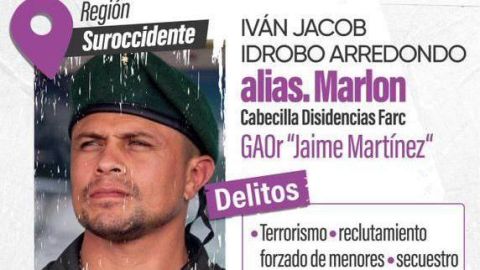
Before the attack that left at least 20 dead in southwestern Colombia last Saturday, alias Marlon was already identified as the leader of one of the guerrilla structures with the greatest capacity for damage in the country.
Now any information about his whereabouts is worth 5 billion Colombian pesos, around US$1.4 million.
President Gustavo Petro attributes to this guerrilla the authorship of the most lethal of the dozens of attacks that occurred in the departments of Cauca and Valle de Cauca in recent days.
This occurred in a section between the cities of Cali and Popayán on the Pan-American Highway, the highway that connects almost the entire continent.
A cylinder with explosive devices detonated on the highway and killed 15 women and 5 men. It also left dozens injured.
Vehicles around were destroyed. The explosion opened a huge crater in the pavement. Images of bodies lying and covered by sheets circulated on social networks.
“Those who attacked and killed (…) are terrorists, fascists and drug traffickers. Their boss is called alias Marlon, fully identified by police and military intelligence,” Petro said in X.
Colombia is just over a month away from holding presidential elections.
Analysts consulted by BBC Mundo see in the actions attributed to “Marlon” a “clear interest” of armed groups to create chaos and destabilization.

dissident leader
The guerrilla’s staunch name is Iván Jacobo Idrobo Arredondo, leader of the Jaime Martínez structure. This belongs to another larger structure called the Central General Staff (EMC), one of the dissidents of the Revolutionary Armed Forces of Colombia (FARC).
The FARC was the largest and oldest guerrilla in the country. In 2016, many of its members signed peace with the government and demobilized.
Other guerrillas, in disagreement, kept their weapons and continued their fight, today also associated with illicit activities such as drug trafficking, illegal mining, extortion and the adjustment of territories.
Idrobo Arredondo dissented from the peace.
“In 2013, still within the original FARC, he was captured in a police ambush. He is also accused of the murder of a journalist,” Gerson Arias, researcher at the Solutions for Peace Foundation (FIP), tells BBC Mundo.
The analyst says that “Marlon” was incorporated for the peace process and in 2017 he was released, with the condition of participating in it.
“But at the end of 2017 he traveled to Cauca, joined another structure and returned to his origins. He is a peace signer who took up arms again,” recalls Arias.
In 2022, after the death of his superior, he became the number one commander of Jaime Martínez.
Arias attributes him to being “the driving force behind many attacks against the public force.” He has more than 500 men under his command, according to the researcher.
It is also related to “terrorism, recruitment of minors, kidnapping, drug trafficking, homicide and extortion,” according to the Ministry of Defense.
Laura Bonilla, deputy director of the Pares Foundation, downplays his figure.
“It is of some importance that he is the ringleader, but you have to understand that in the groups the ringleaders are not so important. You capture one and you get another two, three, four. The recomposition of the violence is very complex,” Bonilla analyzes for BBC Mundo.
The rise of FARC dissidents

The EMC, the largest structure to which the one headed by “Marlon” belongs, is led by Néstor Gregorio Vera Fernández, alias “Iván Mordisco”.
Mordisco is one of the most wanted men in the country. A reserved judicial source revealed to BBC Mundo that it is one of the priority objectives of the Petro government to capture or deactivate in its attempt to weaken the armed groups and force them into negotiations.
The Mordisco dissidents are one of the armed groups that grew the most in the last year in Colombia, going from 3,279 members in 2024 to 4,019 in 2025, according to FIP data.
They have a presence in the south, east and west of the country, with their main strongholds being the departments of Guaviare, Meta, Caquetá, Vaupés and Guainía, the publication says. Perception Crime.
“From there the structure expanded to Amazonas, on the border with Brazil and Peru; Putumayo, on the border with Ecuador; Casanare, Arauca, Tolima, and Huila. It also has a presence in the departments of Cauca, Valle del Cauca and Nariño, in the west of the country, on the coast of the Pacific Ocean,” adds this analysis center.
In total, in 2025 it was reported that armed groups in Colombia had incorporated some 5,000 new recruits, increasing to 27,000 troops.
The largest is the Gaitanista Army of Colombia, known as Clan del Golfo, with around 9,000 individuals. The National Liberation Army (ELN) follows with almost 7,000.
Other dissidents of the former FARC, such as the General Staff of Blocks and Fronts, the National Coordinator of the Bolivarian Army (CNEB) and the Second Marquetalia add another approximately 5,500 combatants.

These groups maintain a growing territorial adjustment and illicit income in various areas of Colombia, disputing dominance with other actors while fighting the military forces and intimidating civilians.
The southwest is one of the hottest spots of the armed conflict and one of the most militarized areas of the country.
In Cauca, where the attack attributed to “Marlon” occurred, violence intensified in 2025 with harassment, ambushes, explosions and combats, according to the Pares Foundation.
Classic violence is mixed with “the use of drones loaded with explosives, car bombs, motorized pumps, dump trucks equipped as launchers and the installation of cylinders in urban and rural areas,” says Pares’ analysis.
Pares points out that the expansion of attacks by groups such as Jaime Martínez against civil infrastructure and the increase in explosions in populated areas have expanded the humanitarian and economic impact, “deepening the perception of insecurity in the civilian population.”
Security before the elections

Security is one of the central issues of the presidential campaign in Colombia, whose first round is scheduled for May 31.
Petro, a former M-19 guerrilla, came to power promising an ambitious strategy of “whole peace” with which he wanted to subdue the armed groups through negotiations.
But months after finishing his mandate, the initiative has not reaped the expected results, with several conversations suspended.
Armed groups are expanding and the crisis of violence in various parts of the country increases the perception of insecurity among citizens.
Given this, the Petro government adopted in recent months an approach defined by specialists as “carrot and stick”: increasing military pressure on the groups, but without giving up the possibility of dialogue.
Bonilla believes that EMC’s recent actions seek to create the sensation that they are more powerful than they really are.
And to the extent that chaos and lack of control are felt in the country, episodes like last weekend’s could further favor the agendas of the opposition, which goes to the elections with a more hard-line discourse against crime and guerrillas.
In the first round, Iván Cepeda, Petrista candidate from the Historical Pact party, the right-wing Abelardo de la Espriella and Paloma Valencia, from the conservative Democratic Center (CD) party of former president Álvaro Uribe, will compete.
Cepeda, favorite in the polls, has stood out for participating in several negotiation tables with armed groups.
De la Espriella and Valencia embody those heavy-handed proposals with which they seek to convince the Colombian electorate.

click hereto see more stories from BBC News World.
Subscribe hereto our new e-newsletter to receive a selection of our best content of the week every Friday.
You can also follow us on YouTube, instagram, TikTok, x, Facebookand in our new whatsapp channel.
And remember that you can receive notifications in our app. Download the latest version and activate them.
- What is known about the victims and 3 other questions about the attacks that left at least 20 dead and dozens injured in southern Colombia


