
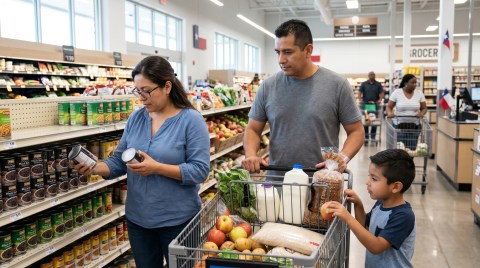
Going to the supermarket in 2026 is no longer a minor task, something to solve quickly. For thousands of families in Texas, shopping became a strategic decision: Choosing well where to shop can mean making the end of the month easier, saving for rent or simply being able to fill the pantry better.
In a state with millions of Hispanic households, where many families cook at home, shop for several members and take care of every dollar, Comparing supermarkets is no longer the custom of a few. Today it is part of the family economy.
The good news is that in Texas there are several chains where money can go much further, especially if purchased with some planning.

There is no single “cheaper” supermarket.
The honest answer is that the possibility of find cheaper products It depends a lot on what you buy, where you live and how many people are at home. A single couple in Austin is not the same as a large family in Houston or a multigenerational home in San Antonio.
Some stores earn on basic products, others on fruits and vegetables, others on volume, and others on Latin items. For this reason, many families save more by combining options than by always going to the same place.
You can see: Texas tightens construction controls: what happens if you work without a license from May 1
Walmart: strong in basics and large purchases
It remains a reference for millions of people for something easy: it usually has competitive prices on a huge number of products.
There many families solve the basics: milk, eggs, rice, cleaning, diapers, household products, and others. Plus, for those who work long hours, making a complete purchase in one place also saves time, which today is worth as much as money.
Aldi: the silent savings favorite
Wherever it has a presence, Aldi has earned a reputation as a profitable store. Fewer well-known brands, more own brands and prices that usually surprise. It is common for all those who try to buy fruits, bread, yogurt, cheese or frozen foods there to return the following week.
For small homes or quick purchases, it is usually a great alternative.
You can see: How much they pay to work for the state of Texas in 2026: real salaries and the agencies with the best salaries
HEB: Texan identity with good opportunities
Talking about shopping in Texas without mentioning HEB would be impossible. It is a very beloved chain in the state and, although it is not always the cheapest in everything, it usually offers an interesting balance between price, quality and promotions.
Many families choose it for reliable own brands, good fresh products, weekly offers and
wide assortment. In several Texas cities it competes strongly with national chains.

Fiesta Mart: key for many Hispanic families
For those looking for Mexican, Central American, Caribbean products or specific ingredients from Latin cuisine, Fiesta Mart can be a great menu.
Sometimes it’s not just about price, but about finding what you really devour at home: tortillas, chiles, seasonings, specific cuts of meat, vegetables and familiar brands. And, when that appears at a good price, the current value rises a lot.
Costco and Sam’s Club: when buying in volume is appropriate
For large households, families that share expenses, or those who have space to store merchandise, buying in bulk can make a difference. Especially toilet paper, detergent, water, rice, meats and school snacks.
Of course: not all apparent savings are. If you buy too much and it is wasted, the benefit disappears.
You can see: Can you be fired for marijuana in the US? What the law says in California, Texas, Florida and NY
The strategy that works the most in Texas
Many families that really manage to reduce spending do not have “a favorite supermarket.” They have method. For example: large monthly purchases at a cheap store, vegetables and fruits where they are better, weekly offers at another chain, own brands for basic products and a wholesale club for heavy items.
This system, repeated month after month, usually generates more savings than pursuing an isolated offer.
How much can a family save per year
It seems little, but it is not. If a family reduces between $20 and $30 per week in purchases, it can represent between $1,040 and $1,560 per year. In many homes that equates to services, school supplies, clothing or part of a vacation.
In cities like Dallas, El Paso, Houston and San Antonio, where a strong Hispanic community lives, taking care of food spending continues to be an everyday priority. And brands know it, and compete. The most famous store doesn’t always win, but rather the one that best suits your family.
Continue reading:
Raids in Texas for false documents: how networks that get jobs with stolen identities operate
Immigration coup in Texas: court allows police to arrest suspects of crossing the border
Why Texas is a good place to watch a 2026 World Cup match


