

By Editorial
Yesterday, the armed individual who burst into the White House correspondents’ dinner on the night of the 25th to the 26th of this month was formally charged with several charges, including attempted assassination of President Trump. The event marks an escalation in the recurring phenomenon of political violence in our country. A process accelerated by the polarization that separates those who support and those who oppose Trump. Although we do not have reliable data that is still under investigation about the incident, they add to a long list of political attacks, committed against both Republican and Democratic figures.
It could be established that it began in 2011, with the attack that seriously injured Democratic Congresswoman Gabby Giffords, killed a federal judge and a nine-year-old girl. In 2017, the shooting that injured Republican Congressman Steve Scalise; the attempt to kidnap Democratic Michigan Governor Gretchen Whitmer in 2020. On January 6, 2021, the attempt to seize Congress and prevent approval of Trump’s election loss; in June 2022, the attempt on the life of Supreme Court Justice Brett Kavanaugh, a conservative, and then the hammer attack that injured the husband of then-Democratic House Speaker Nancy Pelosi.
Starting in 2024, the frequency of acts of violence increases. In July and September of that year, two attacks against Donald Trump from which he fortunately emerged unscathed. Last year, someone burned down Pennsylvania Democratic Gov. Josh Shapiro’s home; On June 14, 2025, a killer killed Melissa Hortman, Democratic Speaker of the Minnesota Legislature, and her husband in their home. On September 10, a sniper killed Charlie Kirk, a well-known conservative activist and founder of Turning Level USA.
The situation threatens to get out of control. Political violence takes on a life of its own, beyond the ability of the government – any government – to contain it.
We cannot let political violence become normalized.
If there is a ray of hope in this situation, it is that Trump’s measured reaction after the attack allows us to think about a way out of renewed reconciliation and cooperation between both governing parties. It was initially feared that Trump would take advantage of the moment to launch attacks against his many opponents, as he has done repeatedly. But it wasn’t like that.
Yes, it is difficult for both sides to tell the truth, because until now many of the politicians who represent us consider this situation to lead to their election and re-election, and refuse to criticize violence when it comes from their own side. Consequently, tens of millions of Americans believe political violence to end Trump’s presidency is justified, as do tens of millions more who want to keep him in power at all costs, as confirmed by an NPR poll from last October.
The negative influence of our leaders is reflected in this PRRI survey from three months ago, according to which “two-thirds of Americans (67%) believe that political leaders’ lack of condemnation of violent rhetoric contributes greatly to violent actions in society.”
Yes, we live in what experts like Professor Robert Pape call “the technology of violent populism.”
But now we are in a moment of grace, which may be short-lived. Maybe a few days.
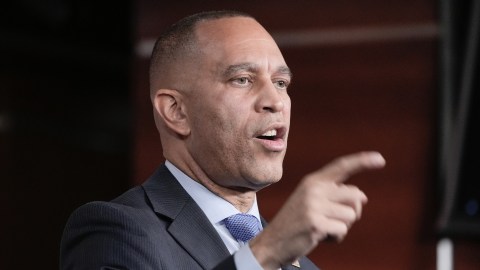
On November 3, in less than 190 days, if nothing changes, we will have the midterm elections. Millions of Americans see it as a last opportunity to defend their vision for the nation, as shown by an NBC poll from March 2026. It is imperative then that the Democratic leadership – the best suited to do so is Congressman Hakeem Jeffries, leader of the Democratic minority in Congress – request a meeting with the President with the sole objective of both, Republicans and Democrats, jointly and publicly condemning political violence, to stop this vicious cycle of polarization, hatred and resentment. So that differences can be resolved at the voting booth. This conversation is essential. This is our first priority.


