
The rapprochement between Venezuela and the United States after the unprecedented military operation that Washington launched on January 3 against the South American country – an action that culminated in the capture of Nicolás Maduro and his wife Cilia Flores – is no longer limited to the oil and mining sectors, but is also beginning to extend to the police and judicial sphere.
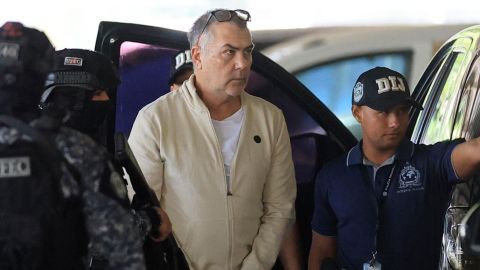
Proof of this is the extradition to Panama of Ali Zaki Hage Jalil, whom Panamanian and US authorities accuse of having collaborated in the blowing up of a commercial airliner in 1994, an event in which 21 people died – among them twelve members of the native Jewish community and three US citizens – and which is considered the worst terrorist attack in the history of the Central American country.
The US and Israel maintain that Hage Jalil is a member of the Shiite militant group Hezbollah, based in Lebanon and which the US, the European Union (EU) and Israel classify as terrorist.
The surrender of Hage Jalil took place this Monday, under a strong security operation, as reported by the International Prison Police Organization (Interpol) and confirmed by the US embassy in Panama.
“This extradition sends a definitive message: the (Donald) Trump administration has a long memory and an even longer reach,” Ambassador Kevin Marino Cabrera stated in a press release.
Between three countries and with two passports
The extradited person was captured in Venezuela, specifically on the tourist island of Margarita, in the east of the country, on November 5, 2025.
The arrest occurred without incident, according to the judicial reports to which BBC Mundo had access.
“(Hage Jalil) was wearing a blue shirt, black Bermuda shorts, and black cholas (sandals),” reads the report written by the agents who arrested Hage Jalil and whose extract appears in the ruling of the Supreme Court of Justice (TSJ) that last March authorized his delivery to Panama.

Although the subject has Venezuelan nationality, it was obtained in 2005. Hage Jalil was actually born in Maicao (Colombia) on October 25, 1968, according to the information provided by the Panamanian police to the Venezuelan justice system.
In the mid-1970s, her parents – Zaki Mohamed Hage Ahmed and Amina Jalil de Hage, of Lebanese origin – moved to Margaret Island, where there is a large Lebanese and Syrian community.
He later moved to Caracas, where he studied business administration, according to the US Center for a Free and Secure Society (SFS), a center dedicated to security and defense issues.
In the 1990s, Hage Jalil moved again and settled in the Colón Free Zone (Panama), where he was a company director. He remained in the Central American country until months after the attack for which he is accused, at which time he returned to Venezuela again, the SFS added.

The suspicions
On July 19, 1994, Alas Chiricanas airline flight 901 took off from Colón’s France Field airport for a short domestic flight to Panama City. However, minutes after takeoff, while flying over Cerro de Santa Rita, the aircraft exploded in mid-flight.
Among the 21 victims, twelve were members of the local Jewish community, three were American citizens and four were Israelis.
The body of one of the victims who was not claimed and who was identified as Lya Jamal or Ali Hawa Jamal began to point towards the now extradited man, who at the time had a company in the Central American country.
Jamal, who was in seat number 6 of the damaged plane, was carrying a briefcase loaded with explosives that was activated with a radio. According to Panamanian authorities, Hagel and Jalil rented two vehicles with false identities, reads the extradition request to Venezuela.
Another element that pointed to the Colombian-Venezuelan citizen is that, days after the attack, he was detained by the Panamanian police while driving a truck in which he was carrying ten submachine guns, ammunition and other items for military use.
Hours later, in another raid at a compound in Panama City with which he had a connection, authorities found more weapons and dollars in cash.
“Panamanian prosecutors allege that Hage Jalil coordinated the logistical aspects of the operation (of the attack),” the SFS stated.
However, despite these indications, the authorities of the Central American country did not prosecute him and he was able to return to Venezuela.

“No one imagined what he was in.”
Back in Margarita, Hage Jalil ventured into the hospitality business and opened a restaurant called Sea bound Bar, in the town of Pampatar.
“The establishment began as a place for light meals with various environments, but then it changed to a place primarily for entertainment, discotheque style,” a resident of the island who knew him and who asked to reserve his identity for security reasons told BBC Mundo.
“It didn’t have good food or beautiful facilities. Its attraction was that it was in its privileged location, under a cliff and facing the bay of Pampatar,” he added.
The capture of Hage Jalil surprised more than one on the tourist island.
“He enjoyed a certain business reputation. He had very good relationships and was appreciated in the gastronomic and entertainment world. Nobody imagined what he was involved in,” added our interviewee, who is an expert in the island’s gastronomic world.
Although the Panamanian authorities had him on their radar, Hage Jalil continued traveling to the Central American country. His last trip was in 2019 for a skydiving event, according to the file that rests in the TSJ of Venezuela.
Suspicions about the Colombian-Venezuelan were revived in 2017, when Israeli intelligence handed over to the Panamanian government, then led by Juan Carlos Varela (2014-2018), information that maintained that Hezbollah was behind the attack on Alas Chiricanas flight 901 and mentioned the man who is now extradited.
The fact that this event occurred one day after the terrorist attack suffered by the Argentine Israelite Mutual Association (AMIA) in Buenos Aires, in which 85 people died and which remains unpunished, has reinforced suspicions about the participation of the militant group.

In 2024, a person who knew the suspect told the Panamanian prosecutor’s office that he admitted to him in 2017 that he knew the suicide bomber who “had helped him as a guide and driver.”
The same witness told investigators that Hage Jalil confessed to him that “he had military training,” reads the extradition ruling of the Venezuelan TSJ.
“Financial intelligence and network mapping, based on data from the US Treasury, place Hage Jalil within a network linked to Hezbollah in Venezuela,” said the SFS, which indicated that his restaurant was part of that financing network.
The extradited person must face charges for crimes against life and non-public integrity, intentional homicide and crimes against collective security, against means of transportation and communication.
The FBI even offered US$5 million as a reward for any information that could help find Hage Jalil.
The close relations that the governments of the late Hugo Chávez and his successor, Nicolás Maduro, maintained with Iran – Hezbollah’s main financier – were one of the main reasons why the possible presence of the group in Venezuela was denounced from the US.
Suspicions were reinforced by accusations made by former Venezuelan officials such as Misael López, former advisor to the Venezuelan embassy in Iraq, who in 2017 denounced that Venezuelan passports and visas were sold without regulation to Middle Eastern citizens.
However, these accusations have been dismissed by the ruling party and described as “destabilizing campaigns.”
“They want to link him to Hezbollah, I know Tareck (El Aissami) well, I know him very well, never in his life, ever, has he had contact with anyone from Hezbollah,” Maduro said in 2019 when accusations arose against his former vice president.

click hereto witness more stories from BBC Info Mundo.
Subscribe hereto our new newsletter to receive a selection of our best content of the week every Friday.
You can also follow us on YouTube, instagram, TikTok, x, Facebookand in our channel WhatsApp.
And remember that you can receive notifications in our app. Download the latest version and activate them.
- In Venezuela “we will build a security shield, we will remove the agents of authoritarian regimes like Russia, Iran or Hezbollah”: complete interview by María Corina Machado with the BBC
- What role does Venezuela really play in drug trafficking and how does it compare to that of Mexico and Colombia, the countries Trump warned after Maduro’s capture?
- What the US accuses Nicolás Maduro and his wife, Cilia Flores, of


