
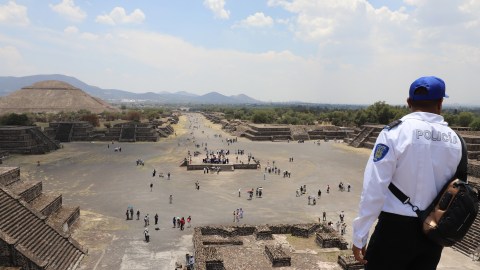
On April 20, what should have been a day of cultural admiration in Teotihuacán, one of the most emblematic historical sites in Mexico, turned into a nightmare scenario. From the top of the Pyramid of the Moon, an attacker began shooting dozens of tourists, including children. The balance was two people dead, including the attacker who decided to commit suicide, and 13 injured of various nationalities.
But what makes this attack even more chilling is not only the place where it was committed but the nature of the perpetrator: a 27-year-old young man, Julio César Jasso Ramírez, whose mind seems to have been captured by an alien ideology of hate.
This event raises alarms that the country cannot ignore. For years, the narrative of violence in Mexico has been monopolized by drug cartels and turf wars. But the attack in Teotihuacán confronts us with a different monster: radicalized fanaticism and the phenomenon of “copycat” or imitator.
The attacker did not choose a random date to act, he did so on April 20, the birthday of Adolf Hitler and the anniversary of the Columbine massacre. By carrying images generated by artificial intelligence where he was projected next to the Colorado murderers and gave Nazi salutes, Jasso didn’t just seek to kill; He sought to join a world tradition of terrorists who find a reason for being in hatred.
Besides, This attack hurts Mexico in a very special way because never before has an attack of this nature been committed in a center loaded with so much historical symbolism as Teotihuacán. And, if that were not enough, the tragedy occurs less than two months before Mexico is one of the hosts of the World Cup. At the international level, the question is no longer just whether the Mexican government will be able to contain the cartels, but whether it will be able to detect a “lone wolf” in the shadows of the internet.
The authorities now face a major challenge. It is not just about shielding each archaeological site with soldiers but about understanding the psychopathology of modern hatred. The prevention of these attacks does not occur in security arcs, but in the detection of erratic behavior, in the monitoring of extremist communities.
The government will not be able to handle this titanic task alone. We need a society that stops normalizing hate speech and learns to identify the warning signs: extreme isolation, obsession with historical massacres and the adoption of supremacist symbols.
What happened in the Pyramid of the Moon is a scar that will take time to heal. If Mexico aspires to host a world party in a few weeks, it must demonstrate that it is capable of protecting not only its borders and stadiums, but also the social fabric to prevent its own young people from becoming executioners.
María Luisa Arredondo is director of Latinocalifornia.com and author of the book “Life after the crossing.”


