
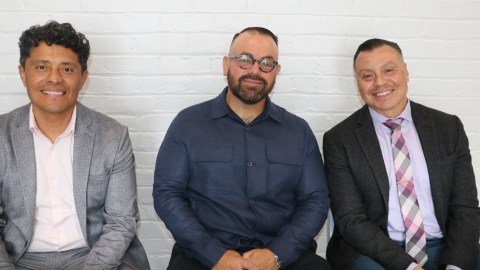
Three nonprofit directors who were involved in the justice system at some point in their lives celebrated the opening of the Restorative Academic Mentorhips’s Program (RAMP LA) in the Boyle Heights area to provide support and resources to youth and adults who likely had the same experience as them.
“10 years ago, during a meeting we had after we were released, we committed that we would do everything in our power to empower individuals to pursue a life of purpose, instead of making poor decisions like the ones we made,” said Roberto Luca, co-founder and CEO of RAMP LA.
“The RAMP LA campus will provide a safe place for community members to pursue career opportunities, with the help of career staff, some of whom were also part of the system.” [judicial]”he added.

After they have completed their sentence, the RAMP LA campus engages youth and adults through prevention and support services, offering them positive alternatives, mentoring and resources to help them reduce their exposure and involvement in the system, homelessness and violence in the community.
In fact, one of them, Joshua Jones, 33, who was released from prison just two weeks ago was scheduled for a job interview as a real estate agent.
“I’m excited for this great opportunity,” said Jones, the son of a Mexican mother and African-American father, who for part of his life was involved in gangs and ended up incarcerated for 17 years.
“Many times, difficult circumstances combined with unfortunate life decisions lead people toward gang activity and street crime. I know, because I was there,” said Joel Aguilar, director of campus programs and co-founder of RAMP LA.
Aguilar will oversee programs on the RAMP LA campus, whose facilities will serve as a free community center, with accessible services focused on healing, growth and professional development.
Alberto Gómez, financial director of the organization explained that the organization’s annual budget exceeds $10 million and is financed in part by Los Angeles County and San Francisco and other counties.
The program assigns life mentors to young ex-offenders, helping them adapt and avoid recidivism.
“70% or more of the students who come to the program graduate successfully,” said Gómez. “When they come to our program, they recognize that they want a better life than the life they have had, because it is not the one they want for themselves and their family.”
While RAMP’s campus offers opportunities to lead a purposeful life, the organization also provides safe, stable housing for individuals following their incarceration, supporting their transition back into the community through comprehensive services including rehabilitation, education, mentoring, and job placement training.
“Having been “inside”—in a highly structured environment—for so long, the most difficult thing for newly released people is finding safe, affordable housing, as well as learning to live on the “outside” and navigate the challenges of life in a context where opportunities for reintegration may be scarce,” said Erasmo Reyes, one of the three co-founders of RAMP LA.
RAMP LA manages and operates six homes for people who have been released from the prison system: three located in the central Los Angeles area and another three in the San Fernando Valley.
These facilities offer residential accommodation to many men and women, also providing them with complementary social services within a safe residential environment, in order to encourage greater social reintegration.

Reyes, a successful construction contractor, oversaw the development of these six homes, arranging their financing through local investments and employing numerous newly released people through an apprenticeship program designed to teach them valuable job skills. Likewise, he contributed to the creation of RAMP Housing with the objective of managing the construction process.
“Looking back, we realize that RAMP LA was not born in a boardroom, but from the lived experiences of three people who had to navigate the complexities of the justice system. We emerged with a singular mission: to foster a community based on restorative justice that empowers people to thrive through therapeutic housing, education and mentoring,” said Reyes. “We are the living, breathing example of this successful healing approach.”
“My freedom is God”: Roberto Luca
Roberto Luca, the executive director of RAMP LA spent 28 of his Fifty three years in prison, where he met his now inseparable friends, Erasmo Reyes and Joel Aguilar, co-founders of the program.
His mother worked two jobs to support the household. His father was absent.
Roberto Luca was 16 years old when he was sentenced to 15 years to life in prison. After serving two decades of his sentence, while in solitary confinement at Pelican Bay State Prison, he had a revelation about the pain he had caused his victims and set out to make amends. He began working toward his GED (high school diploma) while in isolation.
“I was 35 years old and I didn’t even know what fractions were,” he said. “I had absolutely no education.”
Roberto received an education behind bars. Correspondence programs have a long history, especially when it comes to obtaining the GED.
However, in 2014, California passed SB 1391, which allocated funds to hold in-person classes within prison walls. That’s when Bakersfield College launched a pilot program at Kern Valley State Prison in Delano.
Roberto remembered that in prison he met Erasmo Reyes – his inseparable friend – and something interesting happened.
“We recognized that we watered it [nos equivocamos]”, expressed the man who, at the age of 13-14, was a gang member and already carried a gun.
That environment was the only thing I knew. He did not come from a well-rounded family, although he acknowledges that his parents did the best they could to direct him.
“My parents are immigrants, but they are also human and they didn’t know how to help me solve problems,” Luca said.
He also lived in a time of rock cocaine distribution and mass incarceration of Latino and African American youth.
“Then, I took a bad step in the gangs. There I found my “family” and at 16 years old I participated in a violent act [un asesinato]. “I drove the car.”
At the age of 16 he was sent to a juvenile correctional facility. Then to Folsom Suppose Valley Penal complex.
Roberto was not afraid. He thought he was very strong and intelligent.
“Only by the grace of God did I survive,” he emphasized.
After 22 years behind bars, his life changed completely. Forever.
“I had an encounter with Christ and I had to walk my own path and find my faith in time,” Roberto stressed. “There, inside [de la prisión] “I made a promise to myself that, before anything else, I was going to be more reverent with God.”
Little by little he withdrew from the gangs and danger.
“I was no longer afraid to follow my own path, because I had God’s protection; having spoken with Him alone in my cell was when I had the opportunity to leave prison,” Roberto said.
The faith he once lost he regained. He realized everything he had lost, but once free, Roberto assured that he found the love of God.
“My freedom is God; thanks to Him I know what freedom is, I know what a human being is, and in my heart, I believe that all people have to be treated as a person, no matter your color or what race you are…Everyone should have the opportunity to live a dignified life,” argued Roberto Luca.
Like the narrative of the prodigal son, Roberto claims that he has returned to the Father’s house and can now help those who have gotten lost along the way.
The young people who come to RAMP LA have to be taught how to drive a car, how to register to go to school.
He teaches them how to clean, how to iron, how to make food.
“That’s what we do,” he said. “And with these activities we have those moments of sharing our lives and our path so that they and their families do not go through the pain of seeing one of their children imprisoned; we seek to positively impact young people, other adults and their families.”
Now, Roberto draws strength from the suffering he saw in his mother when she visited him in prison and could not get him out of there.
And shed some tears.
“I draw strength from those memories, because I don’t want another child or another mother to go through those moments and experience that pain… That is the most important thing… that that kind of pain not be repeated,” he concluded.
RAMP LA programs include:
⦁ Life skills: Parenting support, emotional regulation workshops and character development.
⦁ Creative arts: Art, painting, cooking workshops that support the expression and well-being of the participants.
⦁ Professional growth: Job readiness training, mentoring, and workforce development support
⦁ Access to resources: A welcoming space that provides support services for youth and residents, providing them with stability, guidance and a sense of community.


