
Few things generate as much doubt in the kitchen as opening the refrigerator, looking at a carton of eggs and wondering if they are still good. From the outside they may look perfect, but inside the story may be different. AND When it comes to eggs, it is advisable not to improvise: if they are in poor condition, they can cause food poisoning.
The good news is that you don’t have to be a chef or food safety expert to figure this out. There are quite clear signs that help to know if an egg is still suitable for consumption or if it is best to throw it away without thinking.
In the United States, where eggs are part of the daily breakfast of millions of homes, the US Department of Agriculture and the Food and Drug Administration recommend always keeping them refrigerated and checking their condition before using them.
The water test: useful, but not infallible
It is the best-known homemade trick and has a logical explanation. As time goes by, the egg loses moisture and air enters through the pores of the shell. This causes its buoyancy to change.
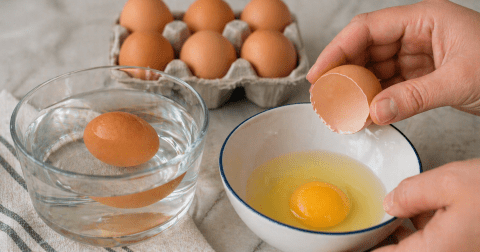
You just have to fill a glass or container with cold water and place the egg inside. If it sinks and lies on the bottom, it is usually fresh. If it sinks but remains tilted or almost vertical, it is no longer at its best, although it could still be used well cooked. If it floats, the most prudent thing to do is to discard it.
It is not a perfect test, but it serves as a first sign.
You can see: Recipes with eggs
The smell never fails
Beyond any trick, smell remains the most reliable indicator. When an egg is rotten, it usually releases a strong, unpleasant and very recognizable aroma when broken.
That smell similar to sulfur or something clearly decomposed does not leave too many doubts. If it appears, it is not advisable to taste it or cook it: it should simply be discarded.
Food safety specialists often repeat an easy rule: if something smells bad, it’s not worth the risk.
What it reveals when you open it
Many times the egg does not smell bad, but when broken it already shows signs of deterioration. It is best to do it first in a separate bowl or cup, especially if you are going to mix it with other ingredients.
A fresh egg usually has a relatively firm white and a rounded yolk. On the other hand, an old one may have a very watery white that spreads quickly and a flattened yolk.
That doesn’t always mean it’s rotten, but it does mean it lost freshness. It is different if strange colors, unusual stains, viscous texture or strange foam appear: in those cases, it is best to discard it.

The shell also speaks
Before opening it, it is worth looking at the outside. If the shell is broken, sticky, cracked or has suspicious debris, the risk of bacterial contamination increases.
Cracks allow microorganisms to enter from the outside, especially if the egg was stored poorly or for several hours at room temperature.
How long do eggs really last?
One of the great confusions is the carton date. Many people believe that when that day arrives the egg automatically stops serving, and this is not always the case.
The US Department of Agriculture points out that, kept under constant refrigeration, The eggs can remain in good condition for several weeks. The key is in the cold chain and that they have not suffered sudden changes in temperature.
The most common mistake at home
Taking eggs out of the refrigerator, leaving them on the counter for hours and putting them back repeatedly is a frequent and not recommended practice. Temperature changes encourage condensation and can accelerate deterioration.
It is also a good idea to avoid storing them in the refrigerator door, where the temperature fluctuates more each time it is opened.
When in doubt, it’s not worth the risk: an egg costs little. Poisoning can cost much more in discomfort, medical consultations and difficult days. If something doesn’t convince you—a funny smell, a suspicious texture, a damaged shell, or real doubts about how long it’s been there—the wisest thing to do is to discard it.
In cooking, sometimes the best recipe is not to take too many risks.
Continue reading:
5 foods you should never cook in an air fryer: you could get food poisoning
8 things you should never flush down the toilet: you will cause a disaster


