
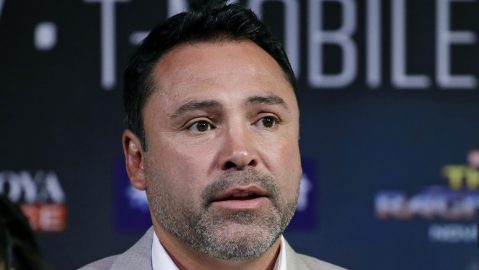
The member of Oscar de la Hoya Boxing Hall of Fame and Nico Alí Walsh, grandson of the legendary Mohamed Alí and candidate for the world middleweight title, led the discussions to decide and against de modifications to the American Boxing Revitalization Act Muhammad Ali.
In a meeting that took place during a hearing of the Senate Commerce, Science and Transportation Committee in Washington DC and where US Senator Ted Cruz acted as referee on Wednesday between the key figures of US boxing who have been involved in expressing their opinions regarding the benefit or not of modifying this law.
Timothy Shipman, president of the Association of Boxing Commissions and executive director of the Florida Athletic Commission, and Prick Khan, executive of TKO Group/Zuffa Boxing.
The hearing was titled “Back to Your Corners: Have Federal Boxing Laws Reached the End of the Road or Left Behind?” , where De la Hoya, Nico Walsh Ali and the other characters mentioned above had a direct participation in the discussion, where the presence of Prick Khan, executive of TKO Group/Zuffa Boxing, was also highlighted. who is spearheading TKO-backed bipartisan legislative improvements around federal boxing regulations.
Four months ago, the U.S. House Committee on Education and the Workforce approved, by 30 votes to decide and 4 against, a law to modify the legislation and create a new professional boxing systemcentralized and alternative, under the name of Unified Boxing Organizations (UNO).
Then, on March 24, the House of Representatives approved the law by voice vote, bringing it one step closer to being signed into law by the president. Donald Trump, where the new bill preserves the Muhammad Ali Boxing Reform Act, which was codified in 2000, and enhances the Professional Boxing Safety Act of 1996 by adding supplemental provisions.
But when it was thought that everything would be stitching and weaving with the proposals for changes, the aforementioned legislation has found reactions on both sides among the main actors in combat sports, since some have shown themselves to decide due to the new opportunities it presents with its improvements, while others They have opposed it out of fear of market preservation, unilateral negotiations and a decrease in the remuneration of fighters.
De la Hoya opposes improvements
Hall of Fame member Óscar de La Hoya was the first to give his speech on the podium, showing his rejection of the changes and improvements in the legislation: “I care a lot about boxing and, more importantly, the boxers who go into the ring and risk their lives for our entertainment.
“I am here because I firmly believe that the proposed changes are taking us in the wrong direction,” De La Hoya said. “This change of principle in the proposed amendment allows a developer to create an entity that functions as a developer and governing body at the same time, a so-called UBO (Union Registered Official).”
This reflects the exact model of MMA and creates a closed system that controls rankings, titles and access to opportunities. Under this structure, as long as the UBO complies with its own internal rules, it would not violate the Muhammad Ali Boxing Reform Act. Meanwhile, traditional developers like me would still be required to comply with full financial disclosure and reporting requirements.
In other words, a system operates with transparency and accountability, while the UBO does not. This represents a fundamental shift in the distribution of power that, if reversed, would prioritize corporate profits over boxers.
We must be clear about who benefits from this. These changes coincide directly with what Zuffa Boxing and Their management at TKO Group Holdings have already stated that they intend to implement in boxing: a model linked to that of the UFC. And we already know how that model works, and it does not benefit boxers.
Khan refuted De La Hoya
In front of De La Hoya’s presentation, Khan took the floor, who refuted De La Hoya’s statements with arguments about the benefits that will be introduced, among them: a minimum wage of $200 per round for boxers; mandatory injury insurance of $50,000 per fight at no cost to the boxer, which starts as soon as training camp starts; a six-year limit on promotional contracts, making it comparable to rookie contracts in the NFL and Major League Baseball; and standardized medical protocols for all boxers focused on annual brain and heart testing.
Oscar De La Hoya notes that boxers have already got protections with the fresh Ali Act.
He moreover notes that boxers form the majority of the money, and that the promoters will pocket many of the money with the Revival Act’s UFC-fashion mannequin.
Prick Khan notes that 63 boxers have… pic.twitter.com/LSxdWmbhvO
— Bryan Fonseca 🇵🇷 (@BryanFonsecaNY) April 22, 2026
“The Muhammad Ali Boxing Revitalization Act is based on a simple premise: give boxers the freedom to choose a better system,” Khan said. «The law, as it currently stands, would remain in force. The system, as it currently stands, would remain in force. This is an “or” option. Create the framework for rotten organizations that can do what great sports do: promote competition, develop talent and enforce consistent standards under one roof. “For boxers, this bill provides concrete protections that are long needed.”
Ali Walsh’s turn
Ali Walsh added that Ali’s Law is based on the principle that those who control boxers should not also control the entire market on which they depend, adding that competition between multiple promoters for boxers creates bargaining power and a fair market value.
“That separation exists to prevent conflicts of interest and exploitation,” Ali Walsh said. «The new Muhammad Ali Boxing Revitalization Act would undermine that principle. By allowing a single entity to operate in the promotion, management and organization of combat, it eliminates independence. When that happens, you fight who they tell you to fight, or you don’t fight at all. At that point, true freedom of choice disappears and, with it, negotiation.
Oscar De La Hoya says that we obtained’t watch “the very most entertaining fight the very most entertaining” if the Revival Act passes as a consequence of some boxers will preserve in the fresh blueprint and others will jump to Zuffa.
He described it as “segregation.”
Nico Ali Walsh has the same opinion. He notes that we obtained’t watch the… pic.twitter.com/SGrPAPfVTY
— Bryan Fonseca 🇵🇷 (@BryanFonsecaNY) April 22, 2026
Ted Cruz decides on the changes
After De La Hoya, Khan, Ali Walsh and Shipman delivered their speeches, Cruz weighed in with his own remarks, before moving into a nearly 45-minute session in which he asked various questions to the quartet together with his Senate colleagues.
“There are hearings that are sometimes designed to emphasize a point, and there are hearings where we genuinely seek expert opinion, and I would classify this hearing in the second category,” Cruz said. “This bill passed the House overwhelmingly, and it is unusual for a bill to receive such broad bipartisan support, from both the far left and the far right. Everyone came together because I think there is a widespread perception that there is a problem, and a problem that Congress could beneficially address”.
“I hope that the version of the bill that the Senate debates is different from the one that passed the House of Representatives. My goal is to achieve mutual benefit: a win for the sport, for the fighters, for the fans and for everyone involved. “If we get it, it will have been a good day at work.”
Continue reading:
– Dana White ruthlessly attacks Mauricio Sulaimán and several boxing representatives
– Óscar de la Hoya bets all his chips on Ryan García
– Terence Crawford and his fear of ending up like Muhammad Ali


