
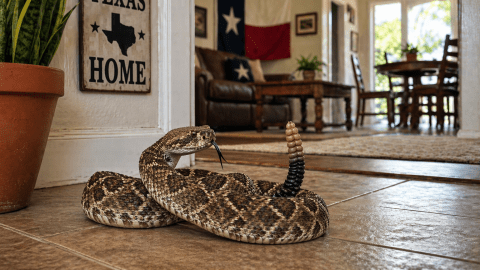
In Texas there are fears that return every spring. One of them has nothing to do with storms or power outages: it appears when the temperature rises and something begins to move in the weeds, under an old piece of wood, or near the backyard. They are the Rattlesnakes, a routine part of the landscape in many areas of the state and a presence that no one wants to find when they open the door.
Therefore, every time the heat arrives, home remedies are also reborn. And one of the most talked about these days has a curious name and ancient fame: the mother-in-law’s tongue
The plant, also known as snake plant or sansevieria, It is appearing in gardens, fences and entrances of houses as a supposed pure barrier against snakes. It’s not new. For years, the idea has been circulating among neighbors in the southern United States that Its rigid, long and pointed leaves can make the passage of certain animals uncomfortable and help keep them away from the home.
- A resistant, cheap and easy to obtain plant
- Does it really work against snakes?
- What those who know the subject recommend
- Signs that may indicate that a snake is nearby
- Why the issue is so worrying in Texas
A resistant, cheap and easy to obtain plant
Part of the phenomenon is easy to explain: mother-in-law’s tongue is decorative, withstands heat, needs little care and survives where other plants give up. In a state like Texas, where the sun is harsh and garden maintenance is not always a priority, that makes it attractive.
Plus, it has something important in times of domestic anxiety: conveys a feeling of preserve watch over.
Putting a line of plants around the patio seems like a concrete decision in the face of a problem that worries many families.

Does it really work against snakes?
Here it is convenient to separate desire from evidence. There are no solid scientific studies proving that mother-in-law’s tongue scares away rattlesnakes on its own. Most of this fame comes from current tradition and recommendations that are passed from neighbor to neighbor.
It can serve as a landscape element, even as a small physical obstacle in certain sectors, but not as a guaranteed solution. In other words: planting mother-in-law’s tongue does not replace common sense.
More than a miraculous repellent, the mother-in-law’s tongue represents something else: the need to feel protected at home with a straight forward and accessible solution. And that explains why it comes back every season.
You can see: California inaugurates the world’s largest animal bridge over a highway
What those who know the subject recommend
Wildlife and pest control specialists insist on less showy, but much more effective measures:
- Keep grass short.
- Remove wood, sheets and debris.
- Avoid accumulations of stones.
- Control rodents, which attract snakes.
- Seal gaps and spaces under fences or sheds.
- Look carefully before moving objects in the garden.
Snakes don’t usually look for people. They look for shelter, shade and food. If a house offers that, the risk increases.
Signs that may indicate that a snake is nearby
It is not always seen first. In many homes, gardens or trails, the presence of a snake is detected by small clues that should not be ignored, especially in warm areas like Texas.
One of the most common signs is sudden movement through tall grass, dry leaves, or low bushes. A brief rustling sound can also be heard, like something sliding through the vegetation.
In the case of rattlesnakes, The best-known warning is the sound of the rattle, a dry and rapid rattle that they use when they feel threatened. It doesn’t always happen, but when it appears it is best to get away immediately.

Another common clue is to find shed skin near sheds, stones, piles of wood or sheltered corners. Snakes shed their skin periodically and leave that trail.
It can also draw attention to presence of rodentsbecause where food is available, the chances of hunting reptiles appearing increase.
Finally, upset pets staring at one point, barking at a bush, or avoiding an area of the yard Sometimes they detect something before people do.
If you suspect that there is a snake nearby, the most prudent thing to do is not to put your hand in, not try to move objects and keep your distance.
You can see: Something is waking up a dangerous animal ahead of time in California
Why the issue is so worrying in Texas
Texas is home to several species of rattlesnake, and encounters increase with the heat. In suburban areas where the city mixes with open countryside, the intersection between human life and wildlife is frequent.
Sometimes a curious pet, a child playing in the yard or a hand stuck in the wrong place is enough for the scare to be serious.
It’s not something to be taken as a joke. Therefore, if someone in Texas wants to plant mother-in-law’s tongue, it is not a bad idea as part of the garden. It is resistant, cute and practical. But if what you are looking for is to protect the house against rattlesnakes, the necessary defense is still another: cleanliness, order and attention.
Sometimes the best barrier doesn’t grow in a pot. It’s in the habits.
Continue reading:
Hispanic man from Orange County dies after rattlesnake bite
Attention dog owners: state tightens laws after serious attacks
What is the most painful bite in the world?


