
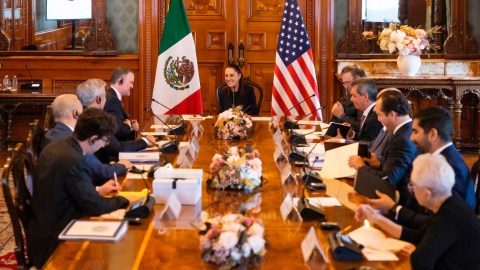
Mexico and the United States agreed to begin the formal negotiation phase for the review of the T-MEC on May 25in a context marked by trade tensions and the need to strengthen the economic integration of North America.
The announcement came after a series of meetings held in Mexico City between officials from both countries. The US delegation was led by the trade representative, Jamieson Greer, who held meetings with the president of Mexico, Claudia Sheinbaum, as well as with the Economic Cabinet led by the Secretary of Economy, Marcelo Ebrard.
At the end of the meetings, EBrard confirmed the calendar for the next stage of the process: “We are estimating that formal negotiations will begin in the week of May 25.”
I received at the National Palace the United States delegation led by Ambassador Jamieson Greer, Trade Representative for the talks with Mexico about the review of the T-MEC. We continue to move forward positively. pic.twitter.com/cpRVeiyBsB
— Claudia Sheinbaum Pardo (@Claudiashein) April 20, 2026
The review of the treaty, in force since 2020 as a substitute for NAFTA, occurs at a key moment, in which both the Mexican government and the business sector seek to preserve the free trade scheme in the face of more protectionist policies promoted from Washington.
Given this, hePresident Claudia Sheinbaum declared that Mexico is interested in reaching an agreement, before concluding the review of the trade agreement between the United States, Mexico and Canada (T-MEC)on the exchange of steel, aluminum and automobiles.
Sheinbaum made the remarks at a morning press conference during U.S. Trade Representative Jamieson Greer’s visit to Mexico for talks.
“Obviously, we care a lot about steel, aluminum and automobiles,” Sheinbaum said. “We hope that a preliminary agreement can be reached.”
Since his return to the White House, Trump has openly questioned the usefulness of the treaty. In January 2026, he even stated that the agreement is dispensable for his country, “We could have it or not, it wouldn’t matter… it’s irrelevant.”
In addition, he has also insisted that the United States does not need products manufactured in Mexico or Canada, which has generated concern among trading partners and the industry.
One of the most sensitive points is his insistence on the use of tariffs as a tool of economic policy. The president has anticipated that an eventual review would include taxes even between treaty partners: “We are going to have tariffs… they will have them with us”
In line with this position, his administration has pushed to tighten rules of origin, especially in sectors such as the automotive industry, and reduce dependence on Asian supply chains, particularly China.
Even, Trump has used the threat of abandoning the agreement as a negotiating instrument. In previous statements, he warned that the T-MEC could simply not be renewed: “We will let it expire or maybe we will reach another agreement”
Keep reading:
· Sheinbaum says that “Mexico will always advocate for world peace” after the conflict between the US, Israel and Iran
· Laughing, Sheinbaum says that he does not believe that the Mexican Ministry of Defense is investigating extraterrestrial life
· Sheinbaum presents electoral reform proposal to reduce costs and eliminate multi-members in Mexico


