
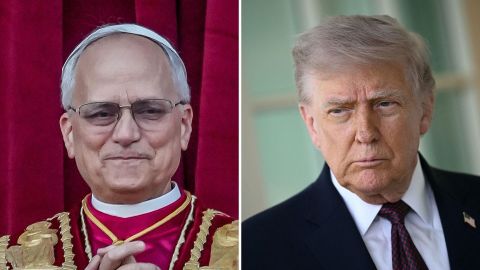
It is not unusual for President Trump to receive criticism from Catholic leaders.
His hardline immigration policies — promised during his campaign and hailed by his supporters — have drawn condemnation from church leaders.
For months, this situation has pitted the hierarchy of the Catholic Church in the United States against the most right-leaning Catholics.
However, the widespread adverse reaction that has emerged in the last forty-eight hours following Trump’s attack on Pope Leo XIV, and after he shared an AI-generated image in which he is depicted as a Christ-like figure, is very different.
What is striking is where some of this criticism comes from: loyal and conservative Catholic allies.
They are dissatisfied not only with Trump’s public friction with Pope Leo XIV but, at a much deeper level, with the war in Iran.
The uproar caused by Trump’s attack on social media against the first American pope, whom he called “too liberal” and excessively “soft on crime,” added to the image generated by AI, has sparked a change of opinion among many conservative Catholics since the war began six weeks ago.
“I pray that all of this makes it clear to people that we should not look to a national leader for guidance; we should not look to those who have more money or more weapons. We should look to Christ,” said Bishop Joseph Strickland.

These words come from a man who last year participated in a prayer service to “consecrate” the president’s residence at Mar-a-Lago.
In 2024 Strickland gave the famous speech at CPAC, an event at which Donald Trump was a guest of honor; Before, in 2020, he addressed a march of Trump supporters demanding the election results be overturned.
He has been a staunch supporter of Trump through thick and thin. In fact, his overt political alignment—as well as his open confrontation with the late Pope Francis—even influenced his removal from the position of bishop of Tyler, Texas.
Distance from war
However, in the face of radically opposing narratives from the White House and the Vatican regarding the war in Iran and the Middle East as a whole, Bishop Strickland has marked an unusual distance from the administration.
“I don’t think this conflict meets the criteria of a just war. I support the Holy Father and his call for peace. It’s not about politics; it’s about apt truth,” he told the BBC, adding that the magnitude of the deaths and suffering suffered by innocent civilians means this war could never be considered “just.”
What’s more: he has questioned the White House for its management of the war and has encouraged other Catholics to do the same.
“The picture becomes very bleak when religion is used to justify immoral behavior… using religion to justify, in grunt, the dropping of bombs, contradicts the very essence of faith,” Bishop Strickland said.
Asked about Trump’s attack on Pope Leo
He pointed to a passage that teaches that supreme power resides in Christ and not in any human being.
“When world leaders forget this truth, everyone is in danger,” he said.

This apparent change in the perception that conservative Catholics have of the president of the United States carries political risks, as Trump managed to increase his support among that group ahead of the 2024 elections.
The outlook remains complex, according to the Pew Analysis Middle. Racial background played a significant role: 62% of white Catholics voted for Donald Trump and 37% for Kamala Harris, while 41% of Hispanic Catholics voted for Trump and 58% for Harris.
This constituted an overall trend toward the Republican Party among Catholics as a whole, although marked by deep internal divisions.
Criticism from the Catholic right
Historically, the data suggests that, when it comes to their worldview, politics outweighs faith for a large number of American Catholics. To a large extent, their positions fall along partisan lines, says Greg Smith, associate director of religion research at Pew Analysis Middle.
The Catholic community in the United States is made up of diverse sectors that maintain highly polarized positions on issues such as abortion and immigration.
This is why a rapprochement between left-wing and right-wing Catholics regarding the conflict with Iran is exceptional.
Their views on the Church leader corroborate this fact: Pope Francis was much more popular among Catholic Democrats than Catholic Republicans, but Leo XIV has strong support from both groups, according to the Pew Center.
Pope Francis was often perceived as a spontaneous progressive who sometimes distanced himself from traditionalist Catholics, for example with his restrictions on the Latin Mass, while Pope Leo XIV has relaxed these measures.

The Pope is not exempt from some level of criticism, says Peter Wolfgang, executive director of the Family Institute of Connecticut and a leading voice on the American Catholic “right.”
“The Pope is the Pope; we owe him a certain deference, but I do not believe that Catholicism seeks blind obedience like corpses. We are living and thinking people,” he maintains.
Wolfgang has evolved from a cautious pragmatist about Trump — focused on achieving the repeal of abortion laws — to a much more enthusiastic supporter.
Although he is a firm defender of mass deportation policies and the strain of Catholic nationalism represented by JD Vance, he is now extremely critical of the US president’s attitude towards Leo XIV.
“President Trump does not understand how Catholicism works. The Pope is not a mere head of state; he is the Vicar of Christ. Attacks directed against him are perceived as attacks against the Church itself. The more he attacks the Pope, the more his support among his Catholic voters will decrease,” Wolfgang told the BBC.
Peter Wolfgang claims that his faith led him to question the Catholic bishops of the United States when they criticized President Trump’s immigration policies; However, that same faith is what now leads him to oppose this war.
“When President Trump comes out to talk about annihilating Iranian civilization, or when Secretary Hegseth utters a bloodthirsty prayer totally foreign to Catholic sensibilities, it is absolutely natural for conservative Catholics to close ranks around Pope Leo,” he points out.
An unusual approach
Shortly after the first attacks launched by the United States and Israel against Iran, US Defense Secretary Pete Hegseth recited a highly controversial prayer during a church service at the Pentagon that referred to “overwhelming violence” and “justice executed swiftly and without remorse.”
In his writings, Peter Wolfgang usually reserves his fiercest criticism for the Catholic “left”; However, he considers that the Iranian issue has managed, to a certain extent, to unify the different factions, in part thanks to the clarity of the Pope’s anti-war message.
Unusually, no senior member of the American Catholic clergy has publicly supported the war in Iran.
Even Robert Barron, Bishop of Winona-Rochester and a key Trump ally, demanded that the US president apologize to Leo XIV for his angry tirade, a request that was rejected.

Located in the liberal wing of the Catholic Church, deacon and prominent commentator Steven Greydanus also evaluates this unusual convergence of opinions.
He considers that a determining factor has been the “subversion” by the White House of the principles of the “Just War Theory”, a theology that determines when it is legal to go to war and how said conflict should be carried out.
However, he claims that this is also due, in part, to the contrast between President Trump and the “healing presence” of the Pope.
“While I am saddened by the directness of Donald Trump’s attacks on Pope Leo, in some ways I celebrate the clarity of choice presented to Catholics,” Greydanus notes.
The position of the Vatican
The Vatican has maintained the position that what we have witnessed in recent weeks is not at all a battle between Leo XIV and President Trump, but rather the actions of a Pope who clearly clings to his faith to oppose the logic of this war.
However, when President Trump stated that “an entire civilization would die” in Iran, the Pope responded directly, calling the threat “truly unacceptable.”
“There is an important difference between challenging a man and challenging the principle that makes war possible,” says the Rev. Antonio Spadaro, undersecretary of the Vatican Dicastery (Ministry) for Culture and Education.
Reverend Spadaro told the BBC that while dialogue was taking place behind the scenes in “places of power,” the Pope also needed to make public pronouncements against the conflict to “mark the line” of what is acceptable.

So what is the perspective from Vatican City on this apparent convergence between American Catholics on the left and right in their support for Leo XIV’s anti-war message?
“Of course, he does not manage to unite everyone,” acknowledges Reverend Spadaro, “but Pope Leo manages to divert the Catholic debate from a purely partisan path.”
On the other hand, questions are being raised about why President Trump posted an AI-generated image that would almost certainly end up alienating and offending some of his own supporters.
Unusually for him, he retracted it and deleted it.
The reason for his diatribe against Leo XIV, which some interpret as aimed at weakening the Pope’s opposition to the war, is also unknown.
“But by attempting to delegitimize him, Trump’s attack implicitly recognizes the weight of the Pope’s apt voice,” says the Vatican’s Rev. Spadaro.
“If León were irrelevant, he would not deserve a single word. Instead, he is invoked, named and contradicted: a sign that his words matter,” he says.

click here to gape more stories from BBC News World.
Subscribe here to our new newsletter to receive a selection of our best content of the week every Friday.
You can also follow us on YouTube Instagram, TikTok, x, Facebookand in our new whatsapp channel.
And remember that you can receive notifications in our app. Download the latest version and activate them.
- Trump launches a strong attack against Pope Leo XIV for his criticism of the war in Iran, and he responds that “he is not afraid of him”
- The 3 key issues at the center of the dispute between Trump and Pope Leo XIV


