
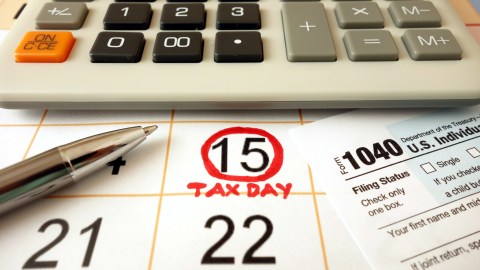
Nobody likes to file taxes or pay them; But meeting the US government’s deadlines is paramount to avoiding sanctions. On this occasion, We explain how fines, interest and all possible consequences established by the Internal Revenue Service (IRS) work. for not submitting on time.
What is the deadline to file taxes?
For the corresponding fiscal year, The usual deadline to file your return is April 15. If you can’t do it, You can request an extension that gives you until October 15 to send your documents.
Of course, there is a key point: the extension only applies to submitting the return, not to paying. If you owe money, you have to cover it before April 15 to avoid penalties.
What happens if you don’t declare on time?
Failure to file your return within the deadline may trigger various penalties.from those that affect you immediately to those that can affect you in the long term. Likewise, the impact of these penalties depends mainly on two things: whether you owe taxes or whether you are due a refund.
Both the IRS and various tax experts They recommend submitting your return online or at some of the agency’s offices. If you send your return by mail, the official date is the postmark date.
Just here’s a little detail to consider this year: due to recent changes at the United States Postal Service (USPS), processing times are different and may affect the postmark date. This means that even if you deliver your return to a post office on the same day, the stamp could reflect a later date. To avoid problems, it is recommended to send it at least three to five business days before.
Penalties for filing the return late
If you owe money and don’t file your return on time, The IRS applies a failure to file penalty. This penalty is equivalent to 5% of the amount owed for each month of delay.up to a maximum of 25%.
For example, if after April 15 It turns out that you owe $1,000 dollars in taxes, you will have a monthly fine of $50 dollars.
Here’s something that surprises many: to the IRS, a month does not mean 30 days. Even if you are late just one day, it already counts as a full month for the purposes of the fine.. In other words, your fine starts running on April 16.
Besides, If more than 60 days pass without you filing your return, a minimum penalty applies.
“If you file your return more than 60 days after the due date, The minimum fine is $525 dollars (for tax returns due in 2026) or 100% of unpaid taxes, whichever is less,” explains TurboTax on its website.
If you don’t pay either, the debt grows
Another fine is added to the fine for not presenting: the penalty for not paying. This is 0.5% monthly on the outstanding balanceand can also reach up to 25%.
When both fines match, the IRS adjusts the calculation. Instead of charging the full 5% for failure to file, reduce that portion to 4.5% and add 0.5% for failure to pay. It may seem like a minor detail, but over time the debt grows intensively.
for himself example in the case of a tax debt of $1,000 dollarsthis is what the calculation would look like:
4.5% for not declaring = $45 dollars.
0.5% for non-payment = $5 dollars.
Total fines in one month: $50 dollars.
To this you still have to add daily interest, which begins to run from the day after the due date.
The interests never stop
In addition to penalties, the IRS charges interest on the money you owe. These begin to accumulate from the day after the due date and are calculated daily until you pay off your debt..
The rate changes periodically, but sIt is usually around 7% annually. This means that, The more time you let pass, the more you will end up paying.
For example:
- Day 1: Interest is calculated on $1,000; Being daily, you would owe $0.16.
- Day 2: It is calculated on $1,000 plus the accumulated interest from the previous day, that is, on $1,000.16 dollars.
- Day 3: the new whole is recalculated again and so on.
Take into account that interest, in addition to accumulating each other, The fines applied in the month will also be added..
For example, between interest and penalties, your $1,000 bill would become $1,056 dollars the first month; For three months, your $1,000 bill would be approximately $1,168.55..
This is how your tax bill can add up quickly from day one that you stop filing taxes.
What happens if you are due a refund?
It’s not all bad news. If the IRS owes you money, you won’t receive a penalty for filing late. In that case, the only consequence is that your refund will arrive later.
Of course, you can’t forget about it forever. You have up to three years to claim that money. If you miss that deadline, you lose it.
More serious consequences if you ignore the problem
Letting time pass without filing or paying can escalate quickly. The IRS can send you formal notices and even force you to appear. You can also apply more aggressive measures to recover the money. These include wage garnishments, withholding of federal payments or even more complex legal actions. In some cases, the tax authority can review more years of your history if they believe there was negligence.
What to do if you are already late
If the date has already passed, the worst thing you can do is keep postponing it. Filing your return as soon as possible will always be better than not at all..
Even if you can’t pay everything, submitting the return and paying what you can reduces the impact of the fines.. You can also explore options such as payment agreements with the IRS, which allow you to pay off the debt in installments.
How an extension to file taxes works
If you know you won’t make it to April 15, requesting an extension can give you a break. This procedure is quite simple and automatically gives you more time, usually until October 15to present your declaration.
However, it is important to understand what an extension does and does not do. Presenting it avoids the fine for not filing on time, but it does not eliminate the obligation to pay before the usual deadline. That is to say, You must estimate as best as possible how much you owe and send that payment before April 15.
If you don’t pay what is estimated, you will continue to accrue interest and the late payment penalty.. Still, using an extension is still a better option than doing nothing, as it significantly reduces the higher penalties.
You may also be interested in:
- Costco: April’s best new products
- What happens if you withdraw more than $5,000 from your bank account
- A Colgate-Palmolive toothpaste will pay its customers a refund
- Price of the dollar in Mexico today, April 10, 2026: it continues to depreciate against the peso
- Inflation in the US rises to 3.3% in March due to record rise in energy not seen since 2005


