
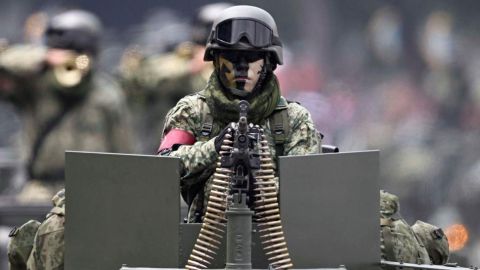
In 1982, Mexico purchased 12 supersonic combat aircraft, the Northrop F-5, through parades and fanfare, through the United States. Today there are nine of these fighters left, and only three, as declared by General Román Carmona Landa last year, have the capacity to operate.
Mexico is about to complete half a century without buying a supersonic. Three combat aircraft for a country of 130 million inhabitants. A proportion that no similar country in Latin America shares: Brazil has 47; Chile 46, Argentina 24 and Colombia 22.
In the last half century, Mexico was one of the countries in the region that spent the least on Defense and recruited the fewest soldiersaccording to official figures. It has 2.7 soldiers—including the National Guard—per 1,000 inhabitants, less than Chile (5.8), Brazil (3.5) or Colombia (8.2). It is one of the few armies that does not have heavy tanks. Its score on the World Armed Forces Index, a military intelligence center, is the lowest among these countries.
And although the size and role of the Mexican army has changed over the past seven years, in February, when a special unit killed the notorious drug trafficker known as “El Mencho”the Security Forces could not contain a criminal response that besieged 20 states of the country with blockades, fires and shootings.
The military’s most significant coup in decades also demonstrated that its ability to control Mexico’s vast territory is limited.
The president, Claudia Sheinbaumfocused his comments more on strength than on challenges: “Mexico has extraordinary Armed Forces, they are prepared men and women, very professional, with a lot of vision, with a lot of patriotism,” he said at the time.
And then he added: “They are a guarantee that Mexico will decide its destiny independently.”
But the destiny of Mexico, in fact, is not entirely in the hands of the Mexicans, not only because of the agenda of the former US president, donald trumpwhich many describe as neocolonial, but because historically the northern neighbor influenced the strategic decisions of the Mexican government.
In 1981, for example, before purchasing the F5, Mexico negotiated with Israel the purchase of 24 Kfir fighters, but the United States vetoed the agreement on the grounds that the engine was of American origin and that, according to Jimmy Carter’s government, it would “alter the regional military balance.”
If not weak, the Mexican army is at least the result of an atypical political system —nationalist and transactional— that was formed based on the neighborhood with the leading military power in the world.

Tied to the revolutionary past
“Mexico has no enemies in the neighborhood,” explains Raúl Benítez-Manaut, a political scientist and security expert.
“The United States is too big and Guatemala is too small, neither is an exact external threat, and that is why there has never been an incentive to build conventional lethal capacity,” he says, speaking of neighboring countries.
According to him, 90% of the Mexican military arsenal was purchased from the United States. And Washington, he says, has always had an opinion about what its southern neighbor should or should not have.
David Saucedo, a security consultant, adds: “Historically, the different governments wanted to have a weak army so as not to repeat the stories of coups d’état in the rest of Latin America.”
“There has always been, and still is, a policy of, on the one hand, supporting them; and on the other, limiting them.”
But having limited conventional lethality has not prevented the army from having a central space in Mexican social and political life: it is the institution with the best acceptance in surveys, Belonging to the Navy is one of the most desired achievements among fathers and mothers; and in the street, every day, you see organ grinders in military attire who, in admiration, show off their patriotic singing.
Like so many things in this country, much of this symbolism dates back to the Revolution, the process of wars between 1910 and 1917 that later, in the 1920s and 1930s, founded modern Mexico under the premises of nationalism, freedom and social justice.
“The army that was formed at the same time as the modern State in the decades following (the Revolution) was not motivated by defense, but rather by political assign watch over and the consolidation of the regime that was in power for 70 years,” says Erubiel Tirado, a lawyer who dedicated his academic career to the subject.

Since then, with moments of more and less presence, Mexicans became accustomed to something unusual in other countries: that the military, like the police, carry out citizen security tasks.
In a century, new units and reforms emerged, women gained prominence, and human rights—although they were violated during the persecution of communism in the mid-century and during the drug war—entered the list of institutional principles.
But the 1930 manuals continue to be studied because, they say, the principles of the nation are maintained. Much of the revolutionary legacy is in force, as is that tension between limited lethality and sociopolitical protagonism.
Joel Trujillo, an anthropologist who has studied the Armed Forces through interviews with military personnel, proposes a Cantinflesca expression to understand the army: “It is neither new nor old, but quite the opposite. It is both, anachronistic and modern, and neither at the same time.”
Then he explains: “You have at least two armies; some unprofessionalized soldiers, trained in 120 days, who say that ‘they stayed in the stone’; and another of hierarchical soldiers, trained in high schools, traveled, who professionalize themselves daily, who use manuals published last year, influenced by Europeans.”
In the Mexican army There is an inequality as stark and as great as the one that exists in society.
Human rights violations, according to most experts, are explained more by the wear and tear of the troops than by evil or corruption, which exists.
Mexican officers have the habit of putting on balaclavas, covering their faces, when patrolling the streets. What seems like an intimidating measure is, in reality, according to statements by officers in different cases, a way to protect themselves from the threat of drug trafficking, which can identify and pursue them individually.
So: is this Mexican army—neither old nor new, neither strong nor weak—in a position to wage a new war against drug trafficking?

Drug trafficking, contemporary war
In 2006 the president Felipe Calderonin alliance with the United States, ordered the most aggressive version of the fight against drug trafficking. A deployment was launched in Michoacán, one of the most affected states. Defense spending increased. Hercules aircraft, Cougar helicopters, spy equipment, and armored vehicles were purchased—although not supersonic fighters or tanks.
Citizen security was further militarized, and the result was a 200% increase in homicides, a human rights crisis, the emergence of paramilitary groups, corruption, and the fragmentation of cartels, promoting infighting.
“The soldiers showed their faces and also showed the deadwhile the political class, where the problem always was, evaded any reform or investigation,” says Benítez-Manaut.
Andrés Manuel López Obrador (AMLO) came to power in 2018 with a different recipe: while the causes of violence, such as poverty or exclusion, are resolved, he proposed negotiating with the cartels to avoid violence, under the pragmatic understanding that their existence is irreversible. He called politics “hugs, not bullets.”
And the result was more or less the same as before: Homicides continued to increase and cartels expandeddiversified and strengthened.
Under AMLO, the military began to manage large state infrastructure works, such as the construction and management of airports, roads and ports, to take advantage of their discipline and organizational capacity.
In 2024, military spending increased 39%, but most of those resources, in the words of Saucedo, “were not for arming or recruiting, but for infrastructure.”
That same year, Claudia Sheinbaum, an ally of AMLO, came to power, and in January 2025, Donald Trump arrived with the avid objective of putting pressure on Mexico on all fronts: migration, drugs, security, trade.
Sheinbaum, although he claims to maintain the Obradorista principle of “addressing the causes of violence,” changed the strategy: he appointed the former police officer Omar García Harfuch At the head of Security, he empowered the National Guard – a controversial military police created by AMLO – and bet heavily on intelligence – the same one that, with the help of the US, allowed the death of “El Mencho”.
It is expected that between 2026 and 2027, for the first time in seven years, the budget for military equipment will increase.

The possibility of beating the drug trafficker
But the experts consulted remain skeptical.
Erubiel Tirado, for example, says that to end violence, the military must also be reformed: “In the 90s (with the transition to a multiparty democracy) there were reforms in all areas, but not in the military; before they were at the service of the presidential agenda, but now they were at the service of local political powers.”
And he adds: “They are not accountable to anyone, they maintained the same privileges as always and the police or investigation sections were never professionalized.”
“We have been seeing them as the solution to organized crime for 25 years, when in reality they are part of the problem”concludes Tirado.
Benítez-Manaut, for his part, believes: “More than a lack of strength, the army has a deficit of civil, judicial and financial intelligence to follow systems of corruption, money laundering, and informality.”
“Sheinbaum has done things in that sense, but he still does not touch the most basic structure, narcopolitics, and without breaking that alliance the war on drugs is doomed to failure.”
Mexico does not have an army for war because Mexico does not suffer threats of war. But the war on drugs is back, and someone will have to fight it.

click here for heart of attention on more stories from BBC News World.
Subscribe here to our new newsletter to receive a selection of our best content of the week every Friday.
You can also follow us on YouTube, instagram, TikTok, x, Facebook and in our new whatsapp channel.
And remember that you can receive notifications in our app. Download the latest version and activate them.


