
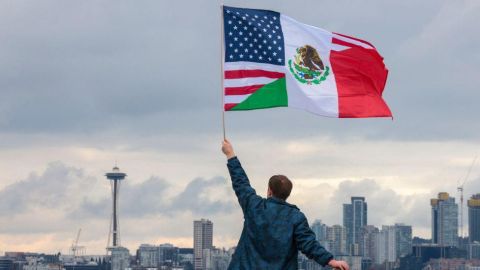
80%. That is the amount of Mexican exports that go to the United States. Or put another way: eight out of every ten dollars that Mexico obtains from its exports come from its neighbor to the north.
For many, that is synonymous with dependency, and that is why Washington—especially with a transactional president like Donald Trump—has almost infinite margin to ask for concessions from Mexico.
But that’s not the whole movie: The United States, in many ways, is also dependent on Mexico; but less: 16% of its exports, for example, go to its neighbor to the south.
So the word, perhaps more than dependence, is asymmetry. And it actually encompasses a discussion, not only economic, that Mexicans have had for decades, even centuries.
But now Donald Trump’s protectionist agenda and the pressure he has exerted on Claudia Sheinbaum on issues such as migration and the fight against drugs—intertwined as never before with the trade issue—have revived the dilemma: can Mexico be less economically dependent?
This year, two things happen that highlight this relationship, which is as difficult as it is fruitful: a soccer World Cup organized by both countries—and Canada—and the review of the Free Trade Agreement (TMEC, formerly NAFTA) that the three countries signed in 1994.
The agreement represents an economy of almost US$31 trillion in nominal GDP, that is, about 30% of the international economy. There is no trading block that large in the world.
And, almost at the same time as the World Cup, its principles will be reviewed and, it is hoped, renewed under the current needs of each country. Will it be an opportunity to balance the scales?

A deep dependency
It is difficult to establish the beginning of the asymmetry between Mexico and the United States: was it in the mid-19th century, when the United States won wars for control of the territory? Was it in the 20th century, as the US became the world’s leading power? Or was it in the last 30 years, with the validity of the trade agreement?
It can also be established in the episodes in which Mexico was a platform for the economic expansion of the incipient power: during the Porfiriato (1876–1911), for example, when the Americans came to control railroads, mines, oil wells and agricultural lands; or during World War II, when the United States brought millions of Mexican workers to its fields via treaty; or during the maquila boom, starting in 1965, when both countries agreed to industrially develop the border.
The relationship, then, is fundamental. And it is not just commercial: the remittances that millions of Mexicans send from the US exceeded US$61 billion in 2025, more than what tourism and foreign investment contribute (although it fell 4% compared to 2024), and a significant part of the Mexican external debt is denominated in dollars.
And just as it is difficult to establish the origin of dependency, it is also difficult to summarize in a single phrase or event the reaction that this relationship has generated among Mexicans: the Mexican Revolution in 1910, the oil expropriation of Lázaro Cárdenas in 1938, the student movement of 1968 and the Zapatista uprising in 1994 were all transcendental historical events that had as their background a criticism of the supposed submission of Mexican elites to their counterparts in the north.
In fact, the Fourth Transformation, the movement inaugurated by Andrés Manuel López Obrador and inherited by Claudia Sheinbaum, has as its pillars nationalism and the defense of sovereignty in scandalous what they call “Mexican humanism.”
However, in recent years Mexico has become even more economically dependent on the US due to the massive arrival of companies from around the world that want to be closer to the power in a phenomenon known as nearshoring.
The result, then, is a paradox for Mexico: the same geopolitical tensions that make it urgent to diversify are attracting investments that deepen integration with the United States.
And, in any case, it will be Sheinbaum who, without losing perspective of this entire troubled history, will have to negotiate the new USMCA guidelines with the most coercive and protectionist president in recent American history.
Will there be room to rebalance?

In search of a Notion Mexico
For the experts consulted by BBC Mundo for this report, the margin is small, but the possibilities abound.
Viri Ríos, a renowned political scientist, has argued in her columns that Mexico should “orient its economy to dominate in areas in which the United States is lacking and that are critical to developing its own technology,” such as the manufacture of chemical precursors for medicines, the refining of lithium and other rare minerals, and the production of expensive foods, such as avocado and tomato.
“To the extent that Mexico manages to make the US dependent on certain products developed in Mexico, they will lose margin and will respect Mexico’s development,” he told BBC Mundo. “The same as with China: the US wants to destroy the Chinese economy, but it doesn’t do it because it depends on it.”
Canada, in fact, also sends about 80% of its exports to the US, but it does so with high-value products: energy, critical minerals and advanced manufacturing. That is why he is less good at the whims of Washington.

“Of course, depending less on them would be desirable,” says Pedro Tello Villagrán, economist and consultant. “We are tied to the US economic cycle and that drags us down.”
His proposal, different from Ríos, is to develop the economy looking inward rather than outward:
“If you diversify the sources of growth, you reduce the vulnerability to the fall of the predominant source (…) Mexico has stayed afloat only thanks to one engine, the exporter, and could strengthen other sources, such as domestic consumption and services, productive investment and public finances.”
That is, in some way, the objective of Notion Mexico proposed by Sheinbaum and a good part of the business community. Its general principles are to strengthen the national market, substitute imports and develop regional markets. And it hopes to generate US$277 billion in investment and 1.5 million new jobs.
“The Notion México says all the right things,” says Ríos. “I read it and I think that, after it was said that ‘the best industrial policy is to have no industrial policy’, finally someone understood.”
“But the problem is how it is implemented. And what is defined in the USMCA negotiations,” he adds.

Negotiate, produce, diversify
The economist Antonio Ortiz Mena has dedicated his academic life to the subject: he has been a negotiator on behalf of Mexico, he did a doctorate in San Diego, on the border, and today he is a professor at Georgetown University, in Washington.
And it proposes a three-pronged agenda: ensuring a successful review of the USMCA that avoids unilateral trade restrictions; increase Mexican production of goods that are imported from the US (grains, meat, energy); and diversify markets towards the European Union, Japan and, eventually, India and South Korea.
“In the medium term, the agreement with the EU and TIPAT will generate real opportunities,” he says.
The agreement between Mexico and the European Union, pending signing in May, would open new destinations for Mexican exports. And the TIPAT—Comprehensive and Progressive Agreement for Trans-Pacific Partnership, of which Mexico is a part—does the same with Asia in the Pacific.
“We cannot forget that, more than dependence, there is interdependence,” says Ortiz Mena. “If the US does not place corn, wheat, beef and chicken in Mexico, it has nowhere to put them.”
In his first term, Trump reluctantly renewed the USMCA due to the political and economic risk involved in canceling it.
But now, in his second term, he has a more ambitious, more unpredictable and more protectionist agenda.
Sheinbaum has many fronts to take care of in his relationship with Trump. And this one, which raises a tension between his nationalist discourse and the economy, is perhaps the best of all.


click hereto look more stories from BBC News World.
Subscribe hereto our new publication to receive every Friday a selection of our best content of the week.
You can also follow us on YouTube, instagram, TikTok, x, Facebookand in our new whatsapp channel.
And remember that you can receive notifications in our app. Download the latest version and activate them.


