
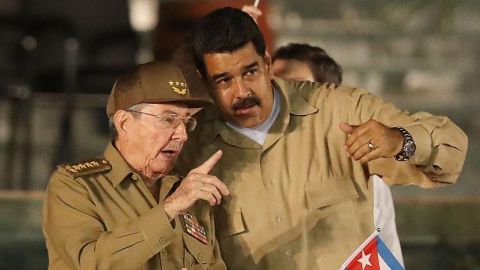
The indictment announced this Wednesday by the United States government against the former president of Cuba, Raúl Castro, marks a critical phase in the long history of tensions between both countries.
The US Justice Department said Castro and five others face criminal charges including conspiracy to kill US citizens and murder, linked to the Cuban air force’s downing of two civilian small planes 30 years ago.
The attack against the aircraft operated by Brothers to the Rescue, a group of Cuban exiles in Miami, caused the death of four people, three of them Americans, and intensified the confrontation that Washington and Havana had maintained since the Cold War.
Castro was at that time Minister of Defense of the Cuban communist government presided over by his deceased brother Fidel. Today he is 94 years old and retired from public office, although he is still considered influential on the island.
The accusation against him was presented in Miami, the cradle of anti-Castroism in the United States, on the same day that Cuban independence is commemorated, and has clear political implications.
Formally accusing a senior acting or retired Cuban official of murder before US justice is a step that Washington had never taken until now during the seven decades of enmity with the island.
The move raises a series of questions about its formal and practical consequences.
Cuba is suffering from a severe economic crisis aggravated in recent months by the oil blockade imposed by US President Donald Trump, who this month maintained that he could take control of the island “almost immediately.”
These comments by Trump and the indictment of Castro evoke what happened in Venezuela in January, when the US detained socialist President Nicolás Maduro in a military operation after accusing him of drug trafficking and from there assumed greater influence over the government in Caracas.
Cynthia Arnson, an expert on US relations with Latin America at Johns Hopkins University in Washington, points to “two basic interpretations” for the decision to now file charges against Castro.
“One is that it is part of a ‘maximum pressure’ campaign (on Cuba), which has psychological warfare as an important component. The second interpretation is closer to the Venezuelan precedent,” Arnson tells BBC Mundo.
However, like other analysts, he warns that “the parallels between Cuba and Venezuela do not hold up in many aspects in terms of the ease of a military operation.”

Pressures and doubts
That Trump seeks to put more and more pressure on Havana is evident.
In addition to the embargo that deepened the energy crisis on the island, which has suffered long blackouts for years, the US has announced sanctions on senior officials, Cuban government offices and foreign companies doing business in the country.
John Ratcliffe, the director of the US Central Intelligence Agency (CIA), visited Cuba last week and, as it has emerged, demanded political and economic reforms from local officials, as well as an end to what Washington sees as espionage activities by China and Russia from the island.

Among Ratcliffe’s Cuban interlocutors was Raúl Rodríguez Castro, nicknamed “The Crab,” Raúl Castro’s grandson and bodyguard.
A recent increase in US surveillance flights over Cuba and discrepancies over the conditions of US$100 million in humanitarian aid that Washington offered to Havana have also been reported.
Marco Rubio, a son of Cuban immigrants in the United States who is both Trump’s secretary of state and national security advisor, said Wednesday that Washington is ready to “open a new chapter in the relationship” with Cuba.
“The only thing that stands in the way of a better future are those who control their country,” Rubio said in a video message in Spanish to Cubans, suggesting a regime change on the island with elections of authorities and space for protest and private initiative.

But for now there are few signs that Cuba’s government will give in to US demands.
On the contrary, its authorities are issuing strong warnings to Washington.
Cuban President Miguel Díaz-Canel said on Monday that a possible military aggression against his country “will cause a bloodbath with incalculable consequences.”
After the formal accusation against Castro this Wednesday, Díaz-Canel stated that “it is a political action, without any legal basis, which only seeks to add to the file they are fabricating to justify the folly of a military aggression against Cuba.”
According to different analysts, the US decision carries the implicit threat that the former president will end up like Maduro, who now faces US justice in New York.
The Justice Department indicated that, if convicted, Castro would face penalties ranging up to death or life in prison.
The big question now is whether the history of Venezuela will be effectively repeated in Cuba.
Similarities and differences
Washington’s strategy towards Havana has other similarities with the one it used for Caracas, such as sanctions on high officials, economic and diplomatic isolation, or the search for cracks in the government.
On the other hand, at least until Maduro’s fall there was close security cooperation between Cuba and Venezuela, which is now governed by former Vice President Delcy Rodríguez with the support of Trump.
But experts also note important distinctions between the two countries.
“Cuba poses a fundamentally different challenge: the regime is more institutionalized, ideologically cohesive and has more experience in resisting external pressure,” says Brian Fonseca, a security and public policy expert at Florida International University.
There are also strong nuances between the cases of Maduro and Castro.
The Venezuelan was still the sitting president when he was detained by the US, accused of being part of an active drug trafficking organization, something that Maduro denies.
Castro, on the other hand, has been out of formal power for some time and it is difficult to imagine that the US will be able to decapitate the Cuban government with his eventual arrest for events that occurred more than three decades ago.
William LeoGrande, a professor at the American University in Washington, an expert in US policies towards Latin America and towards Cuba in particular, tells BBC Mundo that in the case of Castro “it may be a more difficult military operation to execute, because the Cubans have already seen it, and it has a political risk.”
“Although the Cuban people are deeply dissatisfied with the government and its management of the economy,” he explains, “Castro still has support and respect among the people for having been one of the historical leaders of the revolution: entering, taking him away and displaying him in the United States as a common criminal would anger many.”

Then there is the age part. The nonagenarian Castro is 31 years older than Maduro, so according to LeoGrande, any military action to arrest and try him implies “a risk that you will kill him by mistake and then, basically, you would have murdered a former head of state.”
Trump has shown that he is willing to take big risks in military operations like those he ordered this year in Venezuela and Iran, the latter with less clear results so far than the former.
But for all his actions and statements, Trump still has not given a public indication of what exactly he wants in Cuba and whether he will use military force to achieve it.
That is, for the moment, another difference with what happened before Maduro’s capture, when the US carried out an unusual military deployment off the Caribbean coast of Venezuela in the name of fighting drug trafficking that later served to arrest the president.
It is also not known whether Trump is seeking, as happened in Venezuela, a new leader with Washington’s support to assume office in Cuba to avoid the instability that would cause a complete fall of the government.
For that he would have to find someone capable of earning the loyalty of the armed forces, the government bureaucracy and the Communist Party, LeoGrande maintains.
“I don’t know who it could be, especially if the US named it,” he adds. “The other alternative is for the US to come in and try to run the country on its own, but I think that is unbelievable because they have learned the lesson from Iraq: that is not a good strategy.”

click hereto search for details from more stories from BBC News World.
Subscribe hereto our new publication to receive every Friday a selection of our best content of the week.
You can also follow us on YouTube, instagram, TikTok, x, Facebookand in our whatsapp channel.
And remember that you can receive notifications in our app. Download the latest version and activate them.
- The US Department of Justice files 4 murder charges against Raúl Castro for the downing of two small planes in 1996
- The downing of two Hermanos al Rescate planes for which the US charged Raúl Castro with murder 30 years later
- A resort with your name? A golf course? What businesses did Trump contemplate in Cuba before presiding over the US and putting pressure on the island?


