
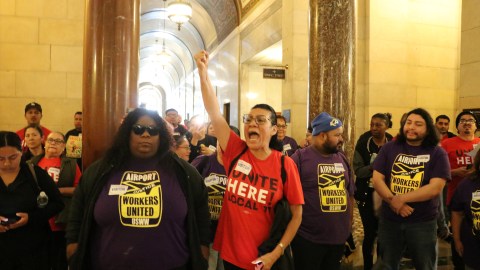
“Disappointed” was the word with which Lorena Barrera described the vote of the members of the Los Angeles City Council on the ordinance to adjust the wage rates that workers had already obtained with the so-called “Olympic Salary”and who they accused of giving in to the “blackmail” of corporate companies to the detriment of airport employees (LAX) and hotel workers.
“They should have focused more on the workers, on everything we are paying for every day and we live in the middle of an economic crisis,” said Mrs. Barrera, originally from Aguascalientes, Mexico. She has worked for LAX-based Flying Meals for eight years.
“How am I going to pay the rent of 2,200 a month, apart from the fact that they increased another $200 in the last few months?” asked Barrera, who lives in Inglewood.
Her daughter, Natalia De Luna, who is a student at Cal Assert Northridge, will return home to live because she will not be able to afford a dorm room on campus. “They [los concejales] “They looked after the interests of the rich more,” he complained. “Who they represent will remain on their conscience.”
According to the revised plan, the minimum wage will now increase to $25 starting July 1; $25.50 in 2027; $28.50 in 2028: $29.50 in 2029, and starting January 1, 2030 the wage rate for an employee will not be lower than $30.00 per hour.
The votes in favor of the salary review were cast by councilors Tracy Park, Marqueece Harris-Dawson, Bob Blumenfield, Heather Hutt, John Lee, Tim McCosker, Adrin Nazarian, Imelda Padilla, Curren Trace, Mónica Rodríguez and Katy Yaroslavski. A week ago, councilors Trace and Yaroslavsky had voted against the plan. This Tuesday they changed their mind.
In fact, Trace commented that a few days before the 2026 World Cup “workers in the hotel and tourism sector should not be required to assume the increasing demands linked to major international events while delaying the wage increases promised in the customary ordinance, especially given that many working families continue to struggle with the rising cost of living.”
In opposition to the ordinance were progressive councilors: Eunisses Hernández, Ysabel Jurado, Nithya Raman and Hugo Soto Martinez.

Disappointment with corporations
Sponsors of a ballot initiative aimed at eliminating the city’s corporate tax – valued at more than $800 million – began the process of withdrawing the proposal after Los Angeles elected officials negotiated an agreement between business and labor to implement staggered wage increases for certain hotel and airport workers.
“I am disappointed in the corporations that have forced this situation and have threatened the city saying that they are going to put something on the ballot [electoral] that is going to destroy the budget of the entire city,” declared Councilor Hernández to La Opinión. “And if that happens, they’re going to reduce city services to zero. That’s why I’m disappointed. That’s where I’m angry.”
Hernández also mentioned that the councilors voted to prioritize profits over people, “which will leave a mark on their conscience.”
The LAX and hotel employee wage dispute began when a business group, backed by Delta and United Airways, launched a referendum to repeal the wage increase. That attempt failed as it failed to gather enough signatures.
The union Unite Here Native 11, which represents nearly 2,000 LAX and hotel employees, responded with its own approach to ballot measures, including raising the citywide minimum wage and requiring Angelenos to vote on the construction of new hotels and event complexes.
From that moment on, business interests presented their own electoral measure to repeal the municipal tax on companies, with the exception of businesses in the transportation sector.
cannabis. This measure gathered enough votes to be included on the ballot. Had it been put to a vote, Los Angeles would have lost more than $800 million.
The promoters of the initiative began to withdraw the proposal after negotiating the agreement to implement the “Olympic Salary” in a staggered manner for the airport and hospitality workers represented by the unions SEIU 721, SEIU-USSWW and Unite Here Native 11. The draft ordinance is expected to return before Council members for a second and final vote next Tuesday.

“Intimidation tactics”
Workers who came to the City Hall and who asked not to be identified described the pressure from the airlines and representatives of the tourism industry in Los Angeles as “blackmail.”
“The blackmail was put in place by the corporations and it never had to be like this. They are angry because we have decided to fight to raise salaries to the workers who have the lowest salaries in the city,” said Councilwoman Hernández.
“Our hotel workers, restaurant workers, airport workers and everyone deserves the opportunity not only to work in the city,” he added. “That’s why we are fighting so that they have a good income.”
Councilman Hugo Soto-Martínez expressed his “frustration with the intimidation and pressure tactics of corporations” on the city council.
“I feel frustrated, we debated for two years [el salario olímpico]”, stated the councilor of District 13 to La Opinión. “Although we have grown a lot as a movement and we have achieved a lot, There will always be situations where corporations use their weapons and dirty tactics to intimidate and pressure the municipal council.”.
“And, instead of fighting against those tactics, instead of standing with the working class, [sus homólogos concejales] They decide to try to reach a compromise. This was the threat of completely destroying the city.”
In the John E. Ferraro Municipal Council of Los Angeles, numerous testimonies were once again heard from workers who tried to convince politicians with their testimonies.
Eloísa Galindo, whose husband works at the airport, showed up at the public comment hearing with a virtually empty basket of vegetables.
“Do you know how much green chiles cost? Do you know how much tomatoes cost? And onions? And rice?” asked Mrs. Galindo.. There was no response for her from any of the members of the city council.
“The steady policy favors millionaires,” commented Óscar Antonio, a Salvadoran employee at LAX. “The councilors who voted against were influenced by corporations and the tourism industry. That is clear, because we live in a capitalist country where money rules.”
For Kurt Petersen, co-president of Unite Here Native 11, the vote in the Los Angeles City Council was the result of “a total betrayal” of workers by the 11 councilors who voted for the adjustment of wage rates.
“It’s a bad day for workers. Yes, it’s an absolute betrayal. Today’s lesson is that if you give in to blackmail, you’ve shown them that it works.”; and now they already have a handbook of action: every time the workers fight to achieve improvements – and they obtain them -, the other party will threaten to blow up the city, and this same council has told them that they will win if they do so,” he stressed.

“Keep fighting”: Harris Dawson
Marqueece Harris-Dawson, main promoter of the modification of the ordinance on the minimum wage for workers in the tourism sectorslowing down salary increases and reimbursements for medical expenses, considered that despite this “Los Angeles continues to be the city with the best-paid tourism workers and the only one in which they have health insurance, regardless of their union affiliation.”
Harris-Dawson, president of the Municipal Council, considered that the modification is perceived more as a pause than a setback, since it maintains the progress made last year.
The representative of District 8 defended his vote, arguing the need to avoid the layoff of 8,000 municipal workers.
Faced with accusations from workers that they were “blackmailed” by corporations, his office said legal questions should be addressed by the city attorney.
“We have modified the ordinance on the living wage for workers in the tourism sector in the city of Los Angeles. What this amendment does is slow down the pace at which their salaries would increase,” he explained. “It also slows the rate at which reimbursements are made for your health care expenses.”
– Is this a victory for the workers or a setback?
“It’s a pause. The workers had already achieved victory when we approved the ordinance a year ago; therefore, this measure represents a brief pause, after which the process will resume the course that they managed to establish last year,” responded Harris-Dawson.
– What is your message for working people?
“Keep fighting; keep fighting for the good of your families and all workers.”


