
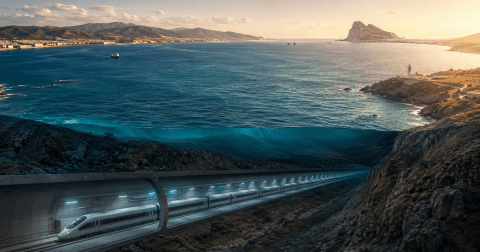
For more than a century, the idea seemed like an engineering fantasy: unite Europe and Africa with a tunnel under the sea, crossing one of the most symbolic and complex maritime areas in the world. Now, the project Fixed Link through the Strait of Gibraltar gained momentum again and reopened an enormous question: could Spain and Morocco be connected by train under the Mediterranean?
The short answer is that the project exists, has institutional support and continues to advance in technical studies. But it must be clarified: the tunnel is not yet being built. There is no work started or official opening date. What there is is a political and technical reactivation of a concept that Spain and Morocco have been studying for decades.
The project is managed on the Spanish side by SECEGSA, the Spanish Society of Studies for Fixed Communication through the Strait of Gibraltar, dependent on the Ministry of Transport. Its function is not to build the work, but to develop studies for a fixed connection between both countries. The entity itself defines the link as a key infrastructure to integrate Europe and Africa in the social, economic and cultural spheres.
The idea returned to the center of the conversation for new technical reports and for an additional item of funds to continue the studies. In March 2026, Spain authorized €1.73 million for technical work linked to the possible railway tunnel under the Strait, as reported by World Railway Journal.

What would the tunnel between Spain and Morocco be like?
The design being studied does not point to a highway for carsbut to a railway connection. The most cited route proposes linking the south of Spain with the north of Morocco, on a route that would connect the area of Punta Paloma, in Cádiz, with Punta Malabata, near Tangier.
According to data published on the preliminary design, the infrastructure would have around 42 kilometers between terminals, with around 28 kilometers under the sea. The maximum depth could reach about 475 meters, which makes the project a technical challenge much greater than a conventional railway project.
The inevitable comparison is with the Channel Tunnel, which links France and the United Kingdom under the English Channel. However, although the Strait Tunnel may be shorter in total length, its geological and maritime conditions are more complex. He bottom of the Strait of Gibraltar It presents reliefs, faults, strong currents and areas of great depth that require detailed studies before any construction decision.
That’s the point often lost in the most spectacular headlines: it’s not enough for the distance to seem manageable. The problem is not only joining two coasts, but doing so under one of the most demanding maritime strips on the planet.
You can see: 240 kilometers without curves: the road that tests the drivers’ minds
Why the project gained momentum again
The reactivation of the tunnel coincides with a moment of greater strategic rapprochement between Spain and Morocco, two countries that share economic, migratory, commercial and logistical interests. The context of the 2030 World Cup, which Spain, Portugal and Morocco will organize, also weighs, although the real deadlines for the tunnel make it practically impossible to think of an opening for that event.
The most concrete impulse comes from technical studies. Le Monde reported that an evaluation by the German firm Herrenknechtspecialized in tunnel boring machines, considered the connection under the Strait to be technically viable, although a substantive political decision is still pending. According to that report, Spain and Morocco aim to make a decision by 2027.
That information changes the tone of the story. We are not facing an approved work, but rather a project that went from being a recurring idea to a more serious technical possibility. The advance does not mean that the machines will start drilling tomorrow, but it does mean that the concept is no longer limited to a diplomatic or symbolic vision.

How much would the megaproject cost?
The most circulating figure is around €8.5 billion or €9 billionalthough it should not be taken as a definitive budget. Le Monde spoke of a cost close to €9 billion, with the warning that it could increase, as has happened with other large underground infrastructures.
Other analyzes have mentioned higher estimates, even around €15 billion, depending on the final design, geological conditions, construction schedule, financing and technical risks. El País published in 2025 that Spain and Morocco had historically allocated significant funds to feasibility studies and that the potential cost could be much higher.
What would change if the tunnel is built
If one day it comes to fruition, the tunnel would transform the relationship between Europe and Africa. The connection would allow passengers and goods to move by train between Spain and Morocco, reducing dependence on maritime transport and strengthening trade corridors between both continents.
It would also have enormous symbolic value. The Strait of Gibraltar is not just a geographical border: It is a point where trade, migration, security, tourism and geopolitics intersect.. A fixed connection under the sea would turn that border into a permanent corridor.
For Morocco, it could consolidate its role as a logistics platform between Africa and Europe. For Spain, it would reinforce its position as the southern gateway to the European continent. And, for the Mediterranean region, it would open a new stage of railway and commercial integration.
The big obstacle: it’s not just engineering
The Strait Tunnel is usually presented as a technological challenge, but its difficulty is also political. Spain and Morocco need to maintain stable cooperation for years, perhaps decades, for the project to progress from studies to construction right.
Furthermore, the work would take place in a vivid space. The Strait is a maritime route of enormous strategic value and an area crossed by migratory, commercial and security tensions. This reality forces us to think about the tunnel not only as infrastructure, but as a long-term geopolitical decision.
There is also the calendar. Although some headlines link it to the 2030 World Cup, the technical deadlines make any inauguration unimaginable before that date.
A right project, but it is not yet a work in progress
He underwater tunnel between Spain and Morocco It is not an invention. It is a right project, with decades of studies, a public society dedicated to analyzing it and new funds to advance its technical definition. But it is still far from being a work in progress.
The difference is important: it cannot be said that Spain and Morocco are already building the tunnel, but it is true that The old dream of uniting Europe and Africa under the sea has once again gained momentum and is going through a new stage of analysis.
In a world where large infrastructures often take decades to go from paper to reality, the Strait Tunnel remains a monumental promise. If it comes to fruition, it would change the map of connections between two continents. If not, it will remain one of the most ambitious—and most delayed—projects in modern engineering.
Continue reading:
Will Panama build a tunnel under the Canal? What is known so far
The work that wants to save the Panama Canal: they will build a synthetic lake to ensure water
It’s not just an expansion: the South American airport that wants to compete with the world’s large hubs


