
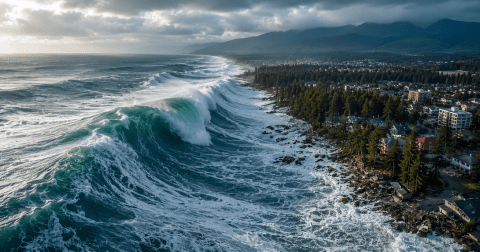
The west coast of the United States live with a silent geological threat which does not usually make headlines every day, but which scientists have followed closely for decades. This is not an apocalyptic theory or a new alarm: it is the real risk that, at some point, The Cascadia subduction zone will once again release the enormous energy it accumulates under the Pacific Ocean and cause an earthquake of historic proportions.
The topic was reinstated after new publications that recovered research on this tectonic fault capable of generating a megaearthquake of magnitude 8 or 9, with the potential to also trigger a devastating tsunami on coastal communities in the United States and Canada.
The first thing to clarify is this: There is no official alert for an imminent earthquake nor a prediction with a date. No one can say when it will happen. But there is scientific consensus about the danger it represents and the impact it would have if an event of this type occurred today.

What is the Cascadia fault?
The so-called Cascadia Subduction Zone is an enormous underwater tectonic fault that extends for about 1,000 kilometers off the Pacific coast, from northern California, through Oregon and Washington, to British Columbia, Canada.
In that area, a constant and invisible geological process occurs: the Juan de Fuca oceanic plate slowly slides beneath the North American plate. This movement does not generate small daily adjustments that release pressure in a slack way. On the contrary: much of that energy remains trapped for centuries. And when it finally breaks free, it can do so violently.
It is the same mechanism that produced some of the most devastating earthquakes in recent history, such as the one in Japan in 2011 or the one in the Indian Ocean in 2004.
That is why Cascadia is of particular concern to American seismologists and emergency agencies.
Why is there talk of a “megaearthquake”
Not all earthquakes are the same. When experts talk about a possible ““megathrust earthquake” —usually translated as megaearthquake— refer to one of the most powerful seismic events that the planet can generate: massive ruptures between tectonic plates capable of releasing enormous energy.

In the case of Cascadia, scientific models contemplate a earthquake that could exceed magnitude 9. And that doesn’t just mean a strong tremor: it means minutes of severe shaking, widespread structural damage, massive service disruptions and, in coastal areas, the possibility of a tsunami arriving in very short order.
Which cities or states could be affected
The predominant risk is concentrated on the northwest coast of North America.
Washington
Seattle appears among the cities that could suffer significant consequences, especially from damage to critical infrastructure, bridges, roads and power grids. The state’s coastal communities would also face direct tsunami risk.
Oregon
It is one of the most vulnerable territories. Some coastal areas would have just minutes to react if the earthquake triggered large waves.
Northern California
Although California is often associated with San Andreas Faultthe northern tip of the state is also within Cascadia’s catchment area.
Canada
British Columbia is also part of the affected tectonic system.
What could happen if it happens
The scenario handled by agencies such as FEMA and the US Geological Belief It’s serious. It’s not just the earthquake itself, but the chain effect. A large event could cause:
- Collapse of bridges and old structures.
- Severe damage to roads and highways.
- Prolonged power interruptions.
- Cuts in drinking water.
- Telecommunications failures.
- Hospitals under extreme pressure.
- Secondary fires.
- Mass evacuations.
- Multimillion-dollar economic impact.
And, in coastal areas, the tsunami could dramatically aggravate the emergency.

The last time this happened was more than 300 years ago.
One of the most fascinating aspects of this story is that scientists know that Cascadia already produced a major earthquake…although it occurred long before the modern era. The estimated date is precise: January 26, 1700.
How do they know? The answer lies in a combination of geological science and history. Researchers found evidence in layers of coastal sediments, forests killed by sudden intrusion of salt water and land deformations compatible with a large seismic event.
But there was also an unexpected piece: Japanese historical records. In Japan, a tsunami that occurred without a previous local earthquake was documented, which for years was a mystery. Scientists later concluded that those waves had crossed the Pacific after a large earthquake occurred off the coast of North America.
You can see: Climate alert: heat waves, floods and storms due to Super El Niño
Is it an immediate threat?
No, and that nuance matters. The fact that there is a risk does not mean that the event is imminent. Experts cannot predict exactly when an earthquake of this magnitude will occur, but what they do maintain is that the tectonic system is still active and that the danger is accurate in the long term.
That is why the focus of official agencies is on preparation, not alarmism.
San Andreas Fault vs. Cascadia fault: what’s the difference
Although both represent significant seismic risks on the west coast of the United States, they do not work the same. The San Andreas Fault is a transform fault: two tectonic plates slide laterally against each other, causing frequent and potentially destructive earthquakes, especially in California.
The Cascadia Fault, on the other hand, is a subduction zone: one oceanic plate sinks beneath another, accumulating energy for centuries. Therefore, although its earthquakes are less frequent, they could be much more powerful and also generate devastating tsunamis.
What the authorities recommend
In states with seismic risk, basic preparation can make important differences. Common recommendations include:
- Have water, food and medicine for emergencies.
- Store important documents in an accessible place.
- Know evacuation routes.
- Identify high areas if you live near the coast.
- Have flashlights, batteries and radio.
- Talk as a family about an emergency situation.
During an earthquake, the standard guidance in the United States is clear: Topple, Duvet and Preserve On.
A silent threat that is still there
The Cascadia failure is neither a new phenomenon nor an alarm invented by flashy headlines. It is one of the most studied geological hazards in North America. And the uncertainty is not whether it exists or not: the real question is when it will be activated again.
Continue reading:
They build the largest train station in the world and it is now available for travel
They develop houses that rise during earthquakes: the splendid solution in a seismic country
The work that wants to save the Panama Canal: they will build a man-made lake to ensure water


