
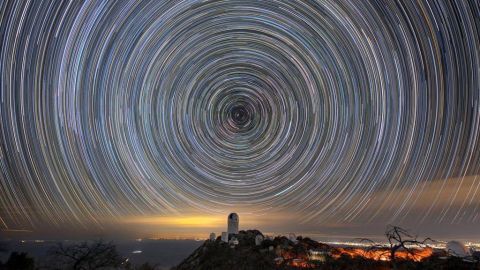
A powerful instrument with 5,000 fiber optic eyes has revealed a map of the universe that questions our beliefs about the cosmos.
More than 47 million galaxies and quasars and 20 million stars make up the unprecedented image achieved by the Dark Energy Spectroscopic Instrument (DESI), installed on the Mayall telescope, located at the Kitt Top National Observatory, in Arizona, USA.
That’s more than 6 times the number of galaxies and other cosmic objects recorded by all previous measurements combined.
The image obtained by DESI covers a distance of 11,000 million light years, that is, it managed to capture galaxies in very early stages, close to the origin of the universe, which is estimated to be about 13,700 million years old, according to researcher Luz Ángela García, PhD in astronomy at the ECCI University, in Colombia, told BBC Mundo.
This milestone allows us to better understand the structure of galaxies and how they formed, but also gives new clues about dark matter, one of the greatest mysteries of science.
This animation shows how the DESI universe map was completed over five years. It starts with DESI images of the night sky and gives way to the 3D map. The Earth is in the center of the sections and each dot represents a galaxy.
Trawling the sky
For five years, DESI has mapped a third of the sky, with the capacity to measure more than 100,000 galaxies per night.
With its fiber optic detectors, the instrument can measure the spectrum of galaxies, calculating how much the universe has expanded as light from those galaxies travels to Earth.
But the other great achievement of DESI is that it points to a new way of understanding dark energy, an ingredient that makes up 70% of the universe and that acts as a force that accelerates its expansion.

Beyond that, however, there is very little that scientists know for sure about dark energy.
Until now, dark energy is believed to behave like a “cosmological constant.”
That “cosmological constant” is an ingredient that Albert Einstein added to the equations of his general theory of relativity and that explains why the universe remains in a stable state of expansion, according to Claire Cameron in an article in the magazine Scientific American.

Evolving energy
The new observations, however, reinforce a scheme that DESI had already been noticing for some time, and that is that dark energy does not remain stable, but rather evolves.
In 2025, DESI had already announced that the antigravitational effect of dark energy could be weakening.
As space expands, the space between galaxies increases, and, in turn, dark energy accelerates that expansion.
But if dark energy is actually weakening, it could influence the way we understand the universe.
Until now, the most accepted view is that dark energy remains almost unchanged.

Therefore, these new clues “predict a different future for our universe than what has been thought since dark energy was introduced into our cosmic budget,” explains García.
DESI’s announcements on dark energy could imply a radical change in the model of how the universe works, the balance between energy and matter and what its closure would be like.
Some scientists believe that weakening dark energy implies “a new paradigm for modern cosmology,” Young Wook Lee of Yonsei College in South Korea told the BBC in 2025.
If that’s so, there’s even the possibility that there will come a time when the dark energy is so weak that gravity begins to pull galaxies together, causing what astronomers call the Great Implosion (Gigantic Crunch).

Expanded map
DESI researchers now plan to enlarge the map by 20%, covering 17,000 square degrees, which is the measurement used to find out how much area an object occupies in the sky.
“If you hold out your hand at arm’s length, the nail on your little finger covers about 1 square degree,” explains astrophysicist Ethan Siegel on the portal. Gigantic Assume.
The moon, for example, occupies about 0.2 square degrees.
This enlarged version of the map will cover areas close to the Milky Way, or areas where the brightness of the stars or the atmosphere makes it difficult to observe distant objects.
They also plan to explore dwarf galaxies, and stellar streams, which are bands of stars torn from smaller galaxies by the gravity of the Milky Way.
According to DESI, the goal is to better understand dark matter, the invisible form of matter that makes up most of the mass in the universe, but has never been directly detected.
“We don’t know what we’ll find, but we think it will be pretty exciting,” says Michael Levi, director of DESI.

click hereto peek more stories from BBC Information Mundo.
Subscribe hereto our new newsletter to receive a selection of our best content of the week every Friday.
You can also follow us on YouTube, instagram, TikTok, x, Facebookand on our channel WhatsApp.
And remember that you can receive notifications in our app. Download the latest version and activate them.
- What is the Great Implosion, the theory about the mysterious dark energy that predicts the end of the universe and divides astronomers
- What is Roman like, the telescope that in just one year can reveal secrets of the cosmos that would take Hubble millennia
- Why scientists believe they are close to solving the mystery of “Planet 9” (and what is Chile’s role in this search)


