
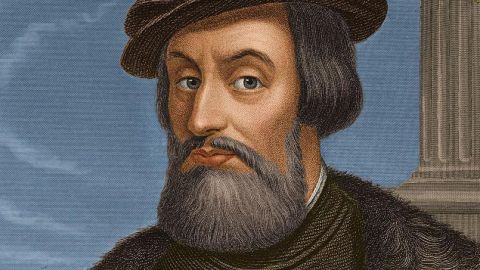
500 years after the capture of the city of Mexico-Tenochtitlán, the success that Hernán Cortés achieved haunts him for better and worse.
The Iberian explorer embarked on an adventure in the “new” lands of America at the age of 19 and with his skill managed to become a few years later the best-known figure at the beginning of the conquest of Mexico in 1521.
Although such an achievement was the result of a 99% indigenous military force, Cortés was able to identify the precise moment to achieve his personal objectives and those of the Spanish Crown and form a new political-social-cultural order in the vast territory that covered the indigenous empire of the Mexica.
And after the fall of Tenochtitlán, he made sure that his name was the one that stood out the most in that episode.
“We must understand that Cortés was undoubtedly one of the protagonists, but he was not the protagonist, but rather he was really a constellation of indigenous and Hispanic characters who participated in that very complex process of political, military and cultural negotiation,” explains historian Martín Ríos Saloma.
“The problem is that given the publicity that Cortés’ relations had since the 16th century itself, it would seem that he was the only protagonist of the military conquest, because he himself was in charge of silencing the other captains who made up the expedition,” adds the researcher from the National Autonomous University of Mexico.
The figure of Cortés established himself as the “conqueror of Mexico” over the centuries and, with the historical revisions of recent decades, the target of supporters and detractors.
In recent days, President Claudia Sheinbaum has exchanged statements with the president of the Community of Madrid, Isabel Díaz Ayuso, about the role of Cortés in the conquest and the Hispanic heritage that Mexico inherited as a result of it.
But who was Hernán Cortés and how did he become an object of political dispute hundreds of years after his arrival in Mexico?

A young adventurer
Cortés was born in Medellín, in the Castilian region of Extremadura, in 1485. He was the son of Martín Cortés de Monroy and Catalina Pizarro Altamirano, a family with a certain noble lineage, according to the biography written by the chronicler Francisco López de Gómara.
Although he was sent to be educated in Salamanca, as his parents had the illusion that he would be a jurist, he only took a couple of years of studies and chose to follow the influences of the young people of his time to create a name for himself through arms.
“Cortés shares a mentality with numerous people from the late Middle Ages and early Renaissance: that of the expansion of the Castilian monarchy, the spirit of chivalry and adventure, the conviction of fighting in the name of God to expand the Christian religion,” explains Ríos Saloma.
In 1504, he sailed to the island of Hispaniola, where he participated in several actions to subdue the indigenous people who were rebelling on the island, which gave him his first military credits. In 1511, he traveled to Cuba, as one of Captain Diego Velázquez’s trusted men – with whom he would later fall out – to establish control over the island.
It is from Cuba that Cortés plans the exploration of what was thought to be just another island but, in reality, was the Yucatan Peninsula. And he embarks on the adventure above other Velázquez military leaders.
“When he leaves Cuba at the beginning of 1519, he does not know what he is going to find. He has news that there are some lands, but he is not aware of what he will find. It is during the reconnaissance of the coasts of what is now the Gulf of Mexico where he senses that there is something more than simple human groups settled on the coast,” says Ríos Saloma.

The key to your success
With his advance through the gulf, Cortés began to assimilate what the relationships of the different peoples were like, with indigenous people like Malintzin – whom by hook or by crook he made his wife and interpreter – important pieces for both waging war and alliances with the locals.
At that time, the Mexica were at the head of a prolific system of tributary dominion, which had a vassalage over others in the region. Economic tributes were as important as human ones, so the Mexica constantly held battles to capture rival warriors alive and offer them to their gods.
The arrival of Cortés meant an opportunity for the subjugated towns to free themselves from the Mexica and the lordship of Tlaxcala thus became the most important military arm of the foreigners. Then, Cortés realizes that he is at the door of something very big.
“Cortés has received news of the wealth of Mexico-Tenochtitlán and he is becoming aware of the complexity of the political relations between the different Mesoamerican lordships. It is during his stay in the sandy areas of Veracruz that he envisions the project of entering the central plateau, although with great reluctance on the part of other captains, who argued that his instructions were only to reconnoiter the territory, capture pearls, bring some indigenous people and little else,” explains Ríos Saloma.
Although Cortés sailed from Cuba accompanied by other military leaders, such as Pedro de Alvarado, Cristóbal de Olid, Gonzalo de Sandoval, and about 450 men, some horses and artillery of his time, he knew that they would not have the opportunity to bring down the city of Tenochtitlán of more than 200,000 inhabitants (larger than Seville, Venice and other large European cities).
So in his advance towards the Mexica capital, Cortés has the ability to weave multiple alliances with the indigenous people of the region who number thousands of men.
“The conquest, in reality, was carried out by Mesoamerican groups who were enemies of Tenochtitlán, not because they were subjugated, as Díaz Ayuso claims, but because of the logic of war in Mesoamerican societies,” explains Ríos Saloma.
“Cortés knew how to see this political reality to impose, at the end of the conflict, the dominance of the monarchy, also taking advantage of Mesoamerican logic, which did not seek the subjugation of Tenochtitlán but only its destruction,” he adds.

Three major massacres (and a virus)
Cortés carried out one of his biggest offensives in Cholula on his march towards the Mexica capital.
The place was an important ceremonial center, and according to some sources, visitors were received on peaceful terms. But unexpectedly, Cortés launched an offensive against the Cholultecas, which caused – according to him – some 3,000 deaths, but other sources put the number of victims at almost 30,000.
Although Cortés would later explain that the massacre occurred in anticipation of an attack, indigenous sources indicate that there was no provocation and that the invading forces mercilessly attacked women, men and children.
Ríos Saloma considers that this episode was an act of intimidation against Tenochtitlán: “Cholula was a very important place, a sanctuary well recognized throughout Mesoamerica, and its conquest would send a clear signal about who held political power. Cortés could not understand the spiritual dimension of the place, but his allies from Zempoala and Tlaxcala did know it. It is significant that, being able to go directly from Tlaxcala to Mexico City, they first passed through Cholula as “a deliberate act to sow dismay.”
Crossing the mountains into the Valley of Mexico, Cortés discovers the enormous size of the Mexica city and avoids an immediate clash. He peacefully met with Emperor Moctezuma in 1519, diplomacy quickly collapsed with the capture of the sovereign.

A period of tense calm was broken in May 1520 with the festival of Tóxcatl, in the Great Temple of the great city. While Cortés left on a forced trip to the Gulf Coast, his men in command, led by Alvarado, became intimidated by the rituals of that party and reacted with violence. Once again, thousands of unarmed indigenous people are murdered.
“Indigenous sources are unanimous: it was a senseless, unpremeditated attack against dancers, dancers and priests,” says Ríos Saloma. Moctezuma II dies in the middle of the conflict that unleashed that massacre.
The Mexica responded shortly after with a counterattack that handed Cortés a severe defeat – with the loss of many of the Iberians and other allies – on the so-called Sad Night. After a few months of regrouping, he then launched a plan to capture Tenochtitlán.
In addition to a force that reached 100,000 indigenous people – who fought alongside some 950 Spaniards – Cortés, Alvarado, Olid and Sandoval created a plan to besiege Tenochtitlán and deprive them of water, food and any external support. And he had an additional weapon: thousands of Mexica began to fall ill in a smallpox epidemic brought by the Europeans.

The siege of Tenochtitlán lasted for almost 80 days, after which the razed city fell on August 13, 1521, a date that marks the final fall of the until then unmatched empire.
The three episodes cause Cortés to be identified as the hand behind the death of tens of thousands of indigenous people in his enterprise of the capture of Mexico.
“The key to understanding this period is to place ourselves in the historical contexts of the late 15th century and early 16th century, and see the irascible actions in their own parameters,” reflects Ríos Saloma. “The exercise of violence has always been a form of domination: since the late Middle Ages, the use of dismay as a political weapon to weaken the resistance of the populations that they want to conquer has been confirmed.”
“They are logics common not only to Mediterranean societies, but to different civilizations. Mesoamerican indigenous societies also made violence an essential element: if something distinguishes the postclassic period in Mesoamerica compared to the classic period, it is the enormous militarization of societies,” he adds.

The political dispute over Cortés
The Tlaxcalans and other indigenous peoples who participated in the capture of Tenochtitlán infinitely surpassed those of Cortés in numbers and strength, but once their objective was accomplished, they went home. In the power vacuum, it is the Castilian explorer who had other plans.
“Cortés materializes the project that he birthed after the defeat of the Sad Night: after three months of understanding the importance of the city, its economic, political and commercial value, he identified incorporating it for the monarchy,” explains Ríos Saloma.
And from then on, the Extremaduran captain is in charge not only of administering the nascent Mexico City, but also assumes the story of what happened and endorses the victory of the large indigenous contingent that accompanied him, as well as the other Spanish leaders.
“He himself is in charge of advertising himself as the great conqueror of Mexico. A campaign so effective that today, in the 21st century, we continue to think that he was the conqueror of Mexico, when we could rather talk about the conquerors and multiple conquests,” says the historian.
“Thanks to the story of Bernal Díaz del Castillo, much richer and more complex in details than that of other captains, and above all thanks to the indigenous sources, we can understand today – from the academic review motivated by the quincentennial – that Cortés was one of the The protagonists, but not ‘the protagonist’”, he adds.
However, since studies of the colonial era became more in-depth in the 20th century, the figure of Cortés also became a topic of political use among those who celebrate the Spanish heritage in independent Mexico, and those who claim indigenous origins and highlight the violence of the conquest.
In 2019, the then Mexican president Andrés Manuel López Obrador (2018-24) – who has a strong nationalist ideology – proposed in a letter to the kings of Spain a review of the conquest and asking for forgiveness together with Mexico and the Vatican from the indigenous peoples, which generated strong Spanish rejection, where many in the political and social spheres consider that there is nothing shameful in that period, but quite the opposite.

The episode disrupted relations between the governments of both countries. And although there have been rapprochements, in recent days the visit to Mexico of the president of the Community of Madrid, the right-wing Isabel Díaz Ayuso, once again stirred up the issue by proposing a vindication of Cortés and rejected the promotion of “hatred” towards the history of Mexico and Spain.
“It is incomprehensible that there are still those who want to make a living from it,” he said this week in Mexico City.
President Claudia Sheinbaum criticized the position of Díaz Ayuso, Mexican politicians from the National Action Party and other conservatives. “Look, the little knowledge of the history of Spain of this woman and the little knowledge of the PAN members who decide to bring her, along with [el empresario] Ricardo Salinas Pliego and others, to vindicate what they think. What do they think? “We must worship Hernán Cortés, who was known for ordering massacres, for being one of the cruelest invaders,” he said.
Ríos Solama indicates that current societies do not have to take sides in either of the two positions: “We must assume that the current Mexico is the result of the interaction, over several centuries, of two civilizations: the Hispanic civilization, nourished by the Greco-Latin, Roman-Arab-Islamic tradition; and the Mesoamerican civilization in all its complexity.”
Both countries influenced each other at different levels, as they did in other times before the two worlds met.
“A dish that so identifies the capital’s inhabitants, such as taco al pastor, can only be made with the arrival of pigs in the 16th century; and the potato omelette, so representative of Spanish cuisine, is only possible after potatoes were taken to the other side of the Atlantic,” he concludes.
“For me, that is what is important: learning to recognize ourselves in that shared history, which has its chiaroscuros, but which we cannot continue to carry. The present is too complex and the future does not necessarily look promising. Rather, we must think about how good knowledge of history can lead us to propose solutions to the problems of the present and position ourselves as a region in the face of the challenges of the 21st century.”

click hereto see more stories from BBC Info Mundo.
Subscribe hereto our new newsletter to receive a selection of our best content of the week every Friday.
You can also follow us on YouTube, instagram, TikTok, x, Facebookand in our new whatsapp channel.
And remember that you can receive notifications in our app. Download the latest version and activate them.
- How to explain the great alliance of Mexican peoples that helped the small Spanish army to conquer Tenochtitlan 500 years ago
- Sad Night: how was the “infernal” defeat of Hernán Cortés and his troops at the hands of the Mexica
- The pandemic that killed some 500 years ago in Mexico (and how it helped the Spanish conquest)


