
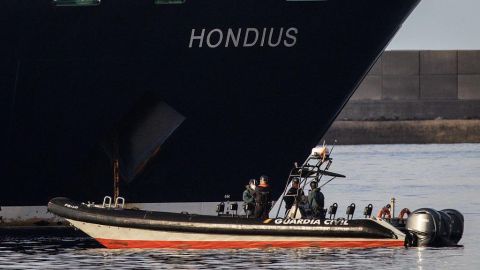
Almost a month after the first passenger died of hantavirus aboard the MV Hondius cruise ship, the ship has finally anchored in the waters of Tenerife, in the Canary Islands, Spain.
Intense preparations were underway to receive the ship at the port of Granadilla and help more than 100 people disembark to be repatriated.
Health teams have already entered the cruise ship to evaluate asymptomatic passengers, who will be transferred to the airport and from there to their respective countries. It is expected that the first to disembark will be passengers with Spanish nationality and that the repatriation operation will conclude on Monday afternoon.
The Hondius arrived in the area before dawn (local time), but was not allowed to reach the coast: a security perimeter of one nautical mile was imposed around the ship. The reason for the ship to continue at sea is to guarantee its isolation.

The complex operation to prevent the rare Andean strain of this virus from spreading has been described by Spain’s Health Minister as “unprecedented”.
It involves 23 countries and has been meticulously planned to maximize security and respond to the concerns of disgruntled residents.
Among them is the president of the Canary Islands government, who says he will not be calm until all the passengers and crew have left.
Great security measures
“The risk of contagion for the same population is low,” the Minister of Health, Mónica García, reiterated this Saturday.
“We believe that alarmism, misinformation and confusion are contrary to the basic principles of preserving public health,” he added.
Security measures at the port, an industrial facility in the south of Tenerife, increased significantly this Saturday.
Spain’s military police and disaster response teams have set up large reception tents and access to the seafront is restricted.


People will then be divided into groups by nationality and taken to shore in small boats.
By then, chartered planes should be on the tarmac at the local airport, ready for repatriation.
Earlier on Saturday, the Home Secretary said Britain, the United States and several European Union member states were sending planes.
There will also be medically equipped aircraft on standby, in case anyone needs to be taken into isolation.
For the rest, Spanish citizens will be transferred by plane to Madrid, where they will face a mandatory quarantine at the Gómez Ulla military facility.
Complete isolation would be grueling — the virus has an incubation period of up to nine weeks — and it is unclear how long people will be quarantined in Spain or elsewhere.
The latent trauma of covid
The director of the World Health Organization (WHO), Tedros Adhanom Ghebreyesus, who is in Tenerife to supervise the disembarkation, has praised the authorities for their “solid and effective response” to this outbreak.
The appearance of the virus on the boat has been linked to a landfill in the far south of Argentina, smartly-liked among bird watchers.
The virus is carried there by rodents and is rarely transmitted between people, but three cruise passengers died.
For this reason, the head of the WHO has urged nervous Spaniards to trust those in charge of the evacuation.
“Your concern is legitimate, due to the Covid experience: that trauma is still in our minds,” he acknowledged.
However, he added that the risk of wider contagion is now low “because of the way the virus works and the way the Spanish government has prepared to avoid any problems.”


Dozens of intensive care specialists are on alert at the Candelaria hospital, in Tenerife, in case someone from Hondius becomes seriously ill during the transfer.
A strict isolation facility has a bed fully equipped to treat infectious diseases, with testing equipment and a respirator.
“We are absolutely prepared,” the head of intensive care, Mar Martin, told me in the unit where there are already large quantities of protective suits, masks and gloves piled up for the non-public.
“We have never seen [hantavirus] before, but it is a virus, with some complications, like the ones we deal with every day. “We are fully trained for that,” he assured.
There was some anger here when people learned that the Hondius was being diverted to their island.
On Friday, a group of dock workers gathered outside the local parliament in a loud protest, concerned that security measures were not strong enough.
Now there is more clarity—and calm—.
No panic
“The virus is dangerous, of course. But they say you have to have very close contact to get infected,” Jennifer told me, who was walking with her son in Santa Cruz, the capital of Tenerife.
“If we are careful, we hope it is not too serious,” he said.
Others were upset that Madrid had decided to send the Hondius here: a political concern, rather than a medical one.
Some recalled how officials had also issued reassuring messages about Covid, before the pandemic took hold.
But there is no sense of panic here.
“If they don’t come here from the boat, then we’re fine,” Esteban told me.
“If the measures are adequate, then I don’t think people here will be worried,” agreed his partner, Isabel.
Not everyone will disembark from the Hondius in Tenerife: around 30 crew members will remain on board to take the cruise ship back to the Netherlands.
Although for most, there is finally a light at the end of the tunnel after weeks of fear and uncertainty at sea.
Now come the long weeks of quarantine.

click hereto find more stories from BBC Info Mundo.
Subscribe hereto our new publication to receive every Friday a selection of our best content of the week.
You can also follow us on YouTube, instagram, TikTok, x, Facebookand in our new whatsapp channel.
And remember that you can receive notifications in our app. Download the latest version and activate them.
- What is known about the trip through Argentina, Chile and Uruguay of the tourists who presented the first symptoms of hantavirus on the cruise ship and then died
- Andean strain of hantavirus that is transmitted between humans is identified in the deadly outbreak on the cruise ship that set sail from Argentina


