
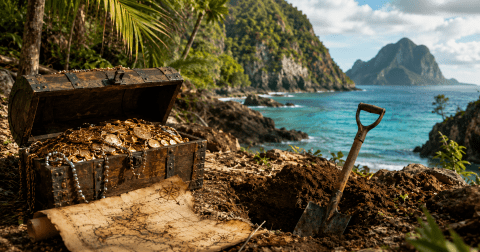
In one remote South Pacific islandhundreds of miles from the mainland, A story of pirates, gold, jewels and failed expeditions gains strength again. The search for the legendary treasure hidden in the Robinson Crusoe Island —a fortune that some estimate at up to $40,000 million—has just received a new judicial boost in Chile, reactivating an obsession that has been going on for decades.
The story has all the ingredients of an adventure novel: colonial loot, a Spanish captain, secret maps, modern treasure hunters and an island that seems straight out of fiction. But behind the myth there are also judicial files, environmental disputes and a question that no one has been able to answer with conclusive evidence:the treasure really exists?
The legend of the treasure that would have left America more than 300 years ago
The most repeated version places the origin of the story in 1714, when a cargo of gold, jewels and precious stones would have been removed from Spanish territories in America to protect it from political and military threats.
According to legend, the person responsible for hiding it would have been the Spanish navigator Juan Esteban Ubilla y Echeverríawho supposedly buried the treasure in the then called Island More a Tierratoday known as Robinson Crusoe, part of the Juan Fernández archipelagoin Chile.
Over time, the story grew until it spoke of nearly 1,000 barrels loaded with riches, including gold coins, religious pieces, jewelry and other colonial goods.
Definitive evidence that this inventory exists exactly as described has never emerged. But the story survived for centuries and ended up attracting explorersinvestors and adventurers.

Where is Robinson Crusoe Island?
Robinson Crusoe Island is part of the Juan Fernández archipelago, in the Pacific Ocean, about 670 kilometers from the Chilean mainland coast. It is an isolated place, with complex access and challenging geography, with mountains, dense vegetation and environmentally protected areas.
Its actual name honors the novel by Daniel Defoe because the place was associated with the true story of the Scottish sailor Alexander Selkirk, whose experience inspired the literary classic.
That isolation is precisely part of the appeal of the myth: if someone wanted to hide an immense fortune centuries ago, few places would seem so suitable.
The man who has been chasing fortune for decades
The modern protagonist of this story is Bernard Keiser, Dutch businessman and treasure hunter who has been trying to find the alleged loot for more than two decades. He is not a newcomer attracted by viral headlines. Keiser has invested time, resources and multiple exploration attempts on the island.
For years he promoted projects with tracking and excavation technology based on hypotheses about the location of the treasure. However, their initiatives repeatedly collided with administrative obstacles, legal questions and environmental concerns.
The difference now is that he just got a key endorsement.
You can see: 240 kilometers without curves: the road that tests the drivers’ minds
The apt conflict that reactivated the search
The Supreme Court of Chile recently ruled in favor of Bernard Keizer, allowing it to reactivate the exploration project after a long legal dispute. The case revolved around permits, regulatory restrictions and objections related to the environmental impact of a possible excavation on the island.
The Juan Fernández archipelago is not just any territory: it is an extremely colorful ecosystem, internationally recognized for its biodiversity and protected under environmental figures. Therefore, for years there was resistance to allowing invasive operations.
The court decision does not mean that massive excavations will begin tomorrow without aid an eye on, but it does open the door again for the businessman to promote a new stage of the project.
How much would the treasure be worth?
Here appears the most spectacular data, although also the most uncertain. Various estimates place the Potential value of the alleged treasure between $20,000 million and $40,000 million, depending on the volume, state of conservation and historical value of the objects.
It is important to emphasize: this figure does not come from a confirmed inventory, but from theoretical calculations based on legend. Still, the number helps explain why the story continues to fascinate.
You can see: Czech hikers find treasure valued at more than $300,000 by accident
What would happen if they really found it?
If the treasure were to appear, the discovery would not mean that the discoverer automatically keeps everything. Chilean legislation contemplates specific rules on heritage, archaeological finds and state property.
Local reports indicate that, under certain schemes, The Chilean State could keep a substantial part of the recovered value. That is to say: even if the treasure exists, the apt battle would probably only just begin.

Accurate treasure or modern myth?
That’s the heart of the story. Unlike other documented archaeological finds, there is no conclusive evidence here to confirm that the legendary gold barrels are still buried.
What does exist is a chain of historical stories, failed expeditions, technology applied to searches and a persistent conviction of those who believe that fortune is there.
And perhaps that is the reason why this story is still alive three centuries later: because it combines history, mystery and a promise that is almost impossible to ignore.
You can see: They are building the deepest Metro in Latin America: stations 65 meters underground
How to get to Robinson Crusoe Island
Getting to Robinson Crusoe Island is not easyand that difficulty helps explain why the legend of buried treasure retains so much appeal. This remote Chilean territory is located in the Juan Fernández archipelago, in the middle of the Pacific Ocean, about 670 kilometers from the continental coast of Chile.
There is no traditional commercial flight like the one that connects large cities. Access is usually from Santiago de Chile through special flights or charter services to a runway located on the neighboring island, Alejandro Selkirk or enabled sectors according to operation, and then complete the journey by boat to Robinson Crusoe, depending on weather and logistical conditions.
It is also possible to arrive by sea, although it is a much longer and more complex experience.
The climate and the state of the sea can alter itineraries, so it is not an easily accessible or mass tourism destination. Precisely that isolation is part of what made the island a perfect setting for legends of pirates and hidden treasures.
The most famous lost treasures in the world
The alleged loot hidden in Robinson Crusoe is not the only legendary fortune that fueled expeditions, documentaries and theories for decades.
- The treasure of El Dorado: Probably the most famous myth of Latin America. History spoke of a city full of gold somewhere in the current Colombian or Amazonian territory. For centuries it promoted European expeditions obsessed with finding impossible riches.
- Captain Kidd’s Treasure: Scottish pirate William Kidd was executed in 1701, but the legend of his buried fortune survives to this day. Several searches were done in North America and the Caribbean.
- Oak Island Treasure: One of North America’s most persistent mysteries. On a small island in Nova Scotia, Canada, entire generations searched for a supposed fortune buried in a pit full of traps. Definitive proof never emerged, but the case continues to fascinate.
- The lost treasure of the Nazis: The chaos at the end of World War II fueled stories about gold, works of art and wealth hidden by the Nazi regime in European tunnels, lakes or underground shelters.
- The treasure of Lima: Closely linked to the story of Robinson Crusoe. According to a colonial legend, an enormous fortune belonging to the Church and Spanish authorities was shipped to protect it and ended up disappearing, fueling multiple theories.
Continue reading:
It’s not just an expansion: the South American airport that wants to compete with the world’s large hubs
The 3 rarest pennies that can be worth up to $30,000 on the market
What is the 1797 coin worth more than $1.6 million like?
The $2 million treasure hunt: what to do to win it


