
For photographer Memo Ortega, Shoe Palace is a place he used to go when he was young to get a new pair of Nike Cortez or the latest sneaker releases.
Now, this photographer, visible artist and creative producer, whose work straddles Chicano culture, street life and contemporary media, is one of eight Los Angeles photographers who showcased their work in a special exhibition at a pop-up store paying homage to Chicano culture for Cinco de Mayo.
“I used to buy my Air Power One and my Nike Cortez here; back in the day, this was the place to go to get our shoes and it still is,” Ortega said, laughing as he remembered those times.
“Art brings us all together and I think it is important to continue organizing exhibitions like this in the community, especially when they involve so many people from different neighborhoods and with different points of view; this is representative of the people who live in this city.”
Shoe Palace and On teamed up to organize “Lens & Legacy,” a Chicano art exhibition held at the Melrose store for Cinco de Mayo. The immersive exhibition featured Mexican American photographers and visual artists from Los Angeles.


According to Shoe Palace x On, they have organized the “LENS & LEGACY” exhibition to publicize the Chicano culture and community in honor of Cinco de Mayo, through the eyes of Mexican-American artists based in Los Angeles such as: Armando De La Torre Jr., Carlos Ponce, Art Meza, Emilio Sánchez, Erwin Recinos, Jacob Martínez, Memo Ortega and Roberto Reyes.
Featuring 30 contemporary black-and-white human-centered photographs and portraits, LENS & LEGACY offers an unparalleled immersive experience, showcasing Arturo Meza’s unflinching work “American As Apple Pie,” and the beloved family humor Erwin Recinos is known for in “Vato Loco from Beginning,” to the lowrider culture and graffiti of Carlos Ponce’s “Love Avenue,” to Ortega’s photography. “El dia de los Muertos” and “Nike,” and the chilling “Out On Bail,” by Pulitzer Prize-winning photographer Roberto Reyes.
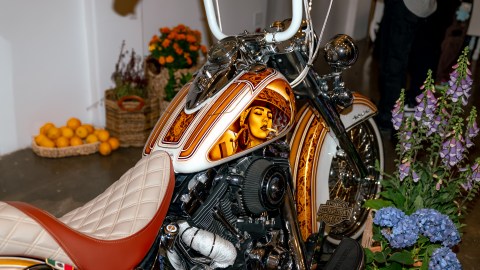
At the opening ceremony, the public enjoyed live music and was able to meet the photographers who exhibited their works in the exhibition. Many of them have been taking photographs around Los Angeles and neighboring cities like San Bernardino for more than a decade. Like the protagonists of the photos, they had low-rider cars, motorcycles decorated with Chicano art and other artistic installations, including an altar dedicated to the Virgin of Guadalupe.
Not only is the exhibition a joy to behold, but according to photographers like Ortega, the photos and installations are not only a celebration of the rich Mexican culture present in the city, but also allow people to connect with photography and even shoes in different ways.
He commented that, in a conversation that arose from one of his photos, in which a person appears wearing Nike Cortez, they talked about how these had a different meaning for his generation than for younger generations.
“I have so many photos of the Nike Cortez in my files, I took this one almost 12 years ago,” he said. “The Nike Cortez in my time had a bad reputation, but now I like to see how the new generations use the Nike Cortez as a positive style, a style of culture and representing where they come from. I like the transformation of meaning and how it represents something different for each person.”
Ortega’s work goes far beyond photography. He creates visual narratives that span internet design, fashion and digital media, often combining a raw documentary aesthetic with strong cultural symbolism. His images have found their natural place in tattoo studios, on car hoods, on online platforms and in communities that see their identity reflected in their lens.
Driven by culture rather than commercial trends, Ortega’s work emphasizes authenticity, community, and the people on camera, capturing moments that appear spontaneous rather than staged.
In the last year and in recent months, the Latino community has been through a complete nightmare with immigration raids that have left thousands of families without their relatives. For many in the Latino community, the last few months have been grueling, with many being detained by ICE simply for looking Latino. Arrested and questioned for using and dressing as many people do in the images of photographers like Ortega.
The exhibit has also often served as one of many spaces where people of all ages can be in community.
“With these photos we try to show people that we are more than what they say we are,” said Ortega. “It gives us a space where we can celebrate precisely what we hold dear and see it as a strength, not as something negative.”


